Table of Contents
1. Introduction
AI Marketing Automation 2026 is the future for customer engagement and has enabled hyper-personalized journeys at scale. Fastpath automation with AI drives a return-on-investment (ROI) of up to 300%, speeds cycle times and improves staff productivity. This paper describes the key obstacles, three high-return approaches, and actionable execution blueprints on how to bring AI into workflows, generate measurable business value and relevance, and increase customer engagement.
2. Context and Problem Definition
The era of marketing automation as a tactical efficiency enabler is over, and we are now living in the age when it is considered a strategic advantage. However, orchestrating ultra-personalized customer journeys represents a daunting challenge: data is fragmented or incomplete, systems are in silos and too rigid to adapt, and workflows are complex all of this against the background of constantly evolving AI technology. Meanwhile, by 2025, the vast majority of marketing teams will have ingrained AI into fundamental operations (76–88%), but only a fraction will actually implement predictive personalization and automated decision-making at scale.
Companies that don’t adopt personalization powered by AI are exposed to inflated customer acquisition costs, lagging response times on campaigns, and lower levels of customer engagement.
Through the use of organized frameworks and by tapping into real-time AI insights at scale, organizations can upgrade their static processes to a more dynamic data-driven process that scales personalized experiences across the end-to-end customer lifecycle so they remain both relevant and efficient in crowded markets.
3. Why This Matters for Business
Financial Impact
AI marketing automation generates huge financial rewards. Automated programs always perform better than manual ones and deliver more revenue and lift across any channel.
Operational Efficiency
Using AI in marketing means streamlined processes, which cut down on mundane tasks and free up 18 or more hours of work weekly for the team to dedicate themselves to higher-value strategies (Neil Patel). Forecasted automation speeds up the running of campaigns and decision-making, enabling you to take promotions or product launches to market much faster.
Customer Experience & Growth
lifetimeFully personalized AI-driven experiences drive hyper-relevant, hyper-loyal customer journeys. Antifragile sequences can generate 30% more conversions (Market)! Companies that implement AI-driven personalization regularly see increased life-time value and retention metrics across the board.
by60-70% of marketers agree that AI will have revolutionized marketing effectiveness in 2026. Winners in running AI at scale are those companies that transform their processes to incorporate automation and can outsource up to 80% of their workloads within the next three years. With AI woven into marketing automation the right way, organizations can drive actual ROI and enhance operational effectiveness and customer satisfaction.
4. High-Level Framework, Core Model The Hyper-Personalization AI Framework (HPAIF)
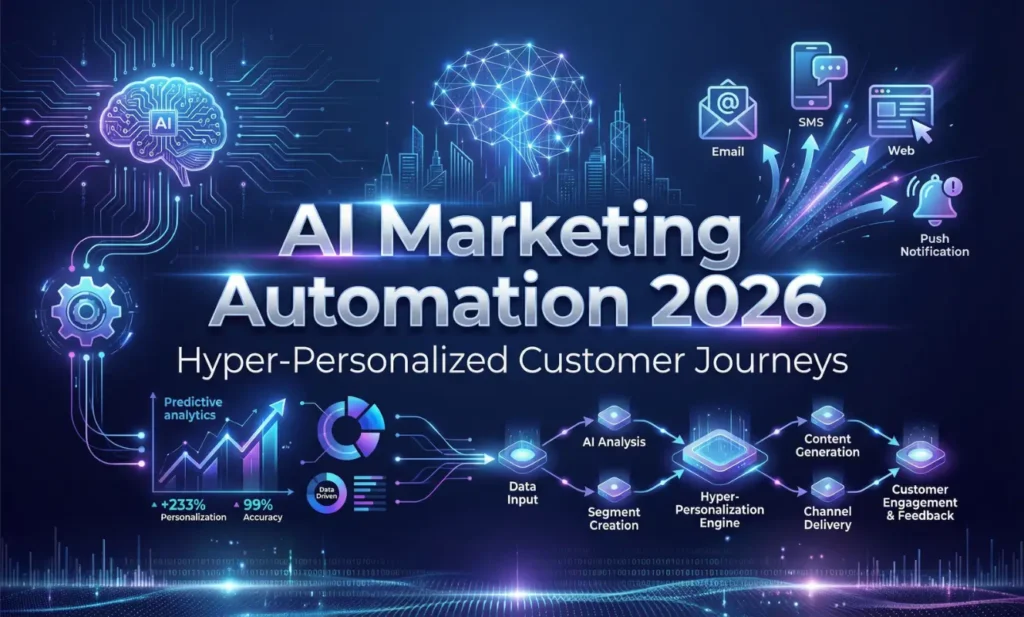
The Hyper-Personalization AI Framework (HPAIF) defines a process for “baking in” AI to marketing automation to create predictive, user-centric digital experiences.
Data & Signal Intelligence
touchpoints,Consolidate and unify customer data across CRM systems, web & mobile touchpoints and behavioral analytics. AI models deliver predictive intelligence that optimally groups audiences, isolates high-value prospects and enables personalized messaging.
AI-Driven Automation Orchestration
dynamically generatedIntegrate AI within workflows to drive dynamically-generated personalized content so you can stop guessing what or when to send. Multichannel triggers in email, push notifications, SMS, and web channels deliver a unified experience that is contextually relevant.
Measurement & Continuous Optimization
Keep an eye on KPIs like engagement lift, conversion rates, and automation impact scores as they happen. Personalization and campaign sequencing are automated and continually optimized by AI, based on performance observed across the entire customer base.
Benchmark Insights
seeing aEarly adopters of AI-powered personalization are seeing 25-35% increase in engagement (Sopro). Advanced AI in marketing automation is expected to be adopted broadly, approaching ubiquity by 2030 (All About AI).
HPAIF turns marketing from reactive campaigns to intelligent, adaptive journeys focused on results, aligning automation with the business and driving measurable return on investment during every stage of the customer lifecycle.
5. Key Points & Strategies
Strategy 1: Large-Scale Predictive Personalization
Predictive Personalization The core benefit a solution rooted in AI marketing automation entails is predictive personalization, which is the act of examining multi-faceted consumer behavior data and predicting their needs, thereby executing contextually relevant interactions on the fly. A score on interactions, engagement history and intent signals allows the AI to automatically predict the next best action for each customer. For instance, retail brands use AI models to forecast purchase intent and automatically trigger lifecycle emails when the chances of conversion exceed a particular threshold. This means you can create a highly targeted campaign and achieve a large amount of organic traffic. Those practicing predictive personalization have seen a 30% lift in conversion rates (for Market’s own part), indicating the actual financial impact and strategic value of AI-driven customer insights.
Strategy 2: Automated Content and Creative Acceleration
We have a strategy; will we make it happen?
Generative AI speeds content generation with room for multivariate testing at scale. Marketing departments are able to automate the generation of optimized email subject lines, ad creatives and landing page copy that can then be plugged directly into automated flows. AI always measures performance and conducts live A/B testing; thus, it automatically scales the better variant without any manual actions. Organizations with integrated, automated mob workflows in place report up to 30% higher engagement rates and consistently higher quality than their published content (SalesGroup AI). By automatically generating creative, teams free up resources to focus on better leveraging personalization and relevancy throughout campaigns.
Strategy 3: AI Workflow Orchestration
AI isn’t just about individual actions; it involves the AI executing an entire workflow across multiple channels. By tracking predictors and automating a series of steps, AI optimizes every customer interaction by ensuring both timely responses and relevant context. For example, a SaaS business could marry predictive email sequences with push notifications and in-app messages, automatically adjusting the flow based on engagement signals. Businesses aligned with early AI workflow orchestration adopters are saving over 18 hours per week for their marketing teams while providing increasingly tailored and more seamless customer experiences (Neil Patel). At this level of automation, marketers can easily scale complex campaigns and lower operational overhead while simultaneously producing higher levels of potency in their customer engagement efforts.
Taken together, those three tactics predictive personalization, automated content acceleration and AI workflow orchestrationrepresent a complete strategy for infusing AI into marketing automation. And they guarantee that campaigns won’t just be well-run but dynamic and focused with measurable ROI. The organizations that do so will be in a position to turn staid, one-size-fits-all campaigns into dynamic, hyperpersonalized customer journeys—and in doing so stimulate engagement, loyalty and revenue.
6. Step-by-Step Execution / Use Cases
Step 1. Audit Workflows & Data Readiness
The first step in migrating to the cloud is considering workflows and data readiness. It is up to you, but the first stage (as always) assesses where AI-enabled personalization can fit and make an impact as well as what it might cost to deliver this new capability. Inventory all automation currently in place across your email, web, mobile, and CRM systems. Profile your data sources (behavioral analytics, purchase history, engagement signals) and assess their completeness and cleanliness. If AI is to be effective, it requires clean and unified customer profiles.
Step 2: Choose High-Impact AI Integration Use Cases
Focus on use cases that deliver concrete ROI and operationalize. These include predictive segmentation, automated content personalization, intelligent email campaigns and cross-channel customer journey orchestration. Begin with pilot projects to confirm the effectiveness of AI before scaling. This stepwise approach enables teams to quantify engagement lift, conversion enhancements, and operational efficiency gains while risk is limited.
KPI: Measure the lift in conversions and the increases in engagement rates when pilot campaigns are implemented.
Step 3: Implement AI-Enabled Platforms
Leverage AI in your marketing automation stack with powerful platforms like HubSpot AI, Salesforce Einstein, Adobe Sensei or cloud ML services (Google, AWS and Azure). Cross-Channel Interoperability: creating seamless customer experiences in real time across all channels. Weave AI into content creation, predictive timing and behavioral triggers so that automation campaigns can adjust dynamically according to customer interactions—reads and engagement signals.
Step 4: Train & Enable Teams
Establish detailed AI model utilization, engineering and governance guidance. Train marketing and data teams to inspect AI outputs and adjust algorithms when necessary—such as when meeting ethical or compliance standards. Strong team enablement means AI supports human decision-making, not taking it over completely.
KPI: Less work for hands, more savings in time, and more efficient workflow.
7. Real-World Use Case Example
A mid-market ecommerce brand implemented AI personalization in their cart abandonment flow. Based on the browsing history, propensity to purchase and engagement with other campaigns, an AI-powered dynamic contextual email journey was then triggered. After just 90 days, the brand was able to see a 25% increase in email-driven revenue as well as a 20% reduction in acquisition costs—the true value of AI-based automation on both revenue and efficiency.
With this sequential implementation plan, companies can progressively build AI into marketing automation. Data readiness, well-chosen use cases, robust platforms and trained teams—all together drive hyper-personalized customer journeys deliverable through measurable ROI and scalable marketing operations.
8. Technical Workflow & Ethical Considerations
Technical Workflow
AI-driven marketing automation starts with action taking in vast amounts of behavioral data web activity, mobile actions and CRM signals. This information enhances the customer profiles and allows dynamic audience segmentation that enables automated triggers across email, push notification, SMS and web channels. Personalization modules utilize machine learning to maximize the impact of the message as well as its timing by adapting it in steps based on engagement signals, predictive scores and customer intent. By driving these workflows with intelligence, enterprises can deliver hyper-personalized experiences at scale, increasing conversion rates and engagement metrics and decreasing reliance on manual campaign management.
Ethical Considerations
The use of AI in marketing automation mandates a crystal-clear policy on transparency, bias elimination and privacy laws such as GDPR and CCPA. Companies must establish consent frameworks and strong data governance to secure customer data. AI drug screen workflows need to be documented for accountability, reproducibility and alignment with any ethical standards. Additional early detection of any unwanted biases or errors in model outputs can protect the integrity of brand identity and customer relationships.
“By championing technical accuracy and ethical stringency, marketers have the opportunity to responsibly scale AI-empowered personalization with measurable ROI in a way that is both compliant and respectful of consumer trust.
9. Real-World Use Cases
Retail Personalization at Scale
A major fashion retailer used AI-powered personalization to predict tastes and automate multichannel product recommendations based on the individual’s behavior and preferences. Based on browsing behavior, purchase history and engagement signals, the AI system served up contextually relevant recommendations through email, push notifications and website banners. The retailer saw a 35% conversion rate uplift, increased customer engagement and lifetime value—proving that predictive personalization delivers measurable business results.
B2B Lead Scoring Automation
One of our SaaS companies used AI to score inbound leads and pushed them into automated outreach sequences. Prioritizing high-value opportunities and launching personalized communications enabled the company to speed up its sales cycles and enhance resource distribution. As a result, the sales cycle shortened by 50%, and close rates increased 22%—an efficiency and revenue impact that demonstrates the value of AI in lead management now combined with multichannel automation.
These are just a few examples showing how AI can revolutionize marketing from one industry to the next. Predictive personalization and automated decisioning will empower companies to drive deeper user engagement more efficiently with a measurable ROI, says Mehta, placing AI-powered automation at the forefront for strategic differentiation in 2026.
10. Tools, Platforms & Stack Recommendations
When implementing AI-powered marketing automation, choose platforms that are easy to integrate into your workflow:
HubSpot AI: Includes a number of CRM-embedded AI-supported features such as content personalization, predictive engagement and workflow automation.
Salesforce Einstein: Offers predictive data for sales and marketing, allowing for dynamic lead scoring as well as multichannel orchestration.
Adobe Sensei: Fuels AI-based customer journey orchestration, analytics and optimization to deliver better personalization.
Cloud AI Services (Google, AWS, Azure): AI microservices can be mixed and matched to support automation, predictive analytics and multichannel integrations.
Internal Links to Your Pillar Page: Use them to strengthen topical authority. Add dofollow outbound links to authoritative AI, marketing, and analytics sites to increase content trustworthiness and for SEO.
11. Tips & Best Practices
Put Data Cleansing First: Your company needs to harmonize and clean up customer data if you want to get the most out of AI capabilities for predictive insights.
Get rolling with high ROI use cases: Look at personalization, predictive segmentation and automated content for results you can measure.
Embed Governance: Document AI pipelines to avoid bias & adhere to ethical practices.
Continuously Measure: Match KPIs to revenue, engagement and conversion metrics to optimize on the fly.
12. Mistakes to Avoid
Full automation cannot be rushed into blindly without having data readiness in place, or you risk causing wasted spending.
Disregarding privacy and regulatory limitations, at the risk of damaging reputation.
Siloed AI operations with no cross-channel orchestration.
Under-emphasizing the need for human oversight of model validation and ethical review.
13. Conclusion
in hyper-personalized journeys and increases operational efficiency and ROI. With structured frameworks such as HPAIF, auditing data readiness and rolling out predictive workflows, businesses move away from static campaigns to ones that are dynamic and data driven.
Next Steps: Investigate the complete Pillar Page on Marketing Automation in 2026 for more in-depth frameworks and AI models, as well as industry benchmarks that let you unlock outside of basic personalization and actual business results.
FAQs
What is AI marketing automation?
AI marketing automation AI-based tools that bring together the power of artificial intelligence and the orchestration and execution of marketing tasks such as customer segmentation, content personalization, predictive scoring and campaign orchestration. It allows brands to provide highly personalized experiences at scale without manual work.
What will AI do for marketing automation in 2026?
Predictive personalization: Use of AI to advantage in anticipating behavioral patterns, improve customer personalization and the like; 84% Real time analytics and outcome predictions from seamless analysis of collected customer data; 77% Content generation via automation; 72% Workflow paired with machine learning algorithms for better business asset orchestration. This drives engagement, lowers costs and results in a higher ROI than the traditional automation-only approach.
Why hyper-personalized customer journeys are best?
1:1 Journeys serve personalization on steroids, with messaging, content and offers that are custom-tailored based on what a customer has done and how they’ve engaged. The payoffs are greater conversion rates, higher retention of customers, lower acquisition costs and a more loyal fan-base.
What AI tools should we be using on our marketing automation?
Key tools include HubSpot AI, Salesforce Einstein, Adobe Sensei, and cloud ML platforms such as Google Cloud AI, AWS AI and Microsoft Azure AI. They offer predictive analytics, automated personalization, multichannel workflow orchestration and real-time performance optimization.
So how are businesses getting it right when it comes to AI in marketing automation?
1. Prepare your audit data & workflows for AI integration.
2. Focus on high-impact use cases such as predictive segmentation and content personalization.
3. Use AI-powered platforms to coordinate campaigns on many channels.
4. Teach teams how to watch over the outputs of AIs, their ethical compliance and campaigns.
5. What mistakes should companies avoid with their AI marketing automation?
6. Using AI alongside dirty, siloed data.
7. Disregarding privacy initiatives such as GDPR or CCPA.
8. Robotic AI implemented in silos and not integrated across channels.
9. Ignoring the value of human intervention in AI-based decisions.
Is AI marketing automation good for small business?
Yes. Small to medium-sized businesses get started with AI technology by using the tools available for pinpointed initiatives, automated personalization and predictive scoring. Cloud AI services also ensure the system is deployed in a cost-effective and scalable manner.
How does artificial intelligence ensure ethical marketing?
AI needs clear governance rulebook of bias and algorithms, along with adherence to privacy laws. Enterprises should have a consent framework, monitor AI decisions, and constantly verify models in order to remain transparent and maintain customer trust.
What does the future hold for AI and marketing automation?
AI-based marketing automation will be mainstream by the end of next decade, allowing fully intelligent, adaptive and predictive campaigns. Companies who lead the adoption of AI will benefit from a competitive edge, with experiences that feel hyper-personalized and have tangible ROI.

Muhammad Asif is the Founder and Growth Engineer at WebNextSol, with 5 years of experience building AI-powered systems that help businesses save time, generate leads, and grow. He combines expertise in WordPress, automation, cloud architecture, and SEO to deliver practical, results-driven digital solutions.