Table of Contents
Introduction
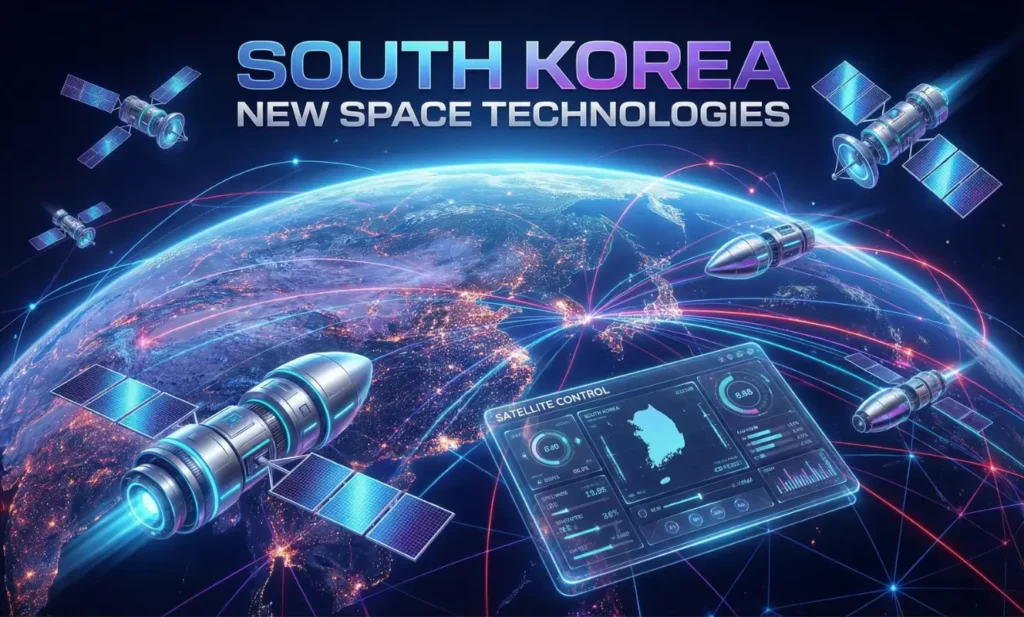
In 2025, the space economy reached a new milestone never before seen. Space was no longer perceived as a national pride symbol but has become a commercial stratum of the digital world. Farming and disaster management is now dependent on the study of the earth, remote economies are joined by satellite internet, and instant orbital data is informing markets, logistics, and security. With a shifting environment, South Korea New Space Technologies are now being one of the major drivers to propel the country to the international space economy through high-speed orbital systems, efficient launch systems, and high-quality sensors.
South Korea had been at a crossroad before.
It had the engineers.
It had the factories.
It had the rockets.
But in its space sector it still had the structural reliance on imported parts and programs directed by the government. There was innovation, but no momentum. Ideas were strong.
Market pathways were weak.
On January 20, 2026, that changed.
Korea Aerospace Administration (KASA) appointed the five original specified New Space Technologies in the country through the Space Development Promotion Act. Out of fifty two proposals, there were five competitive selections. Not for theory. To be original, prepared, and have actual business prospects.
This was not a research grant. It was an industrial signal.
These technologies are made to ground a space economy that is led by the private sectors, in which they build, launch and monetize in space. One that faces competition in the SpaceX era rather than the Cold War era.
The following pillar page unravels the strategy underlying that change and the innovations that characterize it. The starting point in the capabilities in space is the most fundamental: seeing the Earth.
The question of why New Space is a Structural Shift and not a Trend.
Space programs have been run on scarcity over decades. Launches were rare. Missions were limited. Information was sufficiently difficult and costly.
That is all altered by the New Space era.
There are thousands of satellites orbiting the Earth today, which have offered round-the-clock observation, real-time connections, and deluge of information that supplies industries, governments, and research projects. Value is no longer a unit in this environment- it exists in the perpetual movement of the information, the services created on top of it and the commercial ecosystems that orbit both make possible.
In the case of South Korea, it is a risk and an opportunity.
The risk lies in dependency. The dependence on foreign sensors, antennas, or propulsion systems makes national programs the continuations of the intellectual property of other countries. Any mission, any element, any data gets to be in part controlled in foreign lands.
The opportunity is a result of alignment. South Korea boasts of being a world leader in semiconductors, precision electronics and advanced manufacturing. The same technology that is driving smartphones, ships and consumer electronics is now driving satellites and orbital systems.
The New Space designation program of KASA is aimed at transforming that potential into actual market power. It has three important purposes:
National Validation – The acceptability of the technologies of the private sector.
Early Procurement – By negating commercialization risk, the company ensures that first customers.
Market Signaling – Communicating to the market that these technologies are ready to be exported.
The initial technology that can be discussed as having been enhanced by such a program deals with the most basic asset of any contemporary satellite: the vision.
SensoHub: The Eyes of the Earth, Hybrid.
The technology is CCD-CMOS Fusion Multi-band TDI Image Sensor.
All Earth-observation satellites are known to have a trade-off:
CCD cameras provide high levels of sensitivity and image quality particularly during low-light situations.
CMOS sensors have speed, reduced power and smaller form factors.
The two designs are selected in traditional designs at the cost of one another. SensoHub does not accept that compromise.
The engineers at it developed a hybrid system, which is a combination of CCD sensitivity and CMOS efficiency with Time Delay Integration (TDI) to match the orbital movement of the satellite with the sensor capture. TDI gets light on multiple exposures instead of one snapshot, dramatically increasing clarity in the image, but consuming low power.
This is structural rather than incremental:
Better resolution orbital speed images.
High-quality low-light image capture.
Much less energy consumption.
Every watt counts in satellites. Every gram matters. One of the most power-intensive components on board is imaging systems and therefore efficiency will directly translate to mission lifetime and flexibility of payload.
SensoHub enables:
Extensive, quick scanning.
Crystal-clear vision in the morning or evening, or in the dark.
Long run without power cycling aggression.
To the commercial operators, it implies increased images per orbit, increased revisit rates and reduced operational cost per dataset.
Its real-world uses are enormous.
Early-warning and disaster response systems.
Accurate monitoring of agriculture.
Infrastructure analysis and urban development.
Environmental and climatic surveillance.
Compared to the market where the American and European providers dominate, SensoHub makes South Korea a leapfrog providing market player, as opposed to a follower.
It is due to this reason that the approach of KASA counts. The state no longer is contracting one-off missions; it is putting together a domestic, export-ready supply chain to orbit. SensoHub is not a lab investigative document- it is an element created to be utilized in actual satellite networks.
New Space is not flag-planting. It is concerning the construction of pipelines of data that revolve around the planet.
Light to Heat: The Sensory Frontier to Space in Korea.
we already created a mere fact: in the New Space economy, data is currency, and vision is the initial layer of value. SensoHub indicated how South Korea is grabbing a new meaning of optical observation in extreme orbital limits.
Now we pass out of the visible light.
The most dramatic occurrences on earth do not necessarily take place during day time. Wildfires begin as minor thermal abnormalities. First signs of industrial failures manifest in the form of heat stress. Darkness, smoke or clouds can conceal military movements. In order to do control over orbital intelligence, a country has to identify the things which are not visible to the human eye.
i3system and NDT Engineering and Aerospace come in at this point. They all create the following pillars of the new space stack in Korea:
Perception beyond light
Breaking weight limits infrastructure.
i3system: Orbit precision Thermal Vision.
Technology: Multi-Channel Mid-Infrared (MWIR) Detector Two-Dimensional (2D)
The majority of satellites use a visible spectrum, -they use sunlight, have trouble in the haze and are blind at night. The sensor used by i3system does not see – it detects heat.
The detector is based on the Mid-Wave Infrared (MWIR) band and is capable of recording small amounts of temperature variation across several channels. Rather than a conventional photograph, it creates a professional level thermal map of reality: exact gradations, slight abnormalities, and patterns of action.
Its two-dimensional, multi-channel architecture will overcome a typical challenge: conventional thermal sensors usually have to sacrifice one of the two: i3system can keep both:
Thermal imaging High-resolution thermal imaging.
Rapid scanning of wide areas
Subtle temperature variations are identified.
The consequences are huge:
Advanced wildfires detection in advance before they start.
Heat loads monitoring in factories and power plants.
Climate and planning of urban heat islands.
Spying by smoke, haze, or darkness.
To governments, this is a situation awareness. In the case of industries, predictive intelligence. To satellite operators, it is export-ready data and premium.
With limited availability of thermal Earth observation in the market and having a small number of Western providers, i3system localizes a strategic sensing solution and develops a commercially viable component to global constellations.
The vision of an optical eye tells you of what has occurred. Thermal vision is a forecast of what will occur. The recording is visionary.
NDT Engineering & Aerospace: Light but Stronger Rockets.
Technology: Propellant Tanks Friction Stir Welding (FSW) Technology.
Every gram matters in rocketry. On decreasing structural weight, the payload capacity also increases. Buffer payload, and the cost of launch per kilogram reduces. Lower the price and commercial scale can be reached.
The conventional fusion welding is a process that fuses metal to fuse it, resulting in heat distortion, micro cracks and weak areas. These imperfections may be vital to missions in rockets.
Friction Stir Welding is different. A rotating machine is used to stir solid metal in a seam without melting it and in the process producing a continuous, flawless joint that is of a higher strength.
Used on propellant tanks it allows:
Slim body without losing strength.
Seamless seams in high pressure.
Minimal mass and increased reliability.
This innovation is changing the performance of launch vehicles such as the Nuri rocket, Korea: increased payload, increased orbital flexibility, reduced cost of missions.
This goes beyond optimization of manufacturing, it is competitive repositioning. The world leaders such as SpaceX were not only successful with rockets but also with industrial productivity. NDT Engineering takes the same strategy to launch the Korea eco-system.
SensoHub determines the vision of Korea.
What Korea detects is what i3system defines.
NTD determines the efficiency of the reaching orbit of Korea.
Collectively, they constitute the sense and structural base of a household, competitive and export-ready space economy.
Orbit to Everywhere: How Intellian Is Constructing the Space Internet Backbone of Korea.
Observation and launch alone does not generate value. The satellites are impact making machines, not by being in existence, but by transferring data.
All of them (earth observation, thermal intelligence, navigation, and global connectivity) come to one common element, which is bandwidth. Orbital connectivity is controlled in the New Space economy, and scale is controlled.
It is at this point that Intellian Technologies comes in. KASA acknowledged their potential, not once, but twice–a move never before made in history. It was not some incremental improvements but to shape the communications backbone of the space future of Korea.
Intellian Technologies (I): MEO/LEO Gateway Systems.
Technology: Antennas: Ground Gateway High Precision.
Low Earth Orbit satellites (LEO) spin at a speed that is very high indeed.
Medium Earth orbit satellites (MEO) are even faster than low earth orbit satellites. A LEO satellite is able to cross the sky in a few minutes. Having a continuous data connection does not only represent a networking issue; but also a real time control issue at orbital velocity.
The gateway antennas developed by Intellian are designed to address it. They offer an earthly point of reference to space networks, and they include:
Constantly monitoring high speed satellites.
Continuous high-rate data streams.
On-the-fly handoffs between ground nodes.
In the absence of these systems, satellite constellations will be isolated resources. They become fully functioning infrastructure constellations.
These gateways are the environmentally speaking router of space that translates orbital data into real earthly services, which include:
Earth observation feeds at high-resolution.
Sea and air transportability.
Disaster communications Emergency communications.
Global broadband services
This would place South Korea strategically to either run its own Starlink-class networks or provide the basic connectivity infrastructure to foreign operators. Sovereign authority over data and robust ground infrastructure is made feasible.
Intellian Technologies, (II): Flat Panel Antennas.
Technology: Electronically Steered Flat Array Antennas.
The traditional satellite antennas are based on mechanical motion. They are heavy, slow and delicate- not fit in a world of thick constellations and mobile platforms.
Intellian has flat panel antennas which substitute electronics with mechanics. They do this with real-time tracking of satellites, where they do not move any parts, and use phased-array beam steering. This results in:
Low profile, slim body shapes.
Minimal latency
Exceptional reliability
Its uses are on orbit and on ground:
In inter-satellite communication satellites.
In vessels, automobiles and aircraft.
In distant infrastructure and disaster areas.
This method converts the fixed installations of satellite connectivity to mobile adaptable networks. Vehicles are the nodes, ships are mobile data centers, and remote areas are getting accessible and reliable connection. These are not just antennas they are gateways to space.
The gateways and flat panel antennas provided by Intellian are a complete loop:
Orbit – Ground – User
Constant, expansive, business. This is the communications base of New Space, and will not only allow Korea to share in the global space economy, but to dominate a vital slice of it.
The Bigger Picture: The Three-Hub Space Strategy of Korea.
Technology does not in itself make a space ecosystem. Infrastructure, geography and coordination do. The New Space policy of South Korea takes note of this by ensuring that the innovative technologies are put in line with a strategic as well as an operational regional industrial architecture.
The nation has formulated three fundamental hubs:
innovations with a regional industrial architecture that is both strategic and operational.
The country has established three core hubs:
| Region | Role | Strategic Function |
| Sacheon | Manufacturing Hub | Satellite and component production |
| Daejeon | R&D Hub | Talent development, research, and innovation |
| Goheung | Launch Hub | Domestic rocket launches and infrastructure |
This is decentralization not symbolically but by design.
Daejeon creates intellectual capital. Sacheon transforms such intellectual property into physical hardware. Goheung transforms hardware to space resources. It is a loop that is domestic and makes sure that research stays in-country and manufacturing is not broken and launches are not reliant on foreign ranges.
All the five technologies assigned by KASA are easily placed in this pipeline. There are sensors such as SensoHub and i3system that are offspring of the Daejeon research ecosystem. The production and the upscale is done in Sacheon. Launched systems come out of Goheung.
The outcome is a commercially oriented closed space ecosystem. This plan turns a national space program into a space economy that is led by the private sector. Value is no longer a mission or rocket measurement but is an at-scale functional supply chain generating data, services, and products.
That is to say that South Korea is not merely launching satellites into space- it is creating a scalable, export oriented, industrial powerhouse of the New Space Age. Missions are achieved as milestones. Supply chains are transformed into strategic assets. And the nation prepares itself to be able to compete with the world players in terms of technology and scale.
Policy to Orbit: the way Korea is making innovation a self-sustaining space market.
The initial three sections described the technical underpinning of the New Space strategy of South Korea:
Seeing from orbit: SensoHub
Beyond light detection: i3system.
Starting up successfully: NDT Engineering.
Relating space with the Earth: Intellian.
However, the technology is not the most difficult part to build. The bigger challenge is to make innovation a self-generating industry. Technology is never sufficient to build markets markets are constructed with policy, procurement and time.
Here is the point, when the framework of KASA will be more than a regulatory tool, it will be the driver of industrial change.
The Business Motor of New Space Push in Korea.
The name of KASA in the Space Development Promotion Act is not a symbol, but a functional one. Three structural strengths are earned by every New Space Technology:
1. National Validation
Specified technologies are not experimental anymore. They are considered as a strategic industrial resource, open financing, association, and international reputation.
2. Government Procurement of pilots.
Purchases at an early stage decrease the risk of commercialization. Startups do not necessarily have to find their initial customer anymore- they can count on the state as an anchor customer.
3. Guaranteed Market Path
The companies obtain favorable access to the national missions and demonstration programs. Their technology does not hang on a shelf, it flies.
This model transforms research and development to revenue. Instead of requesting firms to be innovative and hopeful, Korea builds a bridge:
Research → Validation → Procurement → Scale → Export
The same principle that enabled SpaceX to grow at a very fast pace is being institutionalized by Korea at the national level.
Policy Structure and National Objectives.
KASA supports this model by three tangible objectives:
| Feature | Objective |
| Supply Chain | Achieve 100% localization of critical space components |
| Procurement | Use government demand to de-risk private innovation |
| Future Rounds | Expand the technology pipeline with biannual cycles |
This strategy makes a compounding momentum. New technologies are brought to the system every April and October. The dependence on the parts of foreign origin is declining each year. All missions are domestic innovation tests.
In the case of founders, this minimizes risk. It gives predictability to investors. In the case of Korea, it is an orbiting sovereignty.
What has come out as a result is turning out to be transformative: this is no longer a space program, but an independent space market. Technology, policy and industry are now in an integrated ecosystem. Information streams, satellites take off, and business prospects grow. South Korea is not only positioning itself to take part in the New Space age, but also to be the leader.
Conclusion
The New Space Revolution in South Korea is not characterised by spacecrafts and satellites. It is characterized by architecture-/technology, policy, and industry interaction in such a way that an ecosystem is created which can be scaled.
Long range sensors with reduced power.
Sensing what the light fails to see.
The production procedures that reduce weight and raise the reliability.
Data transmission networks on an orbital scale.
Policies that transform innovation to industry.
This is whereby a country advances because they become involved and then become leaders.
Each of the five technologies identified in January 2026 is not a solitary breakthrough. They create a base of a self-sustaining orbital economy. Both address a tangible market issue, are meant to be scaled, and become a part of a domestic pipeline of research, production, launch, and commercialization.
New Space is no longer prestigious, it is about infrastructure. It is not the first to reach space, but the most efficient and resilient systems that will be constructed there that will dominate the next decade.
South Korea has chosen its course. The transformation is now being undertaken: missions have become markets, programs have been transformed into platforms, space exploration is giving way to a vibrant space economy.
What is New Space strategy of South Korea?
The approach to space is called New Space strategy and serves to move South Korea towards a space economy that is supported by the private sector though commercialization by the government and domestic supply chains.
Which were the five New Space Technologies identified by KASA?
They consist of a hybrid imaging sensor of SensoHub, MWIR thermal detector of i3system, rockets friction stir welding by NDT Engineering and two satellite communication systems of Intellian.
Why does it matter that KASA is named so?
It offers national verification, assured pilot acquisition, as well as, a direct channel to the marketplace of private space technologies.
What is the effect of this on the global position of Korea?
It helps decrease the reliance on foreign parts and makes Korea a strong competitor in the international New Space market.

Muhammad Asif is the Founder and Growth Engineer at WebNextSol, with 5 years of experience building AI-powered systems that help businesses save time, generate leads, and grow. He combines expertise in WordPress, automation, cloud architecture, and SEO to deliver practical, results-driven digital solutions.