

Table of Contents
Gold price $5300 has been passed, another historic high is achieved and one of the strongest rallies ever seen in the modern market is extended. This wave is not caused by panic buying or speculation excess. Rather, it occurs when the US equities are stable and when the US Dollar is exhibiting some recovery. It is this contradiction that in itself determines the story behind the rally.
Markets are posturing in front of a Federal Reserve determination that would be more significant than the headline interest rate. Although it is commonly believed that rates will stay the same, investors are concerned with credibility, direction of policies and the growing fact that monetary independence is being strained. Remarks about future Fed leadership and increased political power have added a new dimension of uncertainty that cannot be overlooked by the markets.
Gold is acting on the same. The capital is moving towards the protection rather than performance. The long-term stability of the metal is an indicator that investors are about to encounter volatility in policies, and not a smooth slowdown of the economy. When gold attacks in such a vigorous manner in the face of serene risk assets it sends a very strong signal. Confidence is being hedged.
It is no longer fear-driven purchasing. It is positioning before the monetary period which may be volatile.
1. Geopolitics: Temporary Jolts to Structural Risk.
The long-term trend of gold maintaining itself above USD 5,300 is an indication of change in the way geopolitical risk is being priced by the markets. Investors no longer consider tensions in the world as fleeting moments to pass with the news cycle. In its place, they are being priced as long-term structural threats.
There is a fragmentation in the geopolitical space. The relationship between the leading powers is becoming more transactional, alliances are experiencing tension and diplomatic solutions are becoming slower and less effective. The current round of conflicts, lack of peace talks and a new wave of trade tensions have introduced a situation in which uncertainty is a continuous problem and not a lapse event.
This is important since markets are best operated on predictability. Risk premiums increase in the various assets classes when there is uncertainty in supply chains, energy flows, defense commitments, and trade structures. Gold is a credible beneficiary of this change. It is not based on the growth, earnings or political alignment. It is based on trust or rather lack of trust on other systems.
The essential observation of the matter is that gold is receptive to a regime change. No longer a background variable is geopolitical risk. It is one of the fundamental inputs to the portfolio building and gold is the asset that receives that demand.

2. Credibility Over Rates Federal Reserve Policy.
The Federal Reserve meeting is one of the central objects of markets, yet not due to the customary motives. Although the interest rates will not be increased, forward guidance, institutional independence, and long-term credibility is of great concern to the investors.
The most recent political predictions regarding the future Federal Reserve leadership have given rise to an image issue. The mere implication of augmented political impact on monetary policy suffices to change the way markets operate. Trust plays a major role in central banking. When such trust is lost the markets start hedging against policy risk and no longer merely respond to economic data.
This is what is causing the further upsurge of gold even though the US Dollar is stabilizing. In the past, a stronger dollar and stable rates would put a limit on gold rallies. The fact that this relationship is disintegrating is indicative of something more serious. Inflation is not the only hedging that is being done by investors. They are hedging the governance risk.
Future rate cut expectations are also contributing. The markets are becoming more favorable to policy easing in the medium term irrespective of short term inflation. The reduced real rates decrease the opportunity cost of gold holding and stands in favor of its usefulness as a strategic asset and not a tactical trade.
In this regard, gold is serving as a vote on the monetary credibility, rather than betting on an immediate change in the rates.
3. Technology and AI Markets: the Golden Underground Connection.
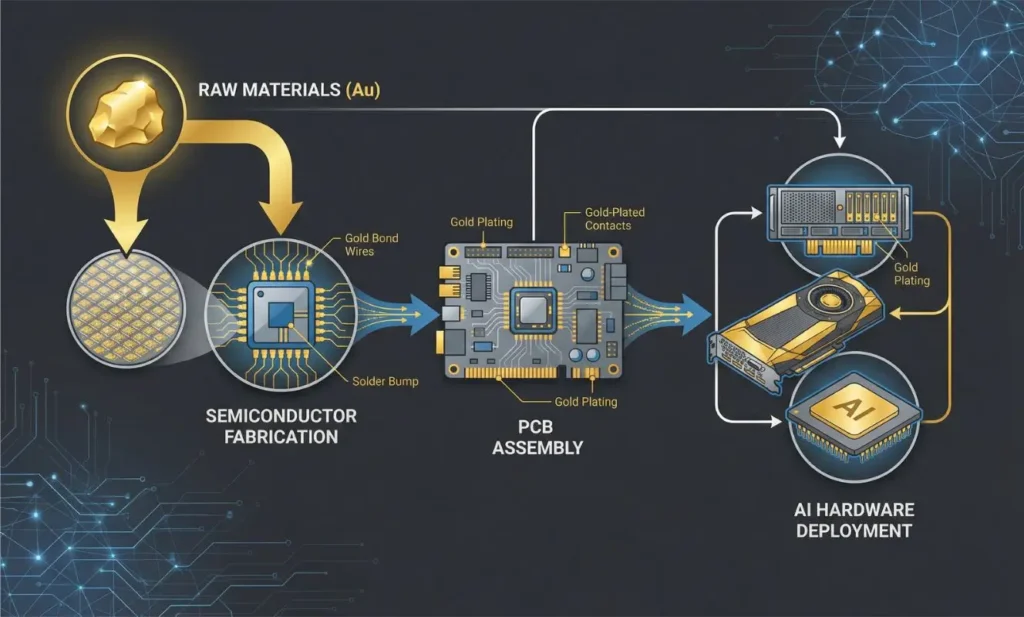
The rise of gold has significant implications not only to the usual financial markets, but also to technological and AI-driven sectors. Gold is an essential component in highly sophisticated electronics, such as semiconductors, high-speed connectors, and high precision components that are applied in data centers and AI devices.
With the prices being high, the pressure of costs is spreading across the technology supply chain. This is when AI infrastructure investment is already experiencing the threat of energy cost, regulatory oversight, and capital discipline. Increased material prices squeeze profits and compel companies to reexamine their procurement and design policies.
There is also a signal effect. When the gold runs with vigor in times when the rate cuts are expected, it is an indication that the capital is reserved. In general, the expectations of eased monetary policy favor more risky assets such as growth stocks and AI startups. The fact that Gold is performing better in this environment suggests that shareholders are not focused on growth but on resiliency.
This action can decelerate speculative investment and hasten the interest in efficiency, recycling, and supply chain localization. To technology companies, the price of gold is not only a cost variable. It is a macro factor of the development of risk appetite in the capital markets.
4. Technical Analysis: Healthy Trend in Checked Overburden.
Technically, the rally of gold is still well-organized. The price is trending in a definite upward trendline in which the price is consistently increasing upwards with respect to the highs and lows. Trend strength as opposed to divergence is still affirmed by momentum indicators.
Relative Strength Index is high and this implies overbought, and not exhaustion. When there is a strong trend, even overbought values can be very long-lived. They are an indication of movement, and not an impending turnabouts. The MACD shows that it is still positive and above its signal and thus the bullish bias.
Key levels matter here. The resistance psychological and technical zone of USD 5,300. It would be normal and market continuation to take a consolidation period around this level. Adversely, the level to observe is channel support close to the USD 5,100 area. Pullbacks above this region are likely to be remedial, but not structural as long as price remains above this region.
The macro narrative is in line with the technical picture. Gold is not acting like a congested business on the verge of collapse. It is acting as an asset that is in price discovery mode, which is backed by fundamentals and disciplined purchasing.
The importance of these insights is in combination.
Geopolitics, Fed action, effects of technology, and technicals, individually, support increased gold prices. They combine to create a logical narrative. Gold is not reacting to fear. It is reacting to a world in which uncertainty is chronic, policy credibility is doubted and capital is becoming discriminative.
That mix is the reason behind the richness, length and strength of this rally.
To investors, the actions of gold affirm the necessity to change reactive trading to formal risk management. The most feasible approach is regarding the gold as portfolio insurance, as opposed to a momentum asset. It is possible to maintain a 5 to 10 percent level to balance the volatility of the equity heavy or technology based portfolio especially in the times when the policy is uncertain. It is not aimed at outperforming, but it is about maintaining optionality in cases where the correlations fail.
To companies, particularly those that deal in technology and those that are involved in production, long term gold rate of more than USD 5,000 requires an operating reaction. This involves exposure to precious metals auditing of hardware components, locking in longer term supply arrangements where feasible and further investment in recycling and recovery of legacy equipment. Companies that are forward-looking with regard to managing material risk will safeguard profit margins and mitigate disruption.
To the builders and developers of the products, the chance is in flexibility. There is an increasing demand of systems that are automatically adjusted to macro stress. Platforms and products can have gold linked instruments, exposure to real world assets, and dynamic hedging layers. Continuous winning is not prediction. It is resilience by design.
The fact that gold has broken out of USD 5,300 is not a temporary event. It shows that markets are refocusing on risk, credibility and long-term uncertainty. This is subject to change by the immediate Federal Reserve decision, which can affect short-term volatility, but the overall trend has already been determined. Capital is redefining durability and not growth only.
The next step is execution. Investors need to review portfolio construction and stress test assumptions on policy stability and correlation. Companies ought to revisit the supply chain exposure and price sensitivity to high commodity prices. Constructionists and planners ought to value those systems that adjust to volatility automatically as opposed to using fixed predictions.
This will be an advantage to the early responders. In a structural environment of uncertainty, a competitive advantage is resilience and no longer a defensive stance.
Conclusion
It is not just a headline when Gold surged past USD 5300 recordly–this is a strategic sign to investors, firms, and developers. Persistent geopolitical tension, policy uncertainty, and structural changes in the perception of risk by capital are reflected in the rally. It is the actions we take today to reevaluate portfolios, obtain supply chains, and develop adaptive systems that will decide who will survive in the unstable world of 2026.
FAQ
Why is the gold going above USD 5,300 even with the stable stock markets?
Due to the geopolitical and policy uncertainty that investors are hedging, and no longer responding to equity volatility.
Is this gold rush being fueled by Federal Reserve itself?
Indirectly. Demand is being supported by concerns on long-term policy credibility and future rate direction.
Is high price of gold an indicator of recession?
Not necessarily. It is an indicator of increased uncertainty and risk repricing, and not a direct economic decline.
Is it possible that gold can keep rising until 2026?
Yea, when there is still geopolitical tension and monetary credibility issues.

Muhammad Asif is the Founder and Growth Engineer at WebNextSol, with 5 years of experience building AI-powered systems that help businesses save time, generate leads, and grow. He combines expertise in WordPress, automation, cloud architecture, and SEO to deliver practical, results-driven digital solutions.