
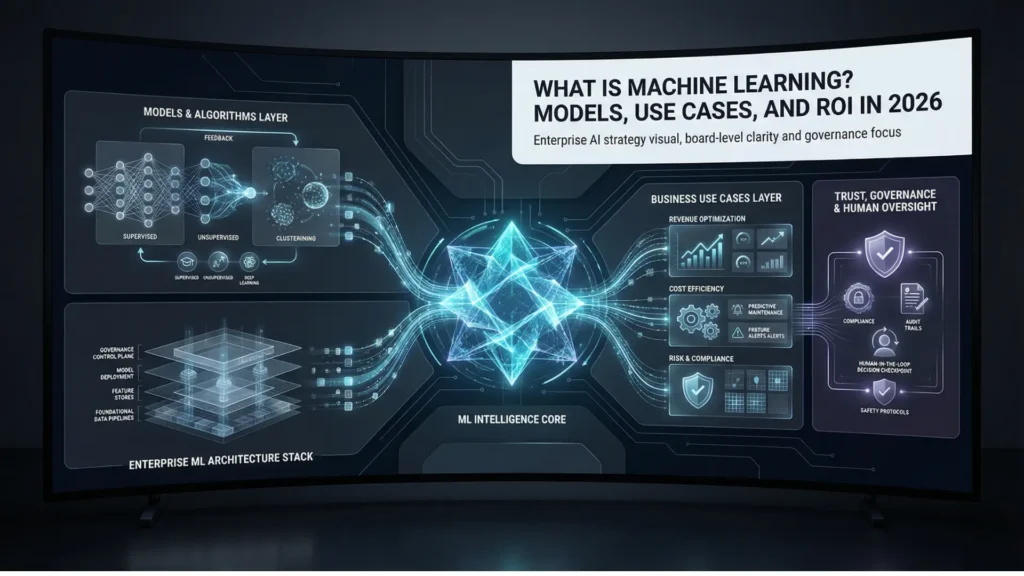
Table of Contents
Machine learning is a branch under artificial intelligence which enables the system to learn information and improve the decision making system without necessarily programmed statements. It is fundamental enterprise infrastructure of 2026, driving automation, personalization, risk management and real-time view into products, operations and controlled business processes across the globe.
1. What Is Machine Learning?
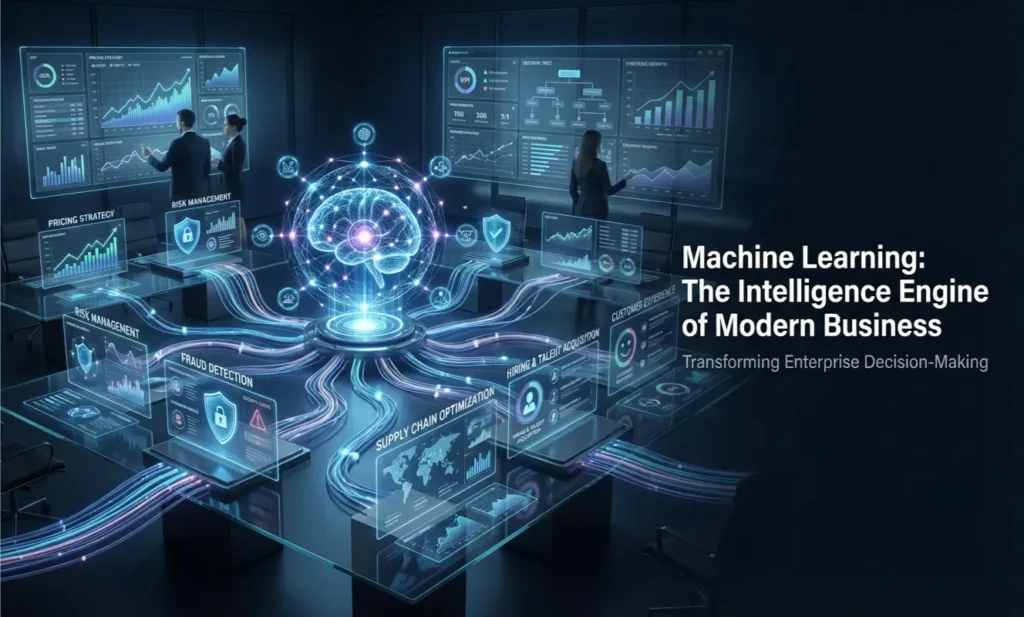
Machine learning (ML) means the capacity that allows organizations to scale predictive and decision-making processes using past and recent data. On the board level, ML should not be perceived as a technical experiment, yet it is a strategic operating resource, the importance of which can be equal to cloud infrastructure or cybersecurity.
Machine learning system does not require a fixed program of rules that the engineers hard-coded but rather adjust their behavior according to the data as seen in conventional software. This allows them to improve the accuracy of their predictions and make complex decisions and respond to changing circumstances without necessarily reprogramming them. In practice, ML is possible to make the decision quicker, less expensive in terms of operations, and customer experience more individual.
Through governance, ML is now directly affecting revenue growth, cost effectiveness and enterprise risk. The predictive models influence the pricing, issuing credit, employment, fraud and optimization of the supply-chain. As this type of decisions may exert a tangible impact on customers and regulators, ML should be regarded as a controlled capability, performance measures, auditing and management.
Another aspect that the executives should be aware of is the relationship between AI and ML. The intelligence provided by machines is also called artificial intelligence, and machine learning is the process of contemporary AI, including systems of generative AI. In a nutshell, AI is the dream; ML is the vehicle that is running in delivering business outcomes.
Whether leadership teams in the year 2026 will make use of machine learning is no longer a question, but how they can do so in a responsible, efficient, and profitable manner across the enterprise.
2. What Are the Powering Results of Machine Learning Models and Algorithms?
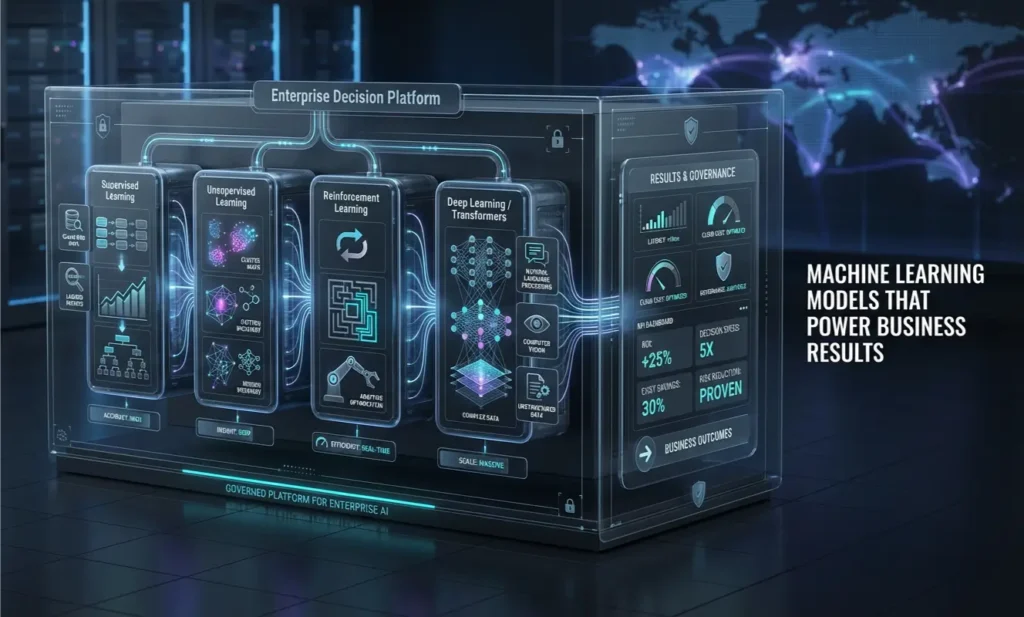
These systems are machine learning systems and algorithms which transform raw data into predictions, recommendations or automated decisions. At an enterprise level, the goal is not to choose the most sophisticated algorithm, but the topology of the model most balanced in terms of accuracy, speed, cost, and risk to specific business application.
The supervised learning taught on labeled data is the most widespread model, and it is implemented in enterprises. They are used to power credit scoring, churn prediction, demand forecasting and fraud detection because the results may be measured and performance audited. Such models are superior when there is a dependable historical data and in situations where regulation measures are to be explained.
Unsupervised learning models determine patterns that are not characterized by labels. They tend to be used on customer segmentation, risk identification, and anomaly identification. They are also hard to be interpreted, though they must be interpreted, and insights drawn out of statistical form rather than stated results.
Learning reinforcement models are acquired through reinforcement. Also they are being used in logistics, robotics, price optimization and resource allocation dynamically where systems must keep changing according to current conditions.
Deep learning models, such as neural networks and transformers, prevail in unstructured data that contain text, images, and audio. The generation AI and more sophisticated perception systems are based on such models but raise the costs in infrastructure and energy.
Another strategic decision is made in 2026, rather than model selection. It has been shown that even computational models of similar size may radically differ in inference latency, which affects real-time performance and cloud cost. Smaller and optimized ones that give good enough accuracy and have shorter response times and less operating costs are therefore preferred in most organizations.
The greatest performing businesses view algorithms as substitutable aspects in a regulated platform, which is evaluated through the extent of business impact, and not scholarly knowledge.
3. What Will machine learning be doing in 2026?
By 2026, machine learning will not only be limited to the analytics departments or laboratories. It is directly incorporated into the processes of the core business and it determines how organizations are making money, managing costs and addressing risk in real time. The applications, which connect the ML products to operational decisions, rather than set reports, are the ones that are most successful.
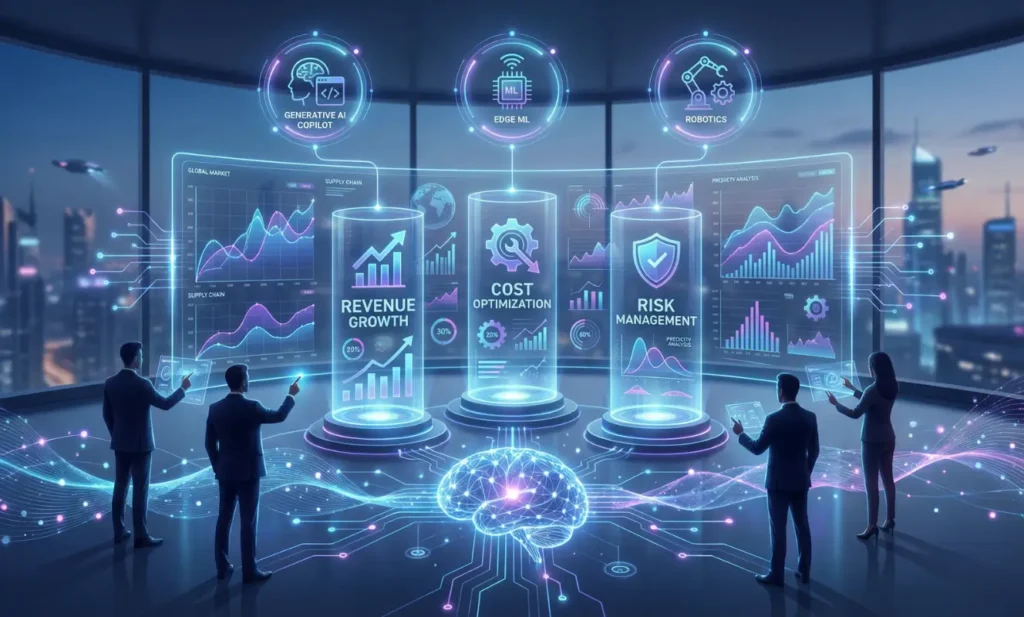
Revenue-based applications have been adopted first. The personalization of products and content in the recommendation systems is scalable and enhances the conversion rate and lifetime value of the customers. Dynamic pricing models vary the prices based on the demand, inventories and competition pointers. ML predicts purchase intent, optimizes campaigns and suggests the next best action to each customer in sales and marketing.
The second important category is the cost and productivity optimization. The ML process automation no longer requires human input in finance, human resource, customer support and in supply-chain processes. Predictive maintenance models are used to predict the failure of equipment in advance before they occur to minimize downtime and repair cost. The automation companies using the concept of ML record high ROI of efficiency and lasting reduction of operational costs within the first 12-18 months.
The risk management and compliance applications have been increasing at a very fast rate. Machine learning has better speed in detecting fraud, cyber threats and anomalies as opposed to the rule-based systems. In regulated industries, transactions, conduct and controls are constantly monitored by use of models to expose potential compliance violations in near real time.
New horizons are also emerging. The generative AI copilots are now useful to employees in all functions and edge and robotics ML focus on ultra-low latency to make real-world decisions. The shift in paradigm which is obvious in 2026 in all spheres is not the understanding, but the possibility of machine learning to take decisions without human intervention and to influence the business outcomes positively.
4. The 2026 Architecture and Enterprise ML Stack
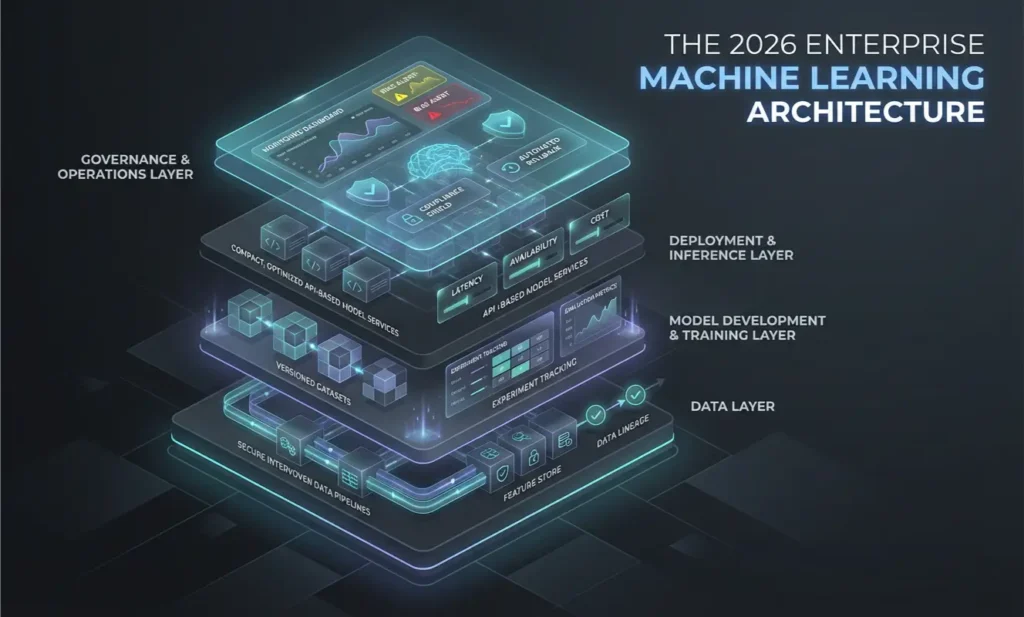
The machine learning stack of enterprise in 2026 resembles the mission-critical software platform, as opposed to a research configuration. It is aimed at delivering high quality, performance and auditable decisions in large scale and control the cost, latency and risk. ML architecture is not a tool set, it is a system, which develops successful organizations.
The first one is the data layer. This comprises pipelines of data ingestion, feature stores and data quality controls that provide models with reliable and constant inputs. Poor data quality and data governance is the primary cause of ML failure, the non-negotiable components of the stack are lineage and access control.
The most important layer above all is the model development and training layer. The comparison of models on an objective basis is carried out by modern teams basing on versioned datasets, experiment tracking, and automated evaluation. It is being trained on accelerated infrastructure but more on inference workload optimization and currently they represent the bulk of total ML spend.
The area that will most likely be most influenced by business in architecture decision making is in the deployment and inference layer. Models using APIs are and possess service-level objectives of latency, availability, and cost. In order to attain a very tight response-time requirement and still be capable of operating on a very limited energy budget, smaller, optimized designs are often wanted to be fabricated.
The governance and operation layer, which links them all, is last but not least. After model drift, bias, performance decay and compliance threats, constant monitoring ensues. Systems are made safe and auditable by the adoption of human in the loop and automated rollback mechanisms.
The one principle that would define enterprise ML architecture in 2026 would be that the models must be able to work in real-life scenarios and not just controlled experiments.
5. Machine Learning Trust, Governance and Lessons in the Real World.
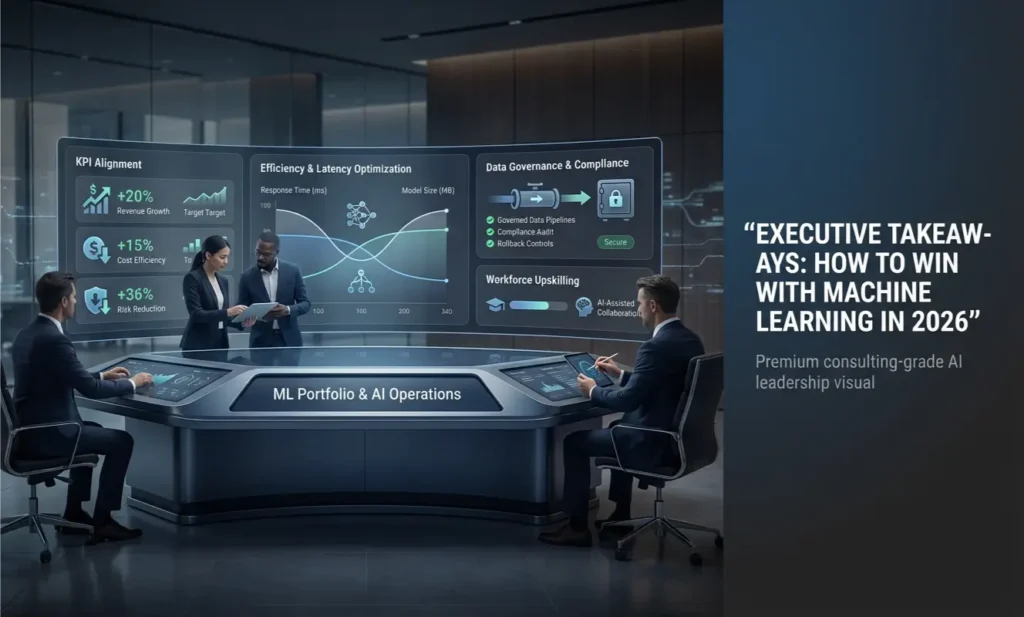
No longer is trust and governance peripheral to business success as machine learning entails becoming part of business processes. By 2026, the executives will be forced to regard ML as a high-risk and highly regulated asset that will influence the revenue, compliance, and reputational risk.
The most important aspects include the quality of data and governance. Studies have shown that bad data not the model used is the cause of 73 percent of cases of ML deployment. Companies are currently paying significant sums of money in data lineage, validation pipelines and access control. This renders predictions to be reliable, reproducible and auditable in order to cover the internal standards and regulatory requirements such as the EU AI Act.
Explainability and risk management also have to be in place. High-risk applications, including hiring algorithms, credit scoring, or automated trading, must be able to disclose their model decisions, as well as the control in the human-in-the-loop. Unexplainable models can be subjected to the threat of being regulated and fined or even put out of business. Organization are then incorporating the use of monitoring dashboards, drift and automated warning to gain confidence in models deployed.
Expert and human oversight problems are emerging. Because 43% of leaders are concerned about the declining human adequacy of ML-enhanced workflows, companies are planning ways to retain key capabilities as automation is increasing. Human-in-the-loop systems are now capable of exchanging efficiency with accountability to circumvent cascading errors in the event of unforeseen events experienced by autonomous agents.
The lessons gained in real life by the leading organizations include:
The perception of ML as a portfolio and not as separate experiments with each model having its associated measurable business performance.
Making investments in data and governance and then training the state of the art models.
Installing automated rollback and drift detection systems to prevent losses in operations or finances.
Performance measurement and compliance measurement, both at the same time, in order to please the auditors, regulatory and board expectations.
Indeed, most thriving business enterprises in 2026 will consider the fact that the trust and governance are essential as model fidelity. The lack of incorporation of these elements brings about operational, regulatory and financial risk and the incorporation of them provisions ensures that ML generates sustainable values across the enterprise.
6. Executive Takeaways: Machine Learning: Win in 2026.
It is not algorithms anymore, but business results to the executives. Machine learning nowadays is a strategic operational resource, and the success depends on the strategy, governance, and performance management.
1. Align ML to measurable KPIs. Enter in targets of revenue, cost or risk and then choose models. All deployments have to be business outcome mapped.
2. Minimize on latency and cost. Smaller and finer models are available and can attain sufficient accuracy and a reduced inference cost and energy consumption. Important measures that should be monitored are time to first token and per token latency.
3. Invest in quality and management of data. It should have pipelines of data of high quality and able to be audited. Bad data is the cause of three out of five ML failures, and not bad algorithm.
4. Develop labor artificial intelligence. Two-thirds of enterprise jobs are passing the ML understanding test. Human beings would be remaining useful as AI-assisted workflow allies once the workers are upskilled.
5. Install the human-in-the-loop systems. To prevent ripple effect failures and be responsible, apply automated ML results with human control, where the risk of it going wrong is high to decision making.
6. Treat ML as a managed portfolio. Measuring ROI, risk, and compliance of both models. The routine includes the incorporation of controlling, retrace, and vigilant controls.
By such principles, the leaders will obtain the maximum possible outcomes of revenue, efficiency, and risk reduction with the support of ML and will be able to turn AI into a sustainable enterprise-wide capability.
FAQs
Q1: What is the difference between AI and machine learning?
The umbrella term of the machines, which can perform intelligence-intensive tasks, is AI. One of the subsets is machine learning which enables the systems to learn using data and improve better performance without need of explicit programming.
Q2: Will machine learning be expensive to utilize?
Though the implementation of ML might involve a huge investment in the infrastructure and talents, automation, higher efficiencies, and optimizing revenues can be rewarded highly in terms of ROI to the enterprise. Small, downsized models reduce the latency and the cost.
Q3: What are the skills required in machine learning?
Besides data science, data engineering, cloud infrastructure comprehension, model and business literacy governance are also expected in the data science profession. The capabilities of AI are becoming a norm in the majority of business operations.
Q4: How is the latency important in machine learning?
Latency is an aspect that has an impact on the speed of response by models. Any delay in real-time systems, including fraud detection, robotics, or AI copilots, can reduce automation efficiency and revenue or safety.
Q5: Does that mean that large language models are being replaced by small ones?
Yes. Small and highly optimized models often can handle 80-90% of large model tasks at a fraction of the cost, energy, and inference time and are suitable in production environments.