
Table of Contents
1. Executive Summary
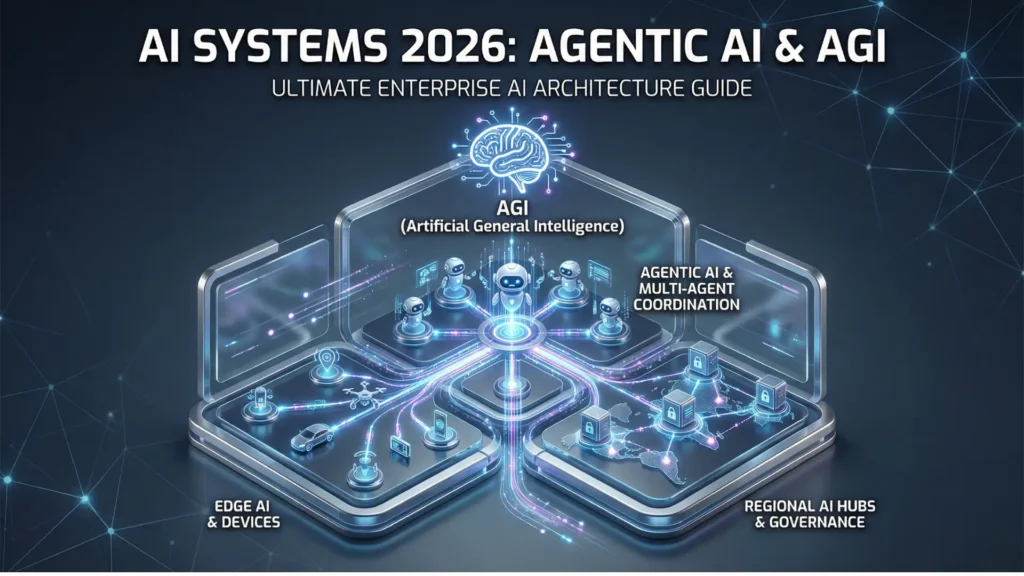
AI systems 2026 will shift to a transformative stage, where agentic AI systems and AGI systems go beyond experimental engagement with enterprises to become part of business operations (see Deloitte’s 2026 State of AI Report; AI Adoption Trends in the Enterprise 2026). Such systems allow real‑time, autonomous decisions on complex work processes like finance, supply chain, and customer support. Organizations are able to scale effectively, minimize human bottlenecks and ensure accuracy and compliance (enterprise adoption data combined from Deloitte and industry surveys).
At the same time, AGI systems are widening cross‑functional functions, enabling businesses to use reasoning and learning on a level that had previously been used only by specialized AI models (enterprise trend analysis from Deloitte and industry forecasting). The combination of AGI and agentic AI will make sure that autonomous agents are based on strategic decision‑making models, bridging operational implementation and enterprise intelligence.
The multi‑agent orchestration ensures that these systems run together. Specialized agents are able to work together on common objectives, organize dynamic workloads, and combine the information of different sources (as observed in multi‑agent enterprise deployments). This architectural design is risk‑averse, scalable, and fast to innovate.
Edge AI is the complementary technology to this ecosystem because it provides low‑latency computations at the edge, keeps sensitive information local, and can make real‑time decisions in distributed processes. It is the combination of agentic AI, AGI, multi‑agent orchestration, and edge AI that makes up a complete architecture with the power to act on strategic and operational complexity (industry benchmark reports).
Lastly, regional AI centers offer governance and compliance alignment, data sovereignty, regulatory requirements, and ethical oversight (regional AI governance frameworks and policy discussions). Businesses will have the advantages of global intelligence and local control as AI adoption becomes responsible, scalable, and sustainable.
In 2026, agentic AI and AGI architectures will change enterprise operations. Scale through multi‑agent orchestration, edge AI, autonomous agents and real‑time decisions, and compliance and data sovereignty achieved through regional AI hubs will empower organizations to operate in advanced AI environments in an effective, safe, and strategic way.
2. Critical Definitions and Entities
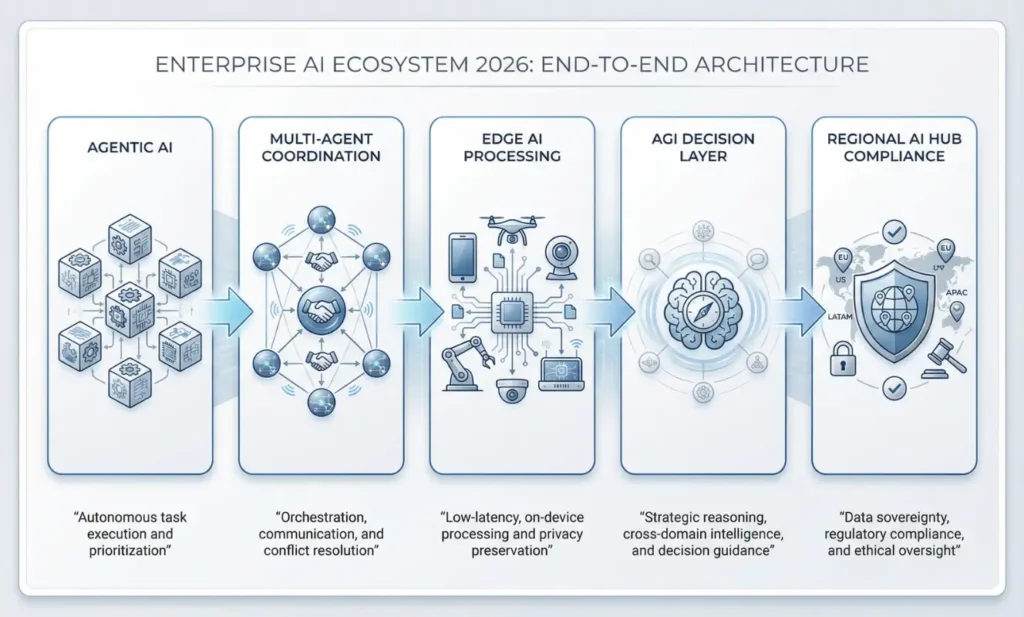
In order to interpret the evolving situation of AI in 2026, one must have a clear definition of five key terms, namely, Agentic AI, AGI, Multi-Agent Ecosystems, Edge AI, and Regional AI Hubs. Each of them plays a particular part in the business operation but establishes a hierarchical structure of regulations with the elements of efficiency, scalability and compliance.
1. Artificial General Intelligence (AGI)
AGI is the highest level of AI. Unlike narrow AI, AGI possesses cross‑domain reasoning, learning, and problem‑solving capabilities and can generalize knowledge across tasks (see Artificial general intelligence definition for context). AGI systems provide leadership, synthesis of information, and departmental action in companies, functioning as the “brain” of an AI ecosystem.
2. Agentic AI
Being a more particular and close concept than AGI, agentic AI describes autonomy agents, which can perform well without human supervision. They are also dynamic data responsive, repetitive or complex process oriented and action oriented agents. Passing strategy and action Going between strategy and action, agentic AI translates AGI-level understandings to work processes (see Agentic AI overview for details).
3. Multi-Agent Ecosystems
Multi-agent ecosystem To achieve the shared objectives, multi-agent ecosystem structures tend to coordinate several agentic AI units. It is these ecosystems that assure proper cooperation of agents, avoidance of conflicts, and integrity of the entire ecosystem via creation of robust limits of activities, norms of communication, and priorities of ends. The scale of multi agent coordination allows the enterprises to expand their operations without going out of control (see Multi‑agent system concept for technical grounding).
4. Edge AI
The presence of an AI layer offering a computation of modeling in the device is called Edge AI, whereby the computation is done close to the source of data. This layer reduces the latency, secures sensitive data and gives the opportunity to make decisions in real time under the conditions such as the IoT network, autonomous vehicle, or mobile application. The functional enabler of agentic AI units that are deployed in a system is known as Edge AI (see Edge AI definition for context).
5. Regional AI Hubs
Governance and compliance, including localized data sovereignty are made possible by local artificial intelligence centers. These centers ensure that the activities of AI in the enterprise comply with local requirements, ethical standards and security. They set up the controlling aid of AI adoption creating a balance between the international strategy and the domestic legislative demands (see Regional governance hubs insight for examples).
Hierarchical Relationships
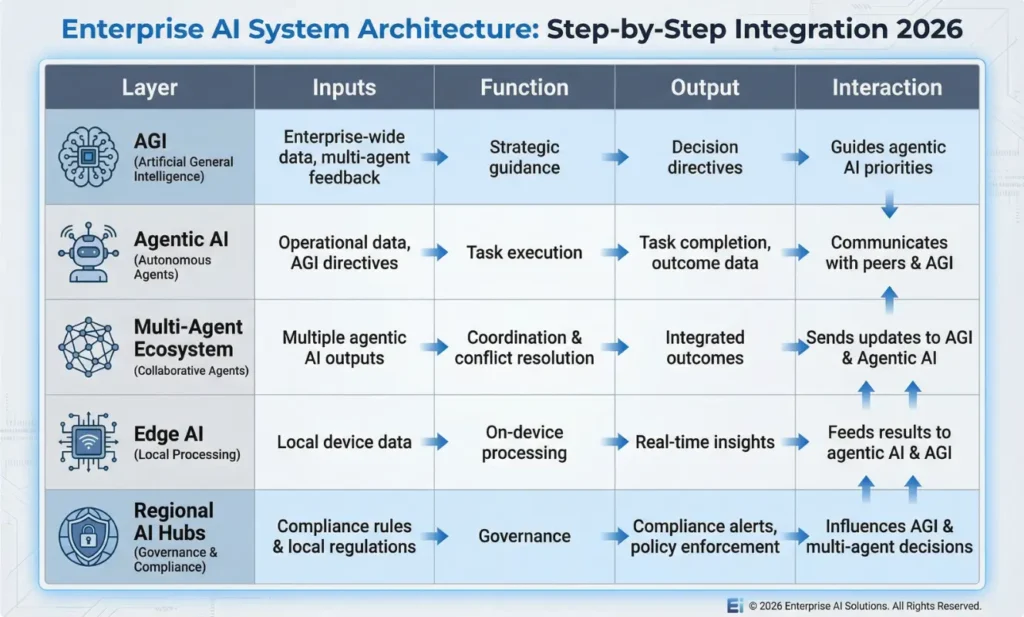
Top Layer: AGI – Strategic decision-making.
Agentic AI- Operational Layer – Task execution.
Multi-Agent Ecosystems – Mechanism Coordination Multi-agent ecosystems.
Processing Layer: Edge AI – secure, low-latency computing.
Governance Layer: Sub-national Artificial Intelligence hubs – Data sovereignty and compliance.
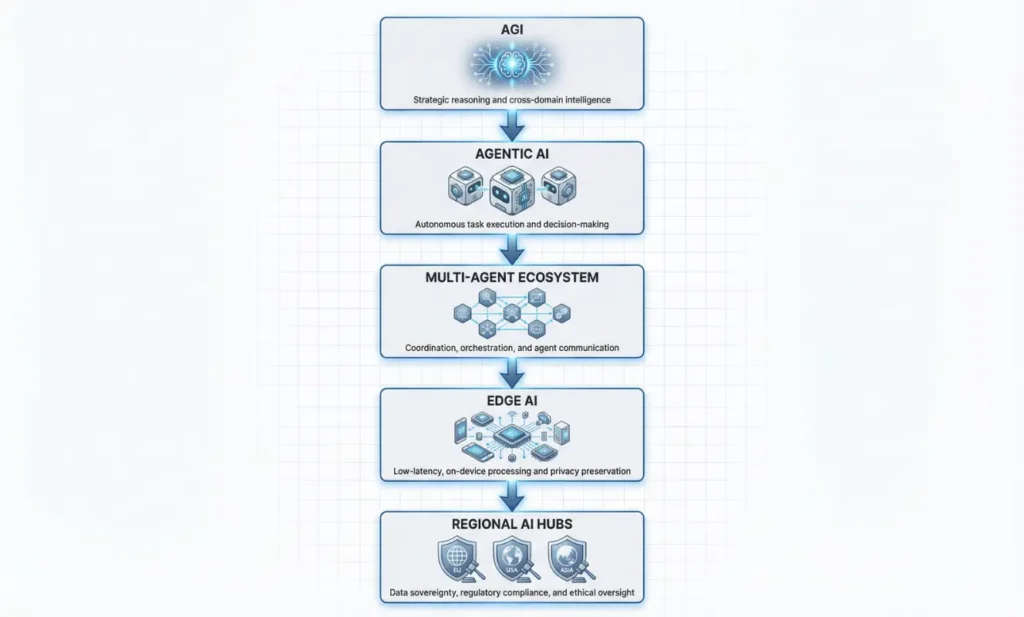
It has arrows that indicate dependency and flow of information. Colour code to differentiate between strategic, operational, processing and governance levels.
This organization also specifies not only roles but also provides some foundation on how the AI systems can be established in all the stages of operations, strategy and regulatory planes to create one, scalable enterprise ecosystem in 2026.
3. Central Ideas & Processes
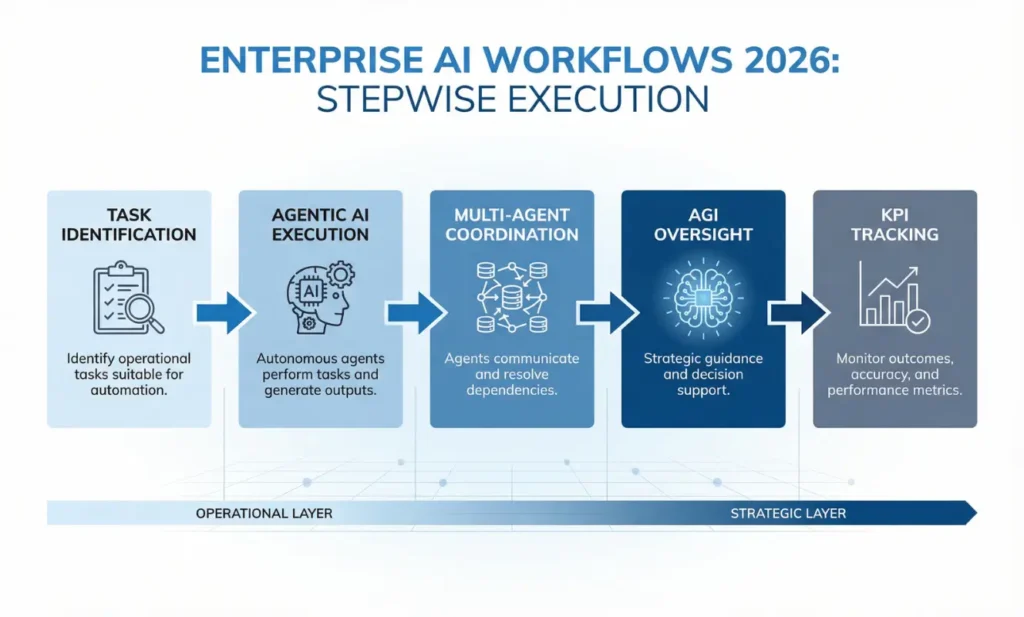
The 2026 enterprise AI ecosystem is an integrated, high-functioning, multi-agent, orchestrated system that incorporates agentic AI, AGI, multi-agent orchestration, and edge AI. To comprehend how it works, various mechanisms should be divided into stages and the way that these layers relate to each other in the reality should be depicted. MDPI
1. The Autonomous Operational Unit Agentic AI.
Definition An agentic AI is an autonomous software agent which is able to make real-time decisions and execute tasks by itself. In contrast to traditional automation, agentic AI is able to constantly evaluate priorities, make adaptations to evolving inputs, and take actions without involving human input. atscale.com
Stepwise Operation:
Input Reception: Agents receive structured and unstructured data of enterprise systems.
Task Prioritization: Agents prioritize actions due to urgency, business impact or predictive modeling.
Execution: duties are performed independently, such as report generation, support ticket management, or supply chain reallocation.
Feedback Loop: The agents evaluate the results with the aim of learning and making better actions in the future.
Analogy: Imagine agentic AI as a very competent project manager which can independently evaluate the tasks which are of the most importance and allocate them to different team members and re-allocate priorities to them when the situations vary.
2. AGI Integration: Strategic Guidance.
Role: AGI acts as the strategic intelligence layer, and it interprets data across various sources and provides agentic AI directions.
Mechanism:
AGI is fed with real-time data regarding the operations of the agentic AI agents.
It analyzes the trends, risks and opportunities in departments.
AGI reports instructions to the agentic AI and impacts the priorities of tasks or recommends alternative approaches.
Analogy Analogy AGI is the company CEO who establishes goals and offers wisdom whereas agentic AI “managers” execute the plan through functional teams. wikipedia.org
3. Multi-agent Ecosystem: Coordination and Collaboration.
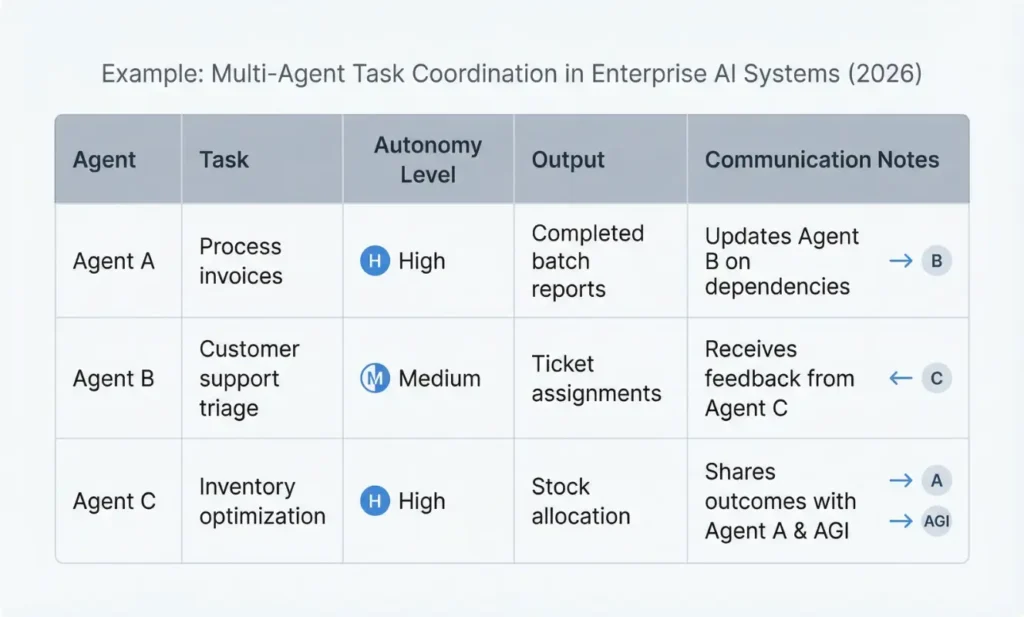
Purpose: Multi-agent systems assemble multi agentic AI units in order to achieve common goals. This eliminates redundancy, provides consistency and scalability.
Stepwise Operation:
Task Allocation: The system allocates tasks depending on the specialization of the agents and the availability of resources.
Inter-Agent Communication: The agents communicate, detect dependencies and resolve conflicts amongst themselves independently.
Outcome Integration: Individual agent results are fed to AGI to analyze them in a holistic fashion.
The analogy: Multi-agent AI works as a project team: all the members perform their independent duties, share progress, and organize the work to meet the common aim. Wikipedia
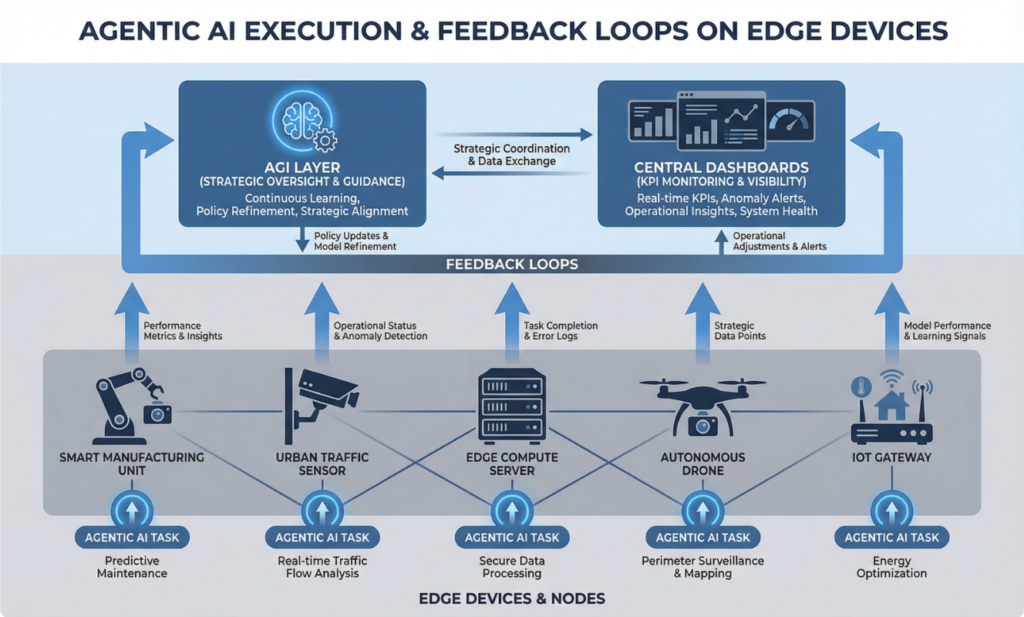
4. Edge AI: On-Device Execution
Definition Edge AI Agentic AI actors can perform computations here at the sources of data, such as IoT devices, sensors, or endpoints on a mobile device.
Mechanism:
Time Sensitive and privacy sensitive tasks can be performed by the edge devices with no need of the central servers.
Local processing reduces the latency and offers actionable information immediately.
As part of conducting a strategic assessment, AGI aligns the outputs of the aggregation to the centralized systems.
Comparison: Edge AI is like mini-offices in every branch of a large corporation: each of the offices will be free to make decisions on the local level, but has to send the report to the headquarters concerning the long-term strategy.
6. Real-Life Enterprise Scenario.
Suppose an international retail company applies AI to streamline supply chains:
Warehouse edge AI detectors identify when there is low stock.
Agents of AI will automatically arrange the products and give the deliveries priority.
Multi-agent orchestration is an assurance that any two agents do not overlap in ordering of items.
AGI evaluates past trends and forecasts demand and realigns agent priorities.
The regional AI hubs leave all data operations in line with the local laws of data sovereignty.
Such a system of integration enables smooth, independent operation and compliance, lowering risk, and scaling.
4. Comparative Analyses & Models
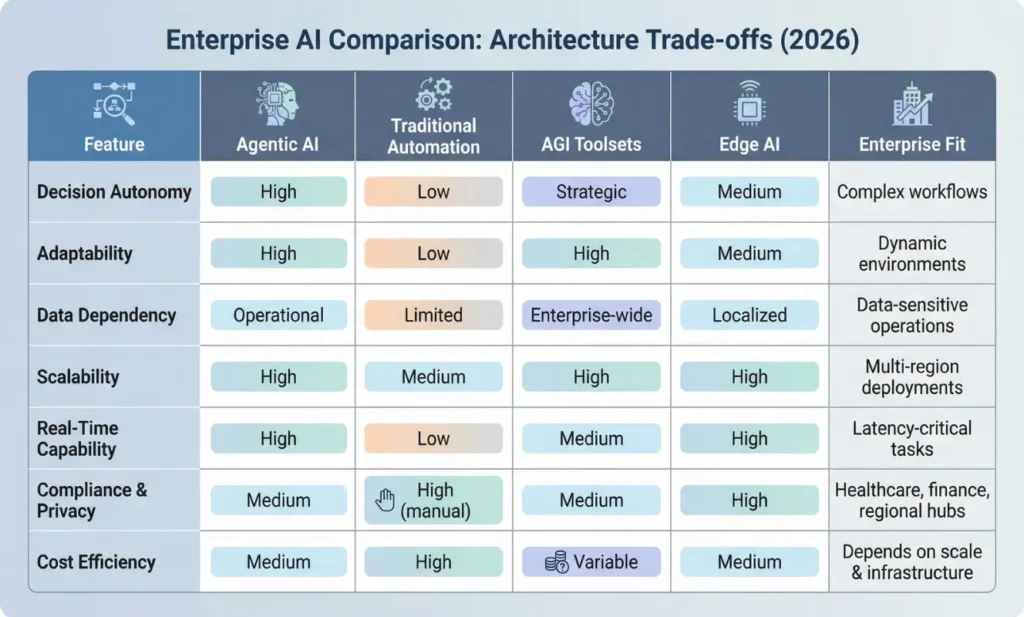
By 2026 when AI is adopted by enterprises, it is necessary to know how the differences, benefits, and adoption situations of agentic AI, traditional automation, AGI toolsets, and edge AI architectures can be used in strategic decision making. All used methods have different purposes, and a combination of the appropriate ones can significantly influence the efficiency of work, upscaling, and compliance.
1. AI vs. Traditional Automation Agentic AI vs. Traditional Automation
Autonomic AI: Autonomous agents can make real-time decisions, adjust to dynamic environments without being under human human supervision. It always focuses on tasks and is a learner of feedback loops.
Traditional Automation: Rules Systems with repetitive tasks, but based on a pre-determined workflow. Low flexibility and incapable of responding to unforeseen situations.
Adoption Context:
Complex, variable workflows should be handled by agentic AI, including customer service triage, finance, and supply chain optimization.
Traditional automation is good in highly repetitive and predictable processes e.g. in batch data entry or report generation.
2. AGI Toolsets vs. Special AI.
AGI Toolsets: Multiple-function reasoning, learning and problem solving intelligence. They deliver predictive and stratagem at the enterprise level.
Specialized AI: Special purpose, limited context, e.g. fraud detection or image recognition.
Adoption Context:
AGI is best suited to companies that are following enterprise-wide AI, innovation pipeline, or intricate research and development programs.
Single domain applications of specialized AI are effective in single domain processes that require deep knowledge.
3. Edge AI vs. Cloud-Only AI
Edge AI: This is executed on devices and allows low latency, privacy, and responsiveness in real-time.
Cloud-Only AI: Processing is centralized and has high-computational power but maybe encumbered by latency and privacy issues.
Adoption Context:
Edge AI is applicable in systems that need real-time decision-making or sensitive data processing, e.g. IoT networks, self-driving vehicles, medical equipment.
Cloud-only AI can be used to support batch processes, big data analytics, or AI research.
Strategic Takeaways
Integration vs. Replacement: To balance operational needs in real-time with deep strategic intelligence, modern enterprises can tend to integrate agentic AI with edge AI and AGI.
Complexity of Workflow Makes Choice: The more dynamic and interdependent the processes are the greater the advantage of agentic AI and multi-agent orchestration.
Compliance & Governance: Regional AI hubs with edge AI will guarantee compliance with local laws, and AGI will guarantee high-level supervision.
Enterprise Fit: There is no universal solution to all problems. The strategic layering provides cost effectiveness, scalability, and resiliency of the departments.
The comparative framework will enable the decision-maker to consider trade-offs, appropriateness, and adoption routes, such that the AI systems will not only be technically optimal but also strategy-driven to develop the enterprise in the year 2026.
5. Frameworks & Decision Guides
The effective adoption of AI in enterprises in 2026 will require organized structures that are used to make decisions in agentic AI and AGI and multi-agent coordination. Frameworks offer an auditable and repeatable way of model selection, system integration and responsible scaling.
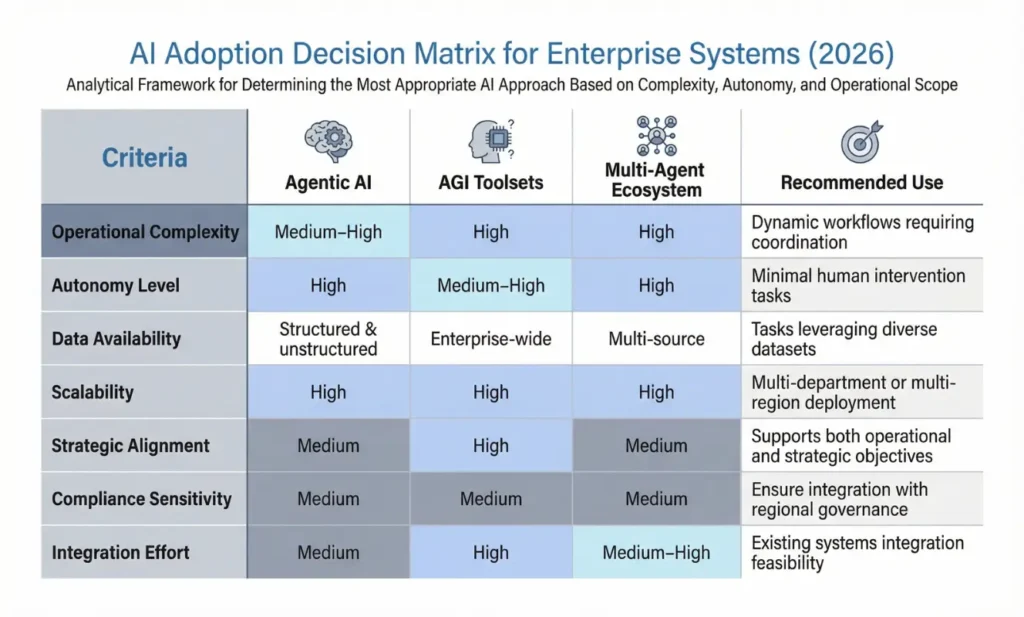
1. AI Adoption Decision Matrix
This matrix assists organizations in identifying the most suitable AI approach in terms of complexity, autonomy and the scope of operations:
2. In order to achieve concurrent collaboration of agentic AI units, follow a three step orchestration model
Task Allocation & Scheduling: Assign tasks using AI-based algorithms according to agent capability, dependencies and priority.
Monitoring and Feedback: Analyze the real time dash boards to track the performance and identify the performance bottlenecks and give the feedback to AGI that will readjust the approach.
Visual Indication: The agents are marked nodes on a marked map, the task flows are arrows and AGI is the strategy centre that coordinates the network.
3. AI Readiness Checklist
Organizational Readiness
Straightforward business objectives per the AI strength.
Technical Readiness
Capability to interoperate with older platforms verified.
Operational Readiness
Data sovereignty and privacy laws.
Actionable Insight: Before scaling agentic AI or working with AGI tools, it is possible to identify gaps with the help of this checklist.
4. Decision Flow Example
Compare freedom and complexity – select agentic AI or AGI.
Check data and infrastructure – edge AI which is low-latency or sensitive.
Demonstrate conformity – address local AI hubs and governmental regulations.
Strategic Takeaways
Integration of compliance: The integration of governance at the early-inclusion can be sustainable and risk-wise in the adoption of AI.
This kind of systematic procedure facilitates the transformation of sophisticated AI decision-making into an auditable, practical, and repeatable process that will give enterprise leaders the assurance to scale agentic AI, AGI, and multi-agent systems to 2026 operation.
6. Implementation Paths/ Model of Implementation
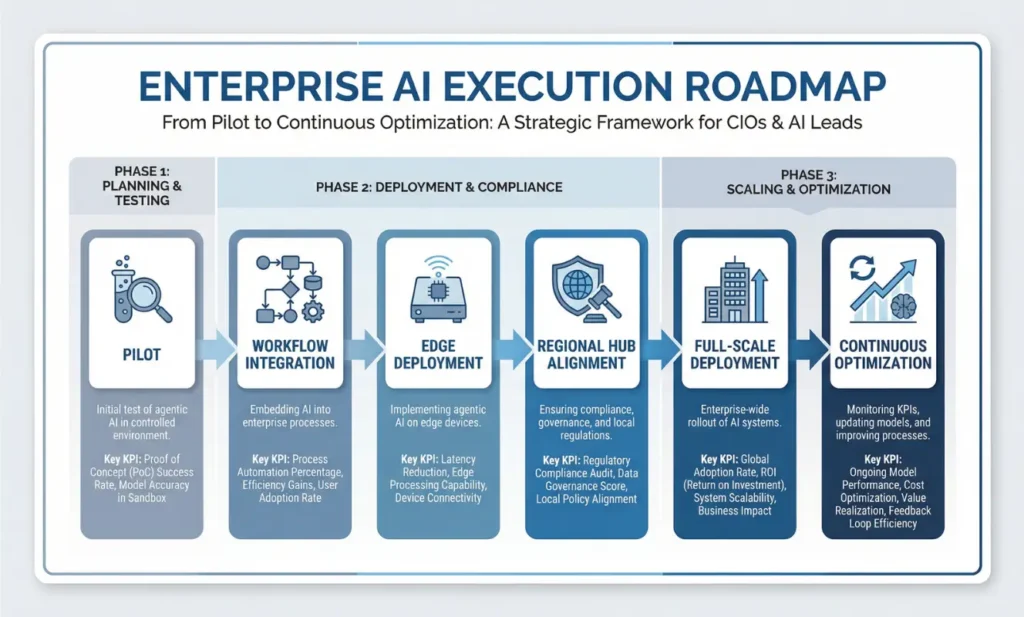
System-scale deployment of agentic AI and AGI systems needs a gradual and systematized pilot testing and operational integration and alignment of governance.
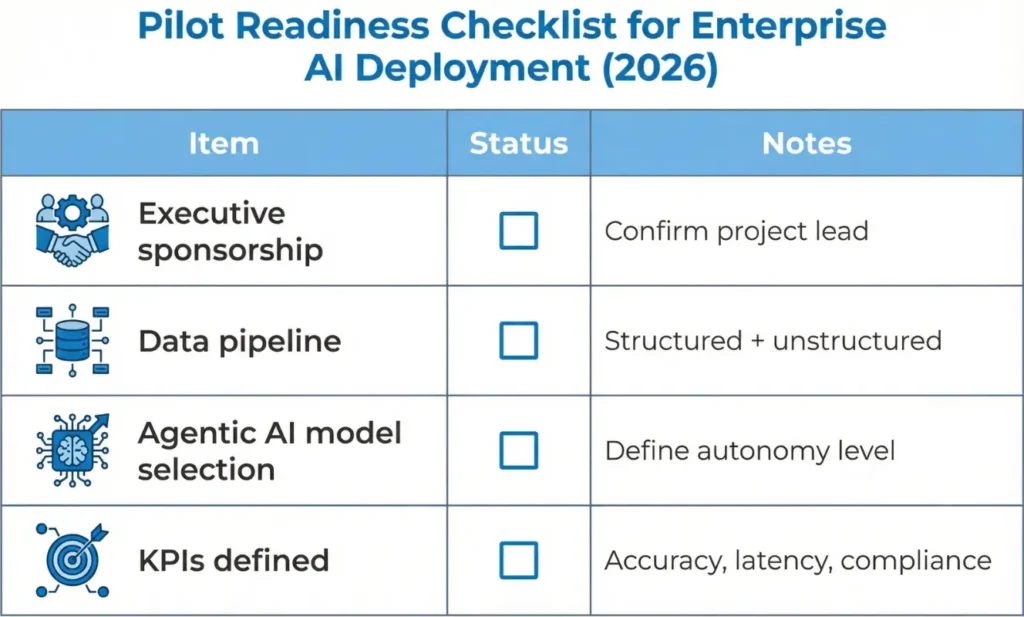
Step 1: Pilot Planning
Purpose: Try AI functionality at the smaller scales and then make it work in the organization.
Actions:
Find high impact, low risk (e.g. customer support, inventory management) business unit.
Choose the correct AI layer: agentic based on the working processes, AGI to aid in the cross-functional decision-making processes or both.
Step 2: Workflow Integration
Act agentic AI actors, whose functions are implemented by monitoring dashboard.
Step 3: Edge AI Deployment
Rendezvous: Provide low latency and privacy sensitive device-level services.
Determine key edge devices and terminals to real-time processing (e.g. IoT sensor, mobile devices, manufacturing equipment).
Train AI models locally and they do not rely heavily on the central servers.
Step 4: Regional AI Hub Setup
Goal: Congruence of goal Adherence, information sovereignty, and local governance congruence.
AGI supervision and multi-agent coordination should incorporate hub outputs to pursue homogenous compliance.
Step 5: Scaling & Optimization
Purpose: To expand AI operation on enterprise-wide basis rather than on pilot units.
Gradually introduce agentic AI representatives in other departments and locations.
Multi-agent coordination of cross-functional scalability.
Repeat AGI decision models which have operational performance feedback.
Ensure audit trails as a means of reporting and complying governance.
Strategic Takeaways
The gradual rollout process facilitates risk mitigation: Pilots in pre-scaling phase work on making sure the system and its regulatory compliance are ready.
Continuous improvement: The optimization of the high performance and the strategic alignment regarding the real-time monitoring and orchestration.
Compliance provides protection over ethical, legal and data sensitive business: Regional hubs and governance structures.
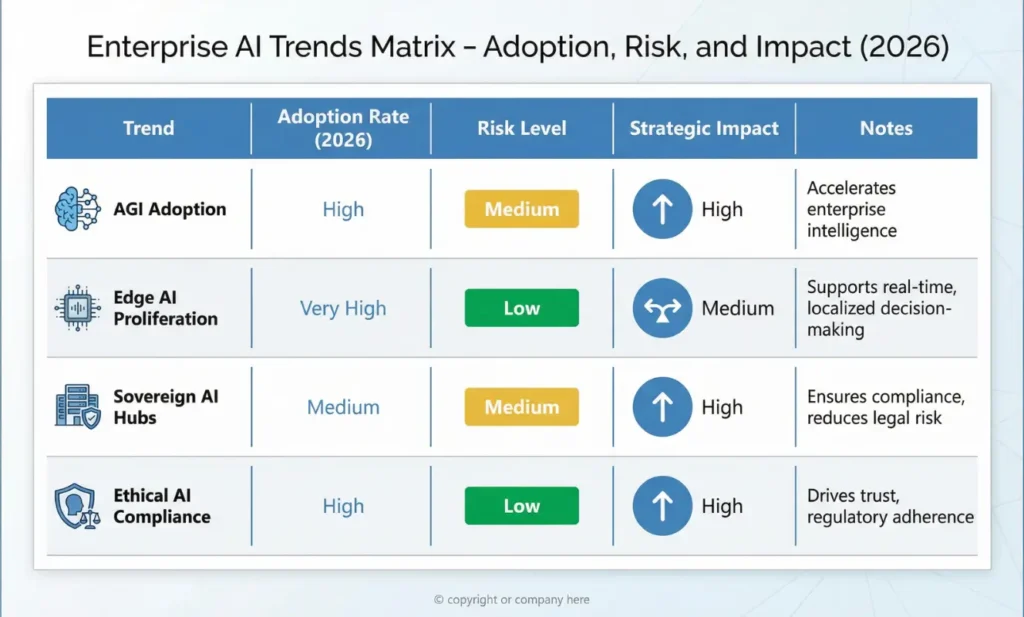
7. Signals and strategic trends of the future
1. Accelerated AGI Adoptio
Signal: The advertisements do not resort to pilot AGI experimentation to scale anymore, and are exploring cross-functioning argumentation in order to make innovation pipelines, research and complex operation choices.
Implications:
2. Edge AI Proliferation
Real time decision-making and safety of sensitive information On-board processing and low-latency real time decision-making and protection of sensitive data.
Implications:
3. Sovereign AI Hubs
Signal: There are regional AI hubs underway that will provide data sovereignty and regulatory compliance especially in healthcare, finance and critical infrastructure.
Implications:
Cooperates with agentic AI and AGI systems in order to bring a governance to the real time.
4. Ethical AI Compliance
Strategic Takeaways
To ensure businesses achieve optimal functioning and also ensure strategic control and management, businesses should invest in AGI and edge AI at the same time.
There will be no more compliance or ethics as optional and regional centres and ethical AI systems will determine enterprise credibility.
The adoption strategies can proactively be adjusted through continuous monitoring of trends through the reports of Deloitte, USAII as well as Info-Tech.
Innovative AI architecture should strike a balance between innovation, governance, and operational resilience to ensure competitive advantage in the global environment of the year 2026.
This trend-based model provides the enterprise leaders with practically applicable insights on how to future-proof AI systems, so that it can scale in a responsible and strategically appropriate manner, as well as within regulatory and ethical requirements.
8. Conclusion
Enterprise AI is no longer a fantasy, it is already a reality in practice by 2026. Agency AIs enable the implementation of tasks independently, AGIs enable strategic planning, and multi-agent ecosystems enable the implementation of complex working processes based on the scale. Edge AI is utilized to deliver low-latency processing, privacy-conscious processing, and regional AI hubs are utilized to enforce local governance and data sovereignty policies. Together these layers will help form an integrated, scalable, and accountable AI architecture that helps enterprises be innovative and optimizing and trustworthy.
9. FAQs
What is agentic AI and how it compares with the previous automation?
Agentic AI is defined as autonomous agents that can make decisions on the fly and prioritize action, compared to traditional automation, which is programmed and does not offer any alternatives of responses. It is agentic and the most suitable type of AI in the dynamic processes, during which human management may be reduced to the minimum and the productivity of operations can be maximised.
What is the role of AGI in assisting business activities?
AGI (Artificial General Intelligence) is the domain-free reasoning, strategy and prediction. It is used together with agentic AI to feed the decision making process, streamline business processes, create multi-agent systems to support intelligence in enterprise-wide environment.
What are multi-agent ecosystems and what does this term mean?
A Multi-agent ecosystems provide coordinated action to the rest of the agentic AI units in the actualization of shared goals. They also ensure that it is efficient, it has fewer conflicts and offers the ability of working across departments or regions in similar fashion as project team is massively handled.
How often does an enterprise require edge AI?
Edge AI is better suited to assist the low-latency, real-time application and processing and sensitive data i.e. IoT devices, health sensors or autonomous systems. It gives the chance to implement the decisions in the real-time and protect the information privacy.
What is the role of the regional AI hubs in compliance?
Local AI hubs establish local data regulation, data regulatory and ethical values. They ensure that the AI activities are not contrary to the legal system and are consistent with the global enterprise strategy.
Which implementation of the AI layers would I place in the top-down?
Start with the complexity of the workflow, autonomy requirements and access to data. The agentic, strategic in areas, multi agent in areas and collaborative in areas are the best types of AIs that can be effective in operational areas. Use decision matrices and readiness checklists should be used to guide adoption.
What do businesses do to make AI ethical?
Is transparent, audited and biased. Implement ethical countermeasures to agentic AI, AGI decision-making and multi-agent coordination. Take into account compliance policy of the region and analyse the results of AI.
What are the tendencies that the enterprises are expected to be attentive towards regarding the application of AI by the year 2026?
The increase in the percentage of AGI deployment, the diffusion of edge AI, the establishment of sovereign AI cities, and the ethical adherence to AI is the most important trend because it is a compulsory response. It is these reasons that render businesses competitive, compliant and futuristic by observation.

Muhammad Asif is the Founder and Growth Engineer at WebNextSol, with 5 years of experience building AI-powered systems that help businesses save time, generate leads, and grow. He combines expertise in WordPress, automation, cloud architecture, and SEO to deliver practical, results-driven digital solutions.