Table of Contents
1. Background and Statement of the Problem
AI Based Personalized Marketing is transforming the way brands engage with their customers. Traditional marketing channels were based on coarse grained segmentation that often resulted in generic communication, low engagement and sub- optimal ROI 1.2 Responding to the above impetus for a new approach to customer engagement, MarTech converged behind the idea of engaging with users at an individual level over their lifecycle through any channel or device pull (e.g.) websites, emails) cross-channel pull and interactive responses wit h messaging and push (e.g.) all arbitrary messaging). Modern customers demand extremely personalized experiences on every touchpoint [which includes websites, social platforms and email]. Epsilon (2023) states that 75% of consumers are more likely to make a purchase from a company that sends personalized communications versus mass e-mails, supporting the strategic significance of AI-based personalization.
Marketers use AI technologies like machine learning, natural language processing (NLP), and predictive analytics to work with large volumes of information and provide personalized content in real-time. It can be used to perform personalized email marketing, web page content, product suggestions, and AI-generated marketing text based on customer behavior, preferences, and predicted intentions.
Preliminary AI-based personalization has augmented both the rate of conversion and customer retention and lifetime worth by up to 25% higher returns. Organizations can achieve a competitive edge by anticipating customer needs and automating customized experiences and constantly optimizing messaging. As the digital ecosystems grow more advanced, AI-enabled marketing personalization is not a matter of choice anymore but the key to engagement, development of revenues, and customer retention in 2025 and beyond.
2. Reasons Why It Matters (Business Impact)
The personalization of marketing, with the assistance of AI, provides measurable value in financial, operational, and customer metrics:
Monetary Response: A 20-30% increase in revenue per customer and increased ROI is created by individualized campaigns.
Efficiency of Operations: AI makes campaign operations smoother, cutting down manual work by up to 35%, so teams can focus more on strategy and creativity.
Customer Retention: The level of churn will reduce by 15–20% as the company makes its customers more unique and valuable through personalized customer suggestions and focused interaction.
Scalability: AI offers hyper-personalization at scale, which will always present relevant experiences to millions of customer profiles in concord even with conflicting channel touchpoints.
The best performance measures that need to be applied to track the ROI include the click-through rate (CTR), the conversion rate, the retention parameters, and the cost-per-acquisition discounts, which will provide a clear picture of the effectiveness of the campaign.
3. A High-Level Framework (Core Model).
Personalization Framework AIPP is a smart automation framework that provides AI-based automation to organizations with a high customer flow.
Acquire: Gather both formal and informal data about customers from CRM systems, online interactions, and social media.
Analyze: AI and machine learning algorithms can be used to determine the preferences, behavior patterns, and segmentation opportunities of customers.
Predict: Using predictive analytics, make product interest, content engagement, and potential churn predictions.
Personalize: The campaigns should be individualized and personalized and sent through dynamic and individualized emails, web, mobile, and other sites.
Measure: Track the engagement, conversions and ROI in real time and feed this information back to AI models to optimize them continually.
Benchmark Data: The growth of engagement and conversion by 30–40%/25% within six months is the strategic value of AI-based personalization, and the brands that already use the AIPP framework achieve it.
4. AI-based marketing personalization strategies and major projections
Hypersensitive Individualized Email Ads
Through AI, marketers are able to develop very personal email marketing campaigns and adjust subject lines, messages, and times of delivery to individual recipients. Having the behavioral data, purchase history, and engagement patterns, AI can forecast what will be best accepted by an individual customer and optimize the engagement and conversion.
Example: An eCommerce store used the AI-based email personalization where the content and delivery time depend on dynamism. The results indicated a 35 percentage point increase in open rates and a significant increase in click-through and conversion rates.
Statistical Support: The Campaign Monitor shows that the AI-optimized mail has the capacity to boost engagement by 30–40 percent, which is more than the traditional segmented mail.
Tools: Salesforce Marketing Cloud, HubSpot AI, and Iterable are tools that personalize emails and are woven into the campaign processes in a way that the personalizations brought about by the AI suggestions seem to happen naturally and are implemented on the marketing campaigns.
Dynamic Website and Product Recommendation.
AI can be incorporated to enhance the user experience on the websites; given the analysis of current activities and previous contacts, it can suggest personalized content and product recommendations, as well as deals on promotions. Not only will this boost engagement, but it will also trigger cross-sell and upsell points, generating incremental revenue.
Workflow: A massive retail brand on its webpage and mobile application installed AI-powered recommendation engines and currently provides its customers with recommendations as to what to purchase individually, depending on the history and buying behavior, which resulted in online sales increasing by 20 percent.
Statistical Support: McKinsey concludes that personalized product recommendations have the ability to increase e-commerce revenue by 15–25%, which shows that AI can have some quantifiable impact on the conversion rate and engagement rate.
Hasie (2018) indicates that these tools represent AI-driven personalization for web-based and mobile channels, which can be easily integrated into analytics to improve the recommendations provided to customers by enterprises. Examples include Dynamic Yield, Adobe Target, and Optimizely.
Customer Journey Mapping in the Future
The AI will be able to predict the next-best action that can be adopted to anticipate the customers in real time, and this allows one to interact with them in a personalized fashion through multiple touchpoints. Predictive models take into account behavioral aspects, transaction history, and engagement patterns to guide customers through the most suitable journeys, increasing their satisfaction and likelihood of conversion.
Framework Instance: An example of AI usage in the case of an online travel service was to visualize customer trips, as well as to propose tailor-made holiday packages. The site increased bookings by 18 percent and enhanced client loyalty by anticipating and enabling individual offers.
Suggestion underpinning the stat: According to the companies that implement predictive personalization, the retention rates of their customers have grown by as much as 20 percent, which is an indication that AI is involved in the long-term engagement.
Technologies: Bloomreach, Emarsys, and Adobe Experience Platform are platforms that integrate with AI-based predictive analytics and marketing automation to enable dynamically personalized emails, web and mobile applications, and CRM platforms.
Strategic Takeaways
By building on hyper-personalized emails, dynamic product suggestions, and predictive journey mapping, organizations can provide timely and relevant engagement, improve customer interactions, increase conversions, and lower customer loss. Along with personalization at scale, AI never stops learning and creating future interactions, as it, too, can adjust to the behavior of its clients to ensure that its campaigns remain relevant to their varying tastes.
5. Minimalist AI Marketing Personalization Step-by-Step.
Step 1 – data collection and integration.
The AI-driven personalization is premised on a 360-degree customer overview. CRM systems, social media response and purchase history, and web analytics require organizations to unite data that arrives into the organization in different forms.
Tooling: Salesforce, HubSpot, Segment, and Google Analytics 4 allow consolidating data across multiple channels and ensuring that each of these touchpoints with the customer is documented and considered for analysis.
Setting: A retail brand has implemented online, in-store and social communication to expand customer profiles, providing one set of data to AI algorithms.
KPI: The share of customer profiles has improved by incorporating behavioral and transactional data, aiming for nearly complete coverage to achieve appropriate personalization.
Step 2 – Artificial Intelligence Analysis and Segmentation.
After merging the data, the AIs segment the audiences based on their behavioral patterns, preferences, and estimated lifetime value. Machine learning clustering algorithms and predictive models establish actionable segments, thereby enabling the implementation of targeted engagement strategies.
Predictive modeling, segment scoring, and behavior analysis are predicted with the help of the tools Python (Scikit-learn), Azure ML, and AWS SageMaker.
A SaaS business successfully categorized users into high-value, churn-prone, and engagement-prone groups, enabling it to target these segments with a specific campaign.
KPI: The accuracy of the predicted segments aims to align the actual engagement behavior with the target range of 85-90 percent.
Step 3 – Predictive Content/Recommendation Engine.
Next-best-content recommendations and product suggestions are then stored in real time within AI, and they are based on the interests of a particular customer and predicted intent. This enables the dynamic customization of websites, applications and emails.
Tools such as predictive recommendation systems, including Adobe Target, Dynamic Yield, and Recombee, enable the integration of predictive recommendations into online touchpoints.
Situation: Recommendations of the products were displayed online during the browsing of an environment that was based on AI and increased the chances of purchase and cross-selling.
KPIs: CTR and lift in conversions, which must be at least 20–25 percent higher than the baseline metrics.
Step 4 – Delivery and measurement of the campaign.
Automated campaigns become hyper-personalized messages on email, push notification and web, depending on the behavior and predicted preferences of the user. We feed the AI models with constantly optimized performance data.
Instruments: Marketo, HubSpot AI, and Klaviyo offer the opportunity to arrange campaigns and test them in real time (organize them, A/B test and analyze).
Situation: A travelling platform has launched personalized products or offers on the basis of their search pattern and forecasted destinations, which boosted their bookings and retention of their customers.
KPI: the engagement rate increased, the conversion rate increased, and the cost-per-acquisition decreased.
6. Profound Dive Insights
Technical Workflows: AI personalization pipelines rely on ETL, NLP to sentiment analyze, and machine learning to give predictive scores.
Competing Frameworks: Structured AI encourages autoscaled AI to create content and highly relevant, customized messages.
Cloud Comparisons: Azure, AWS, and GCP are perceived to provide scalable and reliable infrastructure that can be customized with 99.9% uptime and powerful data protection.
Ethical Reflections: GDPR and CCPA compliance is vital, and personalization must be non-invasive to ensure customer trust.
7. Real-World Use Cases
Retail: AI-based merchandising will increase e-commerce revenues by 20 percent.
Travel & Hospitality: Proactive personalization of packages and offers boosted the number of bookings by 18 percent.
Marketing: AI-assisted outreach and workflow through segmentation and messageboarding enhanced outreach, with a score of 25 improving upon the performance of outreach.
8. Stack Recommendations and Tools and Platforms.
According to AI, the process of marketing personalization requires an integrated technology stack comprising CRM, automation, predictive analytics, and tracking.
CRM and Marketing Automation Salesforce Marketing Cloud, HubSpot, and Marketo are alternative platforms that enable the organization of campaigns without difficulty, autonomic segmentation, and custom messages sent via email, web, and mobile platforms.
Recommendation Engines Adobe Target, Dynamic Yield and Recombee are a few of the tools that can be used to provide real-time personalized product and content recommendations on the basis of behavioral and predictive analytics, which can optimize engagement and conversions.
Machine Learning and Predictive Analytics: Azure ML, AWS SageMaker, and Python Scikit-learn have some predictive models to simulate next-best actions, churning, and customer segmentation to ensure that campaigns are delivered.
Analytics: Google Analytics 4 and Segment represent the platforms that allow the marketer to follow the users and comprehend the performance of the campaign and add concrete information to the AI models.
9. The Personalization of Marketing with AI Assistance: hints and recommendations.
Document Personalization Workflows: The ability to document the campaign processes, data sources, and AI decision rules will allow campaign personalization to be deployed up to 25% less. Documentation ensures consistency, reduces onboarding time for new employees, and enables scaling optimization.
Continuous Model Tuning: Ongoing predictive AI models should be retrained periodically, using the new behavioral and transactional data so as to be accurate. This means that the rate of engagement will be higher and churn will be reduced because the recommendations will be effective over the long term as constant model retraining is adopted.
Add A/B Testing and AI Recommendations: As much as personalization is based on data, it can be combined with A/B testing and AI recommendations to validate their suggestions and determine what will be most effective and raise the CTR and conversions. It is a cyclical approach that supports the accuracy of algorithms and makes them feasible.
10. Mistakes to Avoid:
The Over-Personalization: Excessive targeting can be so overwhelming that it causes a loss of trust and interest among consumers.
Privacy Compliance Lack: GDPR or CCPA breach is not only illegal but also damaging to the brand.
Failure to Track KPIs: CTR, conversions, and retention are not measured, and in that case, we will not be able to estimate ROI and campaign success.
Lack of Multi-Channel Integration: Channel-disintegrated personalization reduces the net impact and customer experience.
These practices will ensure that AI-based personalization is effective, ethical, and measurable, which in turn will make engagement and business development sustainable.
11. Conclusion
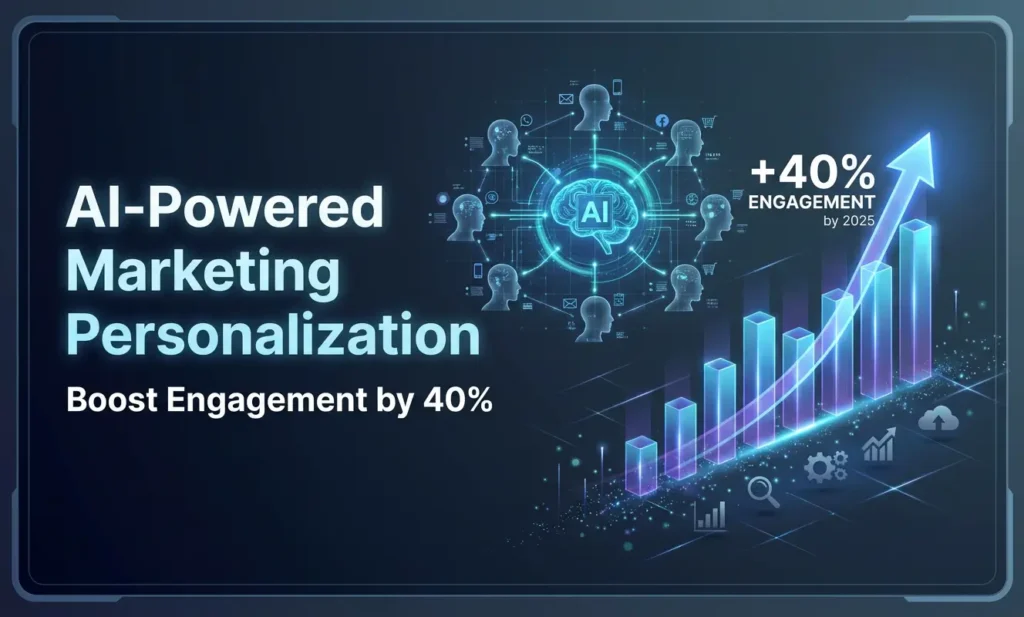
Individualized marketing using AI is transforming the nature of brand relationships with individuals through meaningful, prescient, and timely engagements across a large number of channels. The implementation of the AI-Powered Personalization Framework (AIPP) is going to allow organizations to actively collect, process, predict, and roll out customer insights and hyper-target their individual campaigns. Early adopters report that they see the engagement rate recorded as up to 40 percent and their conversion rates recorded as being improved by 25 percent, which clearly shows the measurable impact on not only customer satisfaction but also the increase in revenue.
Besides performance advantages, AI personalization will reduce the time spent on campaigns manually, enhance business operations and develop customer loyalty over time given its capacity to continuously create value-driven experiences. Some of the concepts that need to be integrated by the brands to achieve the highest ROI are multi-channel personalization, development of predictive models in real time, and monitoring of KPIs, such as CTR, conversion rates and retention measures.
Re-examine the existing marketing procedures, realize the spheres of high-impact personalization, and implement AI-driven campaigns. Further explore the entire topic of “How It Transforms Business and Digital Media in 2025” to acquire advanced structures, practical guidelines, and industry standards and benchmarks that will help succeed in increasing personalization.
FAQs
What is AI’s role in personalized marketing?
AI analyzes customer data (browsing history, purchasing history, engagement data, etc.) in large volumes to deliver personalized messages, personalized product recommendations, and anticipatory content to an individual, based on their preferences.
ROI of AI personalization?
Those organizations that apply AI to interact in the context of personalization report measurable returns, including engagement (up to 40%), conversion (up to 25%), reduced campaigns that customers would otherwise have to apply manually, and increased efficiencies.
Which channels can be the best channels to be personalized with AI?
Email, websites, mobile applications, and social media are the channels that receive the most enhancements. AI ensures consistent, updated messages across all touchpoints for higher CTR, engagement, and customer retention.
What is ethical with personalization in companies?
Moral personalization requires a high data protection level, personal information anonymity, and the comprehensive compliance with the requirements of GDPR and CCPA that should ensure customer trust and avoid any legal or reputation issues.

Muhammad Asif is the Founder and Growth Engineer at WebNextSol, with 5 years of experience building AI-powered systems that help businesses save time, generate leads, and grow. He combines expertise in WordPress, automation, cloud architecture, and SEO to deliver practical, results-driven digital solutions.