Table of Contents
1. The AI Job Tsunami? Or Opportunity?
AI has been instrumental in its emergence as a potential menace to the AI white-collar jobs The IMF projected that the advanced economies were put at risk of a crisis, 60 percent of the jobs were at risk, and aroused a projection of a tsunami heading towards the labor market (Kristalina Georgieva). JPMorgan Chase CEO Jamie Dimon predicted fewer employees would remain in the bank as AI efficiencies reshape the operations and Dario Amodei of anthropic estimated that half or more of the entry-level white-collar jobs would be impacted.
But the truth tells otherwise. Instead of eliminating work, AI is widening the boundaries of white-collar jobs, which is a cyborg amplifier–robotizing the repetitive work but increasing the aspects of human judgment, creativity, and decision-making.
This optimistic picture is supported by the latest labor statistics published in the United States: as of late 2022, white-collar jobs, such as management, professional, sales, and office occupations, have increased by 3 million, despite the increased adoption of AI. Doubledit growth was recorded by software developers, radiologists and paralegals, and white-collar premiums over blue-collar jobs have increased between 5-9 percent.
The story is changing: AI is not a Terminator it is a tool that does not replace human labor, it enhances it, which opens new positions and functions to the most strategically adjusted.

2. Learnings of Technology Revolutions of the past
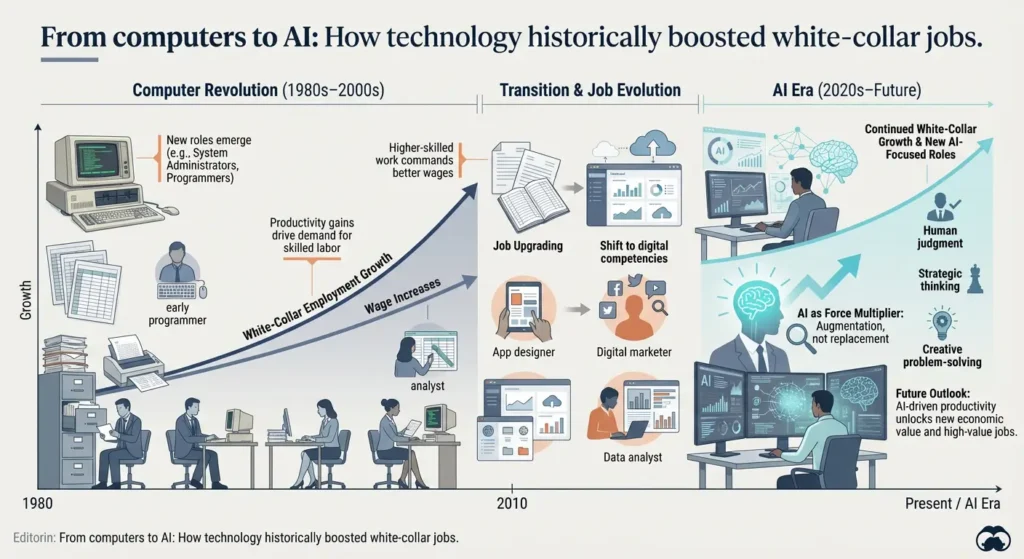
The history provides a good direction of the effect of AI in white-collar work. In the 1980s computer revolution, Wassily Leontief and other economists forecasted radical man-machine transformations which could force office workers out of their jobs. However, statistics paint a different picture: the U.S. white-collar jobs increased two times between 1980 and 2010, and real salaries increased by 33 percent compared to the inflation factor.
Researchers Daron Acemoglu (MIT) and Pascual Restrepo (Boston University) put the blame of that growth on the establishment of completely new jobs – think app designers, digital marketers and data analysts – jobs that never existed before computers became the norm. Instead of substituting human beings, technology enhanced the work, and professionals started to pay attention to more valuable and judgment-based work, as computers began to perform codified and routine jobs.
This trend is happening to AI. High-performance AI is also thought to display jagged intelligence, which is strong on 95 percent of those tasks that can be predicted and weak on the 5 percent of edge cases that may need discretion, subtlety or generative problem-solving. For example:
Air-traffic controllers were no longer involved in tracking every signal but instead got engaged in critical decision-making.
AI has empowered financial analysts in their quest to create insights and strategy as they no longer require themselves to spend time aggregating data.
AI, similar to the computers of the 1980s, is not a replacement it is a force multiplier that transforms the work performed by professionals instead of erasing it.
3. White-Collar Jobs Are Sturdza: Real Evidence
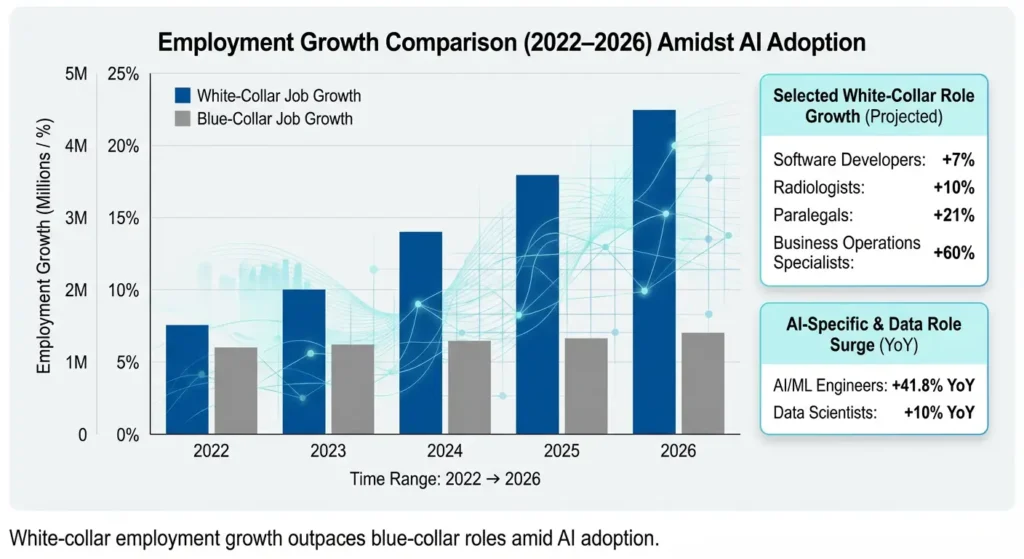
The new data on the labor market proves that despite the increasing pace of AI use, white-collar jobs are growing even more successful. The common assumptions about mass displacement are not based on facts. In late 2022, the U.S. experienced a net increment in white-collar jobs of about 3 million, but blue-collar jobs were generally not growing on a significant level.
Key highlights include:
Software Developers: +7% growth
Radiologists: +10% growth
Paralegals: +21% growth
Business Operations Specialists: +60% expansion.
The white-collar premium has also been enlarged with real wages in professional and office jobs on the increase. Inflation-adjusted wages of professional services increased by 5% and office and administrative jobs by 9% implying that white-collar jobs have increased by approximately 33% compared to those working in the blue collar jobs.
This growth is not being slowed down by the presence of AI. The number of job postings that mention AI has grown more than 130%+ since 2020 and is now 4.2% of all postings as of December 2025. To be more precise, data science-related positions, such as AI/ML engineering and analytics, are growing at a fast pace:
AI/ML Engineers: +41.8% YoY
Data Scientists: +10% YoY
This fact raises a major trend: AI is generating new high-value jobs, especially the ones that workers use technologies to multiply their production, but not to overtake it.
4. AI on the Task Level: Not Replacement but Augmentation
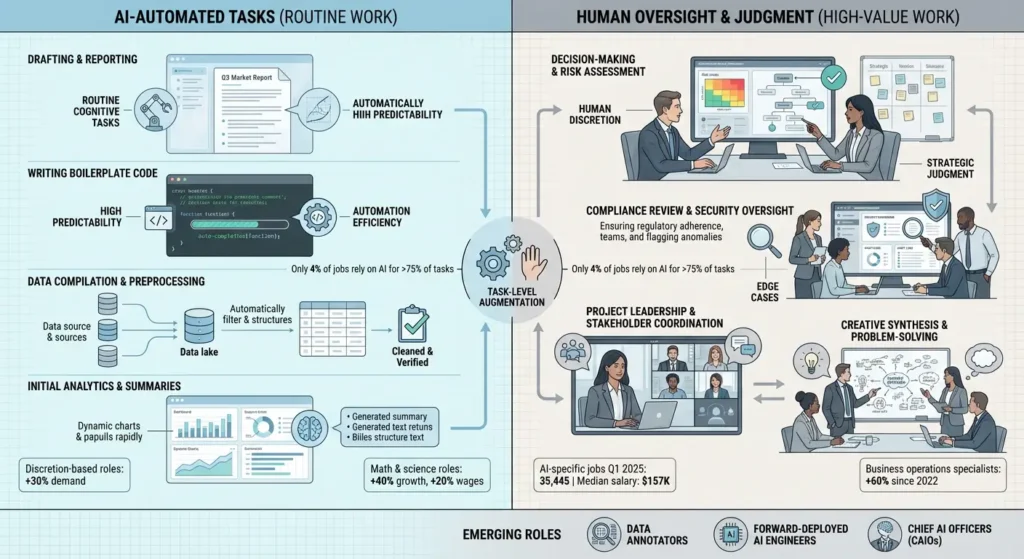
The actual scenario of AI in white-collar employment is task-level change, but not scale replacement. AI is very good at routine cognitive tasks, such as writing reports, writing boilerplate scripts, data compilation, or creating first-order analyses, but it has problems with edge cases, judgment, and human supervision.
According to recent statistics, this ratio is as follows:
There are only 4% of jobs that use AI to do over 75% of the work.
Demand for roles that involve human discretion increased by 30 percent such as project managers, information-security experts and compliance officers.
New forms of so-called cyborgs are taking off, which are a combination of AI capabilities and old skills:
Data Annotators
AI Engineers at the Front Line.
Chief AI Officers (CAIOs)
Occupations in other fields of mathematics and science have increased 40% and salaries have increased 20 percent, business operations specialists have increased 60 percent since 2022. In Q1 2025 alone, 35,445 AI-specific jobs were created, the median salary was USD 157K.
The World Economic Forum estimates creating 170 million additional jobs by 2030, which is compensated by approximately 92 million replacement. This is a definite trend: AI helps humans work more effectively by automating routine jobs, which allows professionals to make high value decisions, strategies, and innovations.
5. Who’s at Risk and How to Adapt
The effects of AI are not evenly spread, although white-collar jobs are being generated at a rapid pace. The knowledge of vulnerability and adaptation ability would be critical to both employees and employers.
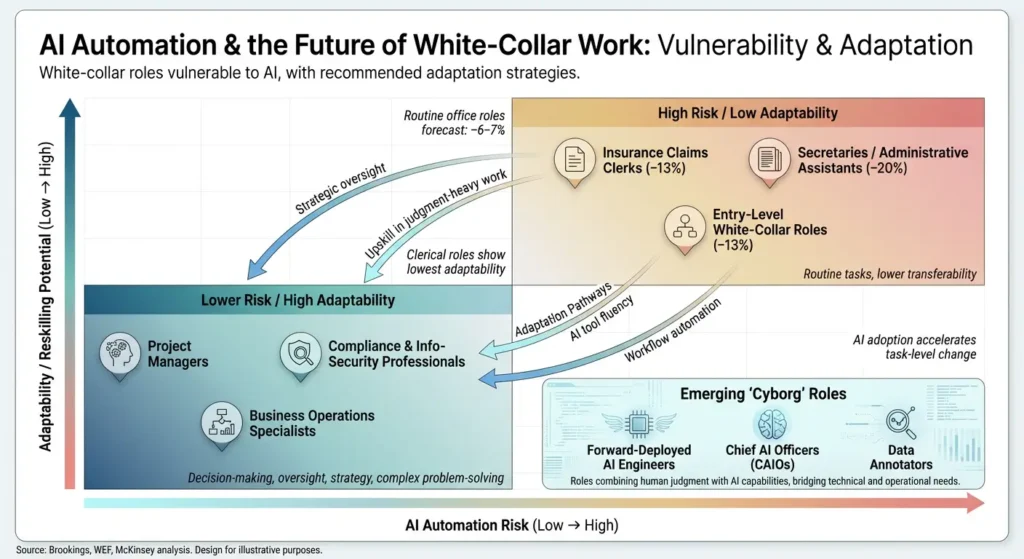
High-Risk Roles:
Insurance Claims Clerks: -13% since 2022.
Secretaries / Administrative Assistants: – 20%
White Collar (Entry-Level): -13% after adoption of LLLM (Stanford/ADP)
According to studies in the Centre of the Governance of AI, clerical and administrative employees, 80 percent of whom are women, are the least able to change with AI because they lack transferable skills. These observations are echoed by Brookings and Goldman Sachs who predict job losses of 6-7% in the U.S. in routine office jobs, which could be faster as more sophisticated autonomous AI code reading and agentic systems become more sophisticated.
Adaptation Strategies:
Upgrade in judgment-intensive sectors: Project management, strategy, human oversight.
Master AI tools: Knowledge of data analytics, platforms of AI integration, and workflow automation.
Shifting to new “cyborg” functions: Forward-deployed AI engineering, chief AI officers, and data annotation.
Live life long learning: Lifelong learning is continuous reskilling that makes one resilient towards task-level automation.
The moral of the story: AI does not kill all white-collar jobs- it transforms them. Human judgment and AI fluency are the key to success of those who proactively change and adapt.
6. Unlock High-Value Skills in 2026
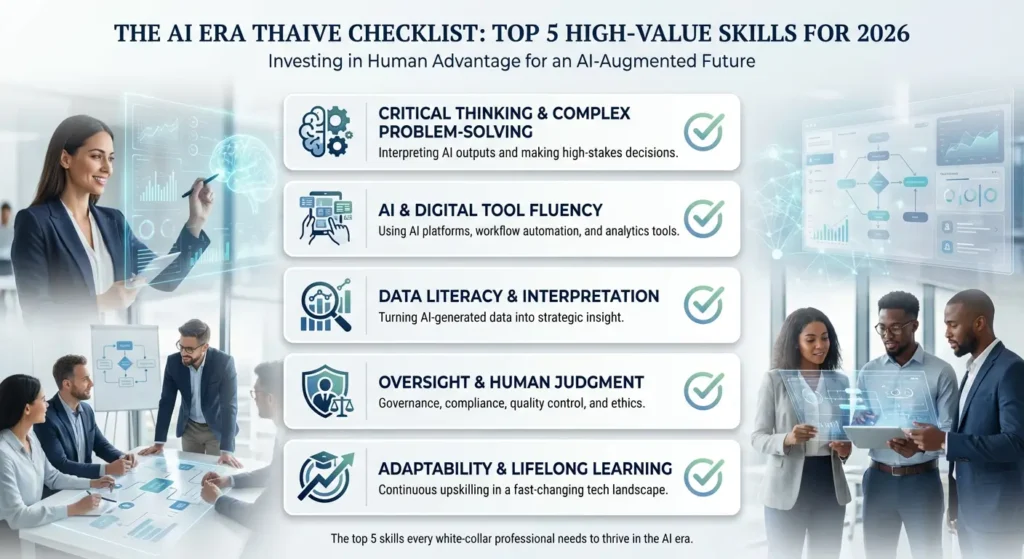
AI is transforming the nature of being a successful white-collar employee. In order to succeed in this new age, employees would need to concentrate on skills that would complement AI as opposed to competing with it. The most useful skills are focused on judgmental, creative, and adaptive skills.
Top 5 High-Value Skills for 2026:
Thinking Nuancedly and Solving Unusual Problems.
The insights made by AI need to be interpreted, put into context, and high-stakes decisions made by humans.
AI & Digital Tool Fluency
It is necessary to be familiar with AI platforms, workflow automation, and analytics software.
Forty-five percent of data-driven jobs demand the ability to use AI tools.
Information Literacy & Analysis.
Read, analyze, and act on AI-generated data is another strategy, finance, and operations differentiator.
Oversight & Human Judgment
Governance, quality control, compliance and ethics roles are ever-increasing. AI will never substitute a sophisticated decision-making.
Flexibility & Life Long learning.
The rapid technological transformation favours the people with the ability to constantly upgrade their skills and shift to new positions.
By investing in these abilities, employees will become so-called cyborg professionals, who can use AI to increase their effectiveness. Businesses will have a better and more efficient workforce, and individuals will have better pay, job security, and access to advanced positions.
7. Become a Cyborg Professional
AI is no longer a far-fetched dream it is taking a very active form in changing the workplace. The time to act is now. It is a combination of human judgment and AI capabilities which will ensure you have a secure spot, a higher value, and a place in the careers of tomorrow.
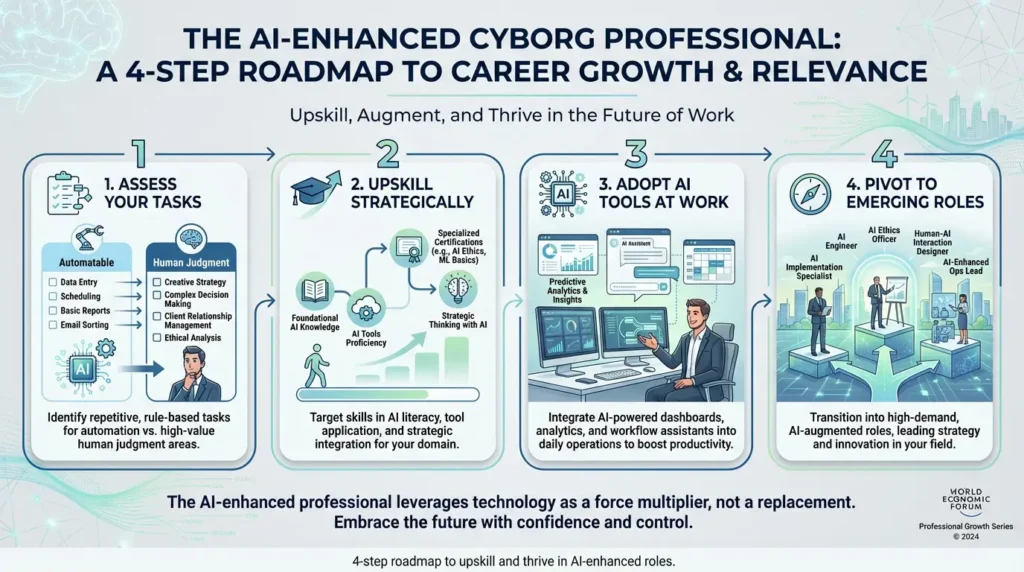
The 4-Step Roadmap to AI-Enhanced Success:
Assess Your Tasks
Determine what aspects of your job can be automated and which need to be human-judged.
Upskill Strategically
Centralize on critical thinking, AI, data literacy, supervision, and flexibility. Attend online courses, certifications, and practical projects.
Adopt AI Tools at Work
Combine AIs to analyze, report, and optimize workflow. Train to manage AI outputs as opposed to substituting.
Pivot to Emerging Roles
Investigate the frontier of AI engineering, chief AI officer jobs, and business application roles when AI enhances human knowledge.
Using such roadmap, you become a cyborg worker instead of a white-collar one, that is, one who uses AI to gain productivity, promote strategy, and become irreplaceable in the fast-changing labor market.
8. Conclusion
The white-collar jobs are not killed by the AI but rather brought to change and evolve. History, modern figures of labor production, and the analysis of work have a single outcome: the interest of jobs in which human judgment should be combined with machine effectiveness is increasing, but not disappearing. The professionals that do embrace AI will earn more money, skill strategically and move to new emerging professions as cyborgs and be more resilient in their careers.
It is clear to the companies that they should invest in the capabilities of their employees, consider AI carefully, and emphasize the human-AI interaction as the method to attain the most fruitful results in regard to productivity and creativity. At the individual level, the course of action is to as simple as to learn the best competencies: critical thinking, AI tools, data literacy, oversight and adaptability and be in the first line of the AI-enhanced work environment.
Work in the future is not a zero-sum game, the white-collar work. Human beings and AI can create a synergistic ecosystem through active adaptation, and use technology to expand human potential, create new opportunities and redefine 2026 and beyond professional success.
It does not get talent out of the way, it develops it. This is the era of the cyborg professional; this is the time to fill your niche.
9. FAQ
Q1: Is AI going to cause the disappearance of white-collar jobs?
No. AI has the task of automating mostly routine jobs in the mind but human beings still maintain control, decision making and creative work. A lot of new positions are being created, ranging forward-deployed AI engineers to chief AI officers.
Q2: Which white-collar positions are under the greatest attack?
The greatest exposure is to routine administrative functions and back-office functions, including insurance clerks (-13%), and secretaries (-20%). Also more resilient are jobs that involve discretion, judgment or intricate problem solving.
Q3: What are the skills that I need to learn to remain competitive?
Concentrate on critical thinking, fluency with AI tools, data literacy, oversight and flexibility. These are AI complements to augment your value in the new cyborg roles.
Q4: What is the speed at which the white-collar jobs will be affected by AI?
AI-related posts are up 130%+ since 2020, and agentic AI with the ability to perform autonomous activities is increasing at a swift pace. Those professionals who are flexible at this point will have an enormous edge.

Muhammad Asif is the Founder and Growth Engineer at WebNextSol, with 5 years of experience building AI-powered systems that help businesses save time, generate leads, and grow. He combines expertise in WordPress, automation, cloud architecture, and SEO to deliver practical, results-driven digital solutions.