1. Disrupting Trends in AI and Technology
In January 2026, there was a change in the global AI world but silently. As the Silicon Valley was in full fever developing the next so-called superintelligent closed-source AI, a team of Chinese laboratories came up with a breakthrough that has shaken the world of technology. The launch of DeepSeek AI R1 was an example of the fact that it is not only possible to see Chinese AI as competitive with systems of US origin but also make it more affordable, available and highly effective.
Over the years the story has portrayed China as a backwater-restricted by export regulations and restricted proprietary breakthroughs. That story is now obsolete. The Chinese AI systems such as DeepSeek and Qwen by Alibaba are growing to be the top system of choice among the large consumer platforms and business operations all over the world.
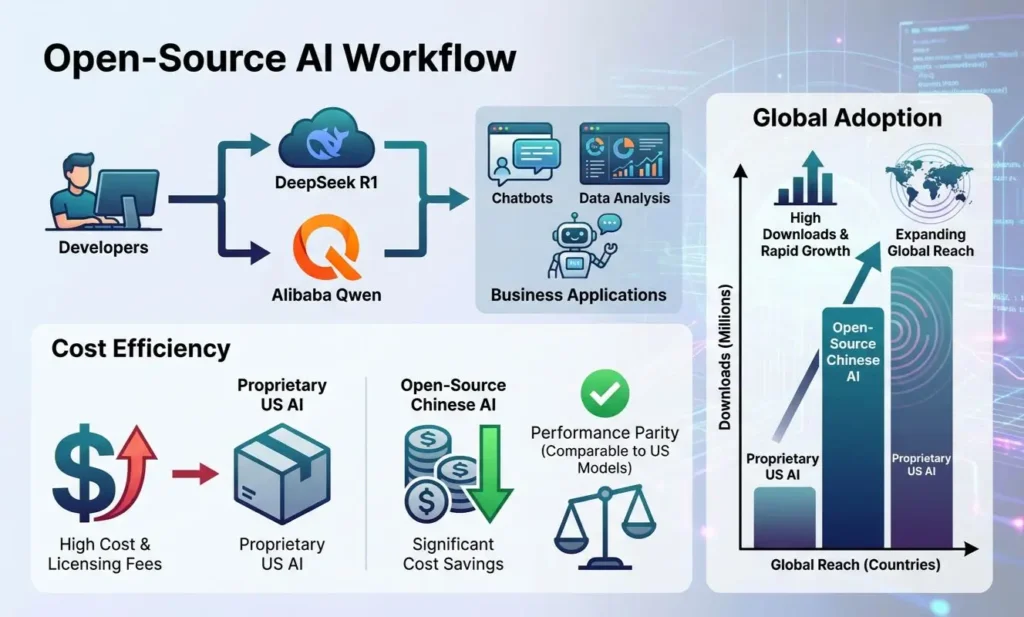
By December 2025, Qwen had more monthly downloads than the three combined of Meta, OpenAI and Mistral and marked a pivot towards the open-source and efficiency-focused AI. The developers and startups have now an easy decision to make: they can go with the costly and restrictive US APIs or they can go with the free and highly capable Chinese models they can put to deployment on their own.
It is not merely a news item, but a strategic turn in the AI race, a remaking of the architects and the setters of the future of artificial intelligence.
2. The changing nature of technology and business with AI
1. Open-Source Benefit: The New Infrastructure.
China does not merely have an advantage in AI, but in accessibility and openness. As US tech giants including OpenAI and Google grow more proprietary and closed, Chinese companies are adopting radical open-source practices, offering free or low-cost models to be customized and deployed by developers.
Cost Efficiency: Firms that use open-source Chinese models record colossal savings. According to Pinterest CTO Matt Madrigal, home-built models that are trained on open-source algorithms are 30 percent more precise and up to 90 percent more affordable than proprietary APIs in the US.
Performance Parity: Stanford University AI Index 2025 reports that the performance gap between the US models and the Chinese models has been essentially eliminated. Chinese models statistically equal Western models on such benchmarks as MMLU (general knowledge) and HumanEval (coding tasks).
The Fast Dot: The Qwen family in Alibaba had exceeded 1 billion cumulative downloads on Hugging Face by January 2026. By the month of December 2025 alone, Qwen recorded more monthly downloads than the sum of Meta, OpenAI and Mistral which would indicate widespread acceptance on the global scale.
2. Real-World Impact: US Giants are resorting to Chinese AI.
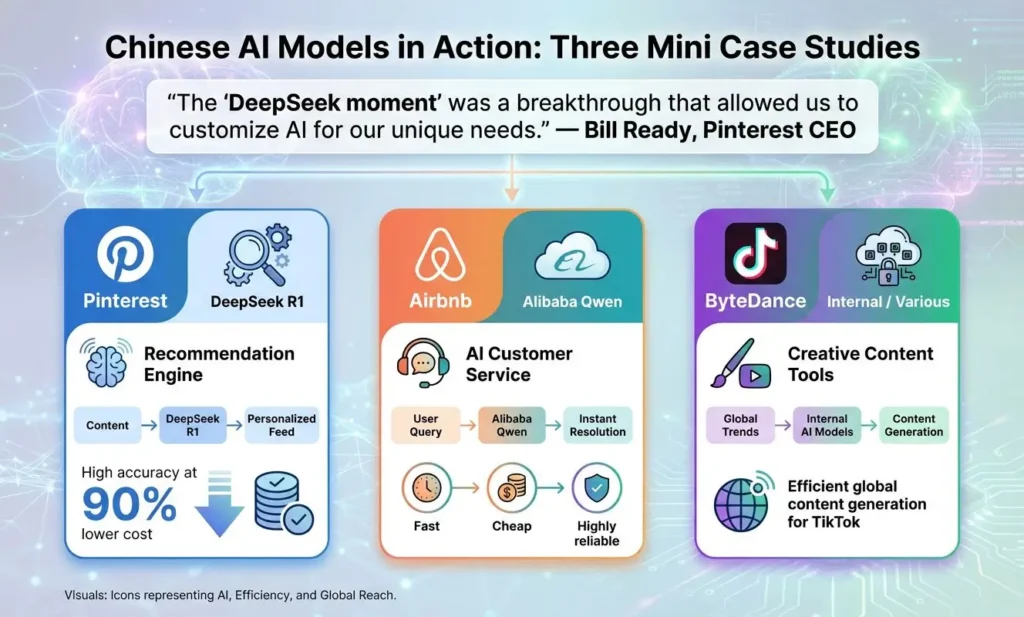
Chinese AI is no longer merely a hypothetical benefit it is actively implemented by Fortune 500 organizations in the US. Companies are incorporating models such as DeepSeek R1 and Alibaba Qwen into their business in order to address the triple threat of speed, quality and cost.
Mini Case Studies
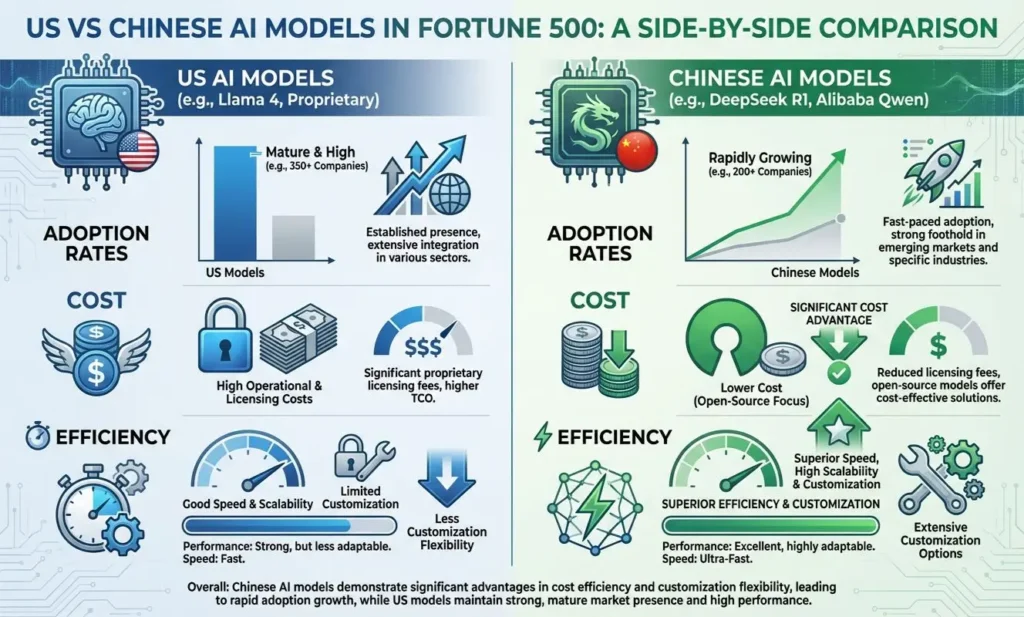
The practical change in the implementation of Chinese AI in such companies is reflected in the current emphasis: not only theoretical studies but the solutions that can bring tangible business outcomes are of interest.
3. Efficiency-Driven Innovation: Applicable Benefits.
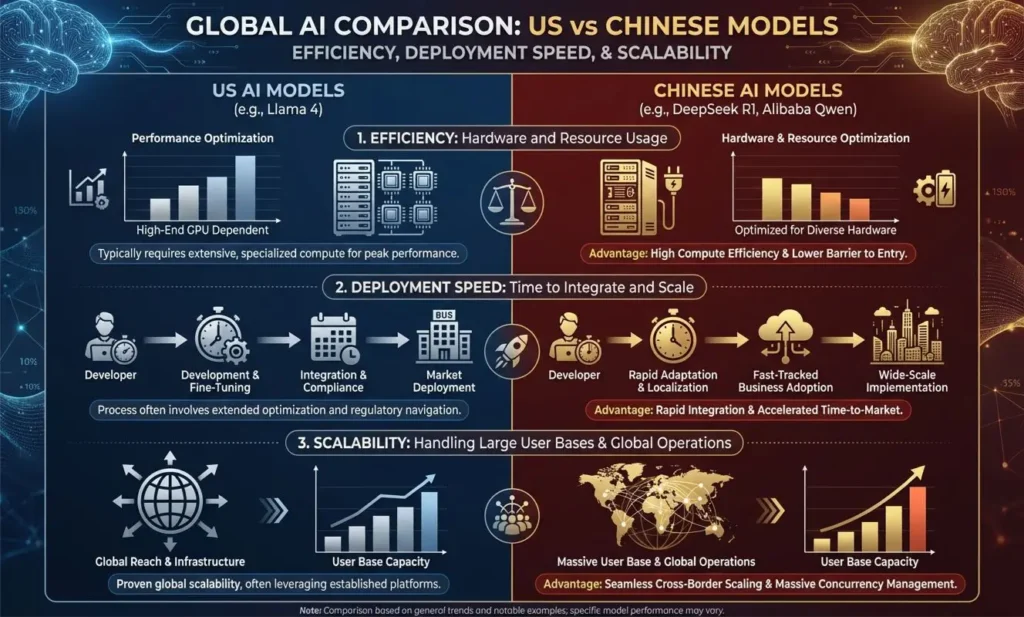
The Chinese strategy presupposes objective, short-term applications of AI. US companies are concerned about AGI (Artificial General Intelligence), an intellectual endeavor to enable human-like reasoning, whereas China has been more interested in good-enough models that can be executed on fewer chips, use less energy, and can be scaled.
The advantages of AI driven by efficiency include:
Less Operational Expenses: The lowered power and hardware needs make implementation affordable to new companies and mid-sized companies.
Quicker Development: Open-source models enable companies to customize and train AI to suit its requirements within a short amount of time.
Scalability: Chinese AI models are global deployment optimized models that are best suited to those companies that are venturing internationally.
Mini Example: Pinterest added DeepSeek R1 on its recommendation engine. In this way, they not only attained high accuracy but at a fraction of the cost of the conventional US models, but they could scale quickly without spending more on infrastructure. Likewise, Qwen enabled Airbnb to respond faster to customer service, with the addition of AI technology, and lessens the use of costly US APIs.
4. Tactical Change: Short-term vs. Long-term AI Objectives.
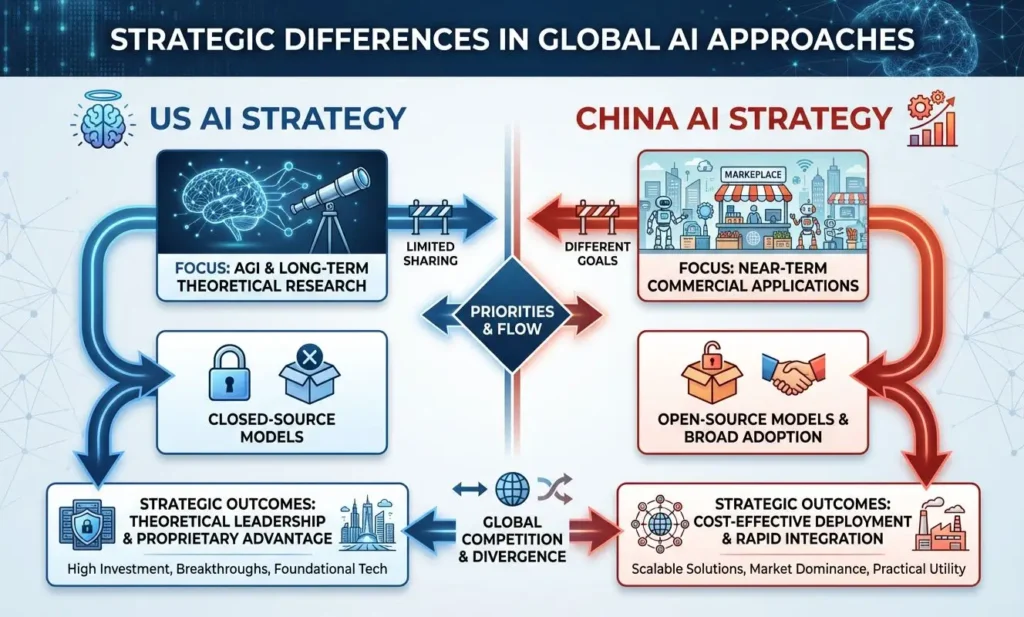
There has arisen a philosophical difference between the US and China in the AI strategy:
United States: AGI-oriented, long-term theoretical work, closed-source proprietary models.
China: Oriented towards commercial short term applications, open source frameworks and wide usage.
To startups and multinational organizations, the choice is simple: spend money on costly, limited, US-based APIs or various open-source Chinese alternatives that can be deployed and modified without relying on third-party services.
The trend of Chinese approach has succeeded in commoditising AI to enable powerful models to be available to both small and big businesses. Chinese AI is making innovation in practical uses of artificial intelligence go faster, whether that is content creation or customer service or recommendation systems.
3. Opening up Opportunities with AI.
The emergence of Chinese open-source AI is becoming a real benefit to businesses and startups that want to grow effectively. Relying on such models as DeepSeek R1 and Alibaba Qwen allows companies to pay less and create faster as well as tailor AI to their own requirements.
Practical Benefits:
Cost Effectiveness: Implement highly effective AI at a small percentage compared to US proprietary APIs.
Customization: Adapt models to particular business processes either content generation, recommendation engines or customer service.
Speed: Rapid iteration enables businesses to innovate without bottlenecks in the infrastructure.
International Scalability: Open-source models are designed with international usage in mind, which makes them suitable to startups that can widen their operations internationally.
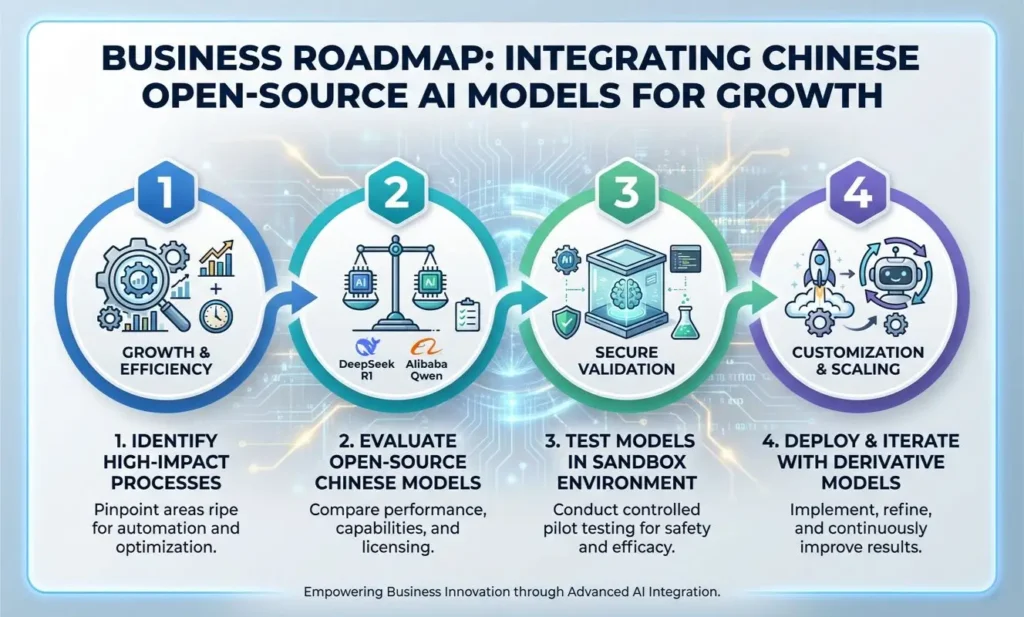
Business Action Plan:
Determine the high impact processes that could be used with AI.
Test open Chinese models such as DeepSeek R1 and Qwen.
Test in a sandbox environment to optimize performance.
Deploy and repeat, building your own models which are more specific to your workflow.
The DeepSeek moment is not just a technical breakthrough but it represents a worldwide turn in the use of AI. The companies using Chinese open-source solutions such as DeepSeek R1 and Alibaba Qwen are getting cost, speed, and scalability advantage.
4. Key Takeaways
Chinese AI is an open source that has been widely embraced worldwide.
Practical effects of the integration can be seen in real-life applications by such companies as Pinterest, Airbnb, and ByteDance.
Customizable AI solutions are now readily available to startups and enterprises that will eliminate the reliance on costly US APIs.
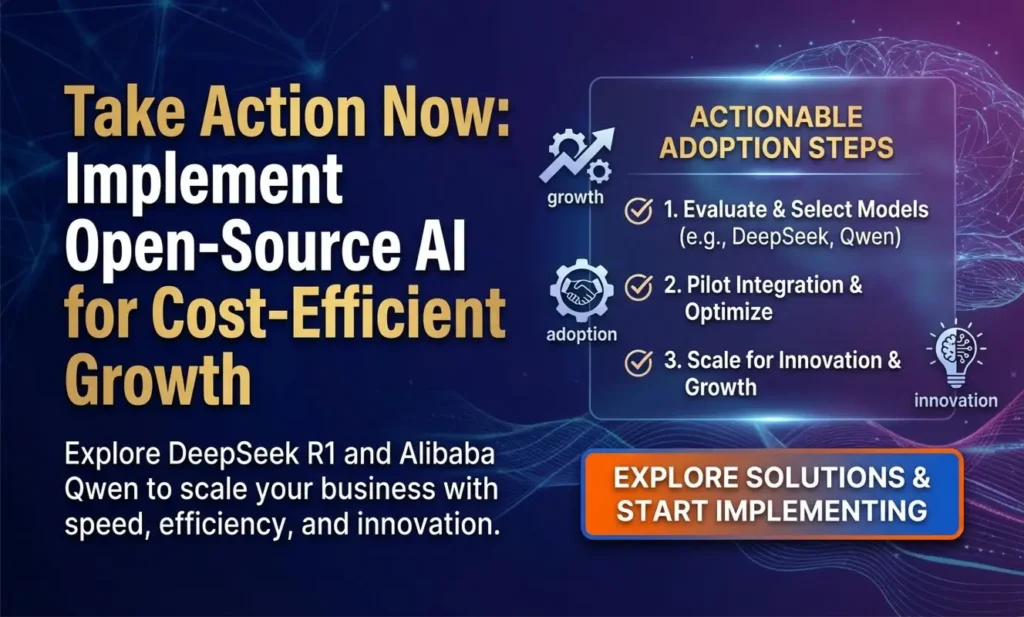
Next Steps: Assess the opportunities of Chinese AI in improving your business processes, experiment, and begin developing personalized solutions in the present day.
5. FAQs About the Global AI Race
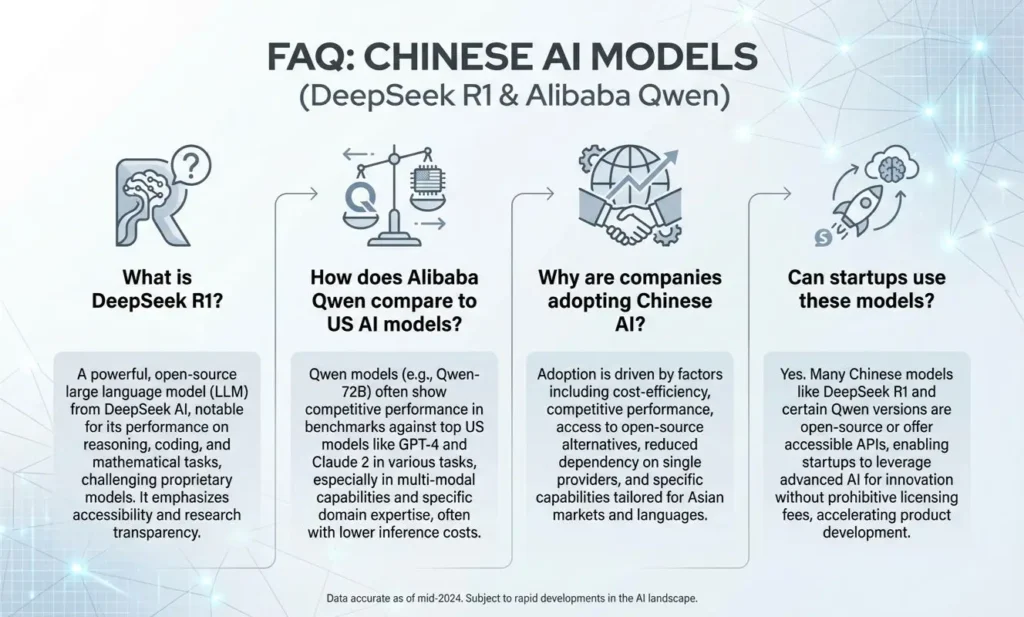
Q1: What is DeepSeek R1?
DeepSeek R1 is a Chinese open source AI model released in 2025, which provides good performance, is cost effective, and is widely accessible by businesses and developers.
Q2: What is the comparison of Alibaba Qwen with the US models of AI?
Qwen is similar to the US models such as Llama 4, while being more affordable, more customizable, and more proliferated across the world.
Q3: What is the reason to embrace Chinese AI within companies?
Firms enjoy reduced costs, expedited deployment and scalable solutions that can be applied to realistic business activities.
Q4: Are these models applicable when starting up?
Yes. Chinese AI based on open-source is most suitable to start-ups because it offers the opportunity to experiment and use derived models without the need to invest heavily in infrastructure.

Muhammad Asif is the Founder and Growth Engineer at WebNextSol, with 5 years of experience building AI-powered systems that help businesses save time, generate leads, and grow. He combines expertise in WordPress, automation, cloud architecture, and SEO to deliver practical, results-driven digital solutions.