Table of Contents
Introduction
The world banking environment is changing at a fast pace. Fintech innovations, artificial intelligence, and digital payment systems are transforming the manner in which money is transferred, the way banks operate business and the relationship that customers have with financial institutions. The traditional banking system is being strained as customers and companies seek faster, smooth and secure banking services. Central banks have to change in this high-speed world. The Qatar Central Bank fintech strategy shows how regulators can be innovative, modernize their infrastructure, and avoid structural gaps that sluggish capital flows and markets fragmentation.
Though urgent, more than 100 central banks across the globe do not have instant payment systems, and many economies are still way behind in the implementation of digital finance. This sluggishness does not only decrease efficiency but also narrows the chances of financial inclusion, economic growth and innovation powered by fintech. The non-modernized countries will have a slow market transaction and increased operational friction, which might impede their economy competitiveness in general.
The Qatar Central Bank (QCB) is at the frontline in dealing with such challenges. QCB has also been proactive under the command of Sheikh Bandar bin Mohammed bin Saoud Al-Thani by being both a regulator and an enabler. The Fawran instant payment system, and the AI governance regulations facilitate the fast movement of capital, and the extensive implementation of intelligent systems is safe and transparent. The regulatory sandbox promotes the innovation of fintech without endangering the stability of the markets, and the active prevention of fraud and education of consumers protect consumers. Together, these pillars indicate the efforts of Qatar to maintain the stability of the market and technological development that would be an example to other economies.
1. Digital re payment Revolution – Fawran.
The Fawran instant payment system is one of the most radical projects that the Qatar Central Bank has initiated with an aim of enhancing the speed with which capital moves in the Qatari economy. Fawran unlike the conventional transfer system where it might take hours, even days, to transfer money, Fawran makes transactions instantaneous as the senders and receivers can have their money transferred in a few seconds. This live system is a game changer when it comes to business and consumer efficiency as it shortens the time taken by businesses to pay their employees, suppliers and even in their daily business transactions.
One of the innovations of Fawran is the easy to identify system. Rather than using a complex international bank account number (IBAN) to transfer funds, users are given an opportunity to send or receive money with mobile numbers, email address, or personalized nicknames. This makes it easier to digital payments by simplifying the process of making payments to daily users and small businesses and even those less well known with conventional banking systems can now do so.
The economic effect is tremendously high. Rapid money circulation increases the dynamism of the market, which promotes faster business cycles and more effective allocation of funds, and Fawran contributes to this matter. Another benefit of the system is the promotion of the digital adoption, which will place Qatar at the forefront of the modern banking infrastructure in the region.
Mini Case Study: A small Qatari online shopping company used Fawran to facilitate the payments to its suppliers. In the past, it used to require one to two business days to complete a transaction which delayed inventory. With the adoption of Fawran, the payments were made immediately, and the business could hold the best stock levels, decrease operational bottlenecks, and enhance customer satisfaction.
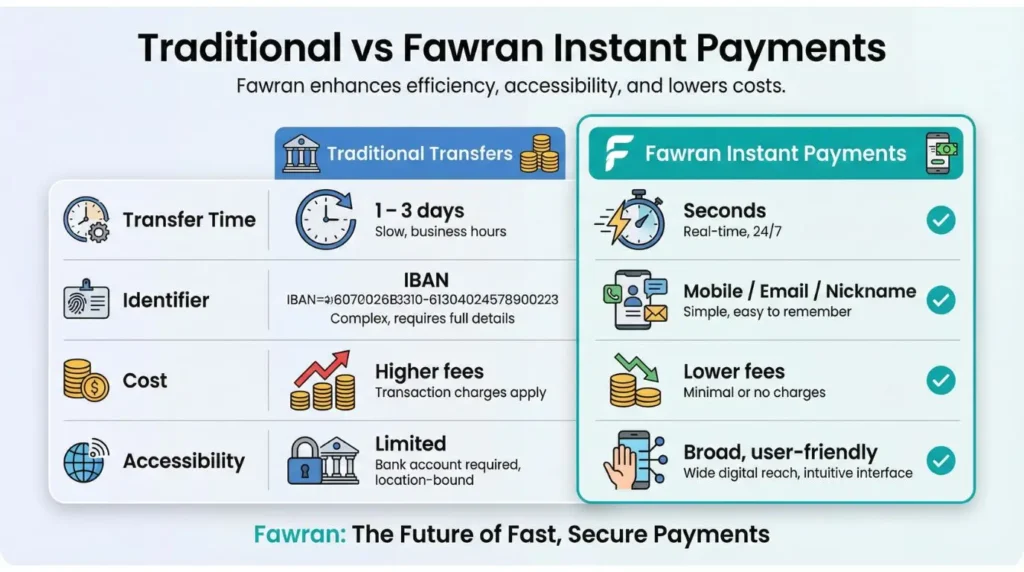
An example of how the innovation of digital payments can boost efficiency, make accessibility more favorable, and support the larger economy is Fawran.
2 Artificial Intelligence Regulation and Governance.
The financial industry is changing as artificial intelligence can provide banks with opportunities to improve consumer experiences, automate functions, and increase profit. Nevertheless, there are also new risks associated with the rapid adoption of AI, such as data breaches and lack of transparency of the decision-making process. Having identified these challenges, the Qatar Central Bank (QCB) published its 2025 AI Guidelines, which are aimed at making sure that AI is used safely, in an ethical and transparent manner throughout the financial ecosystem.
The main focus of QCB is data protection. The banks are required to manage information of their customers in the most secure way such that the privacy remains intact but at the same time not violating the national and international laws. Along with it, there is a robust risk management framework needed, which implies board-level oversight of AI systems and formal records of the AI implementation and use. This makes the decision-makers responsible both in terms of operational and ethical results.
Auditability and transparency is another important pillar. Artificial intelligence systems should not be black-box systems, but also present explainable and traceable outputs. This will enable the regulators, auditors, and customers to know how decisions, like credit approvals, fraud detection, or investment recommendations are taken, which can minimise the chances of making silent mistakes or biases.
Case study: One of the biggest banks in Qatar had introduced AI recommendations provided by QCB which meant the introduction of a centralized AI compliance dashboard. All decisions made by AI, such as automated loan approvals, customer risk scoring, and so on, are tracked and recorded. There are notifications that are raised in the case of anomalies in the data or system malfunctions, and regular meetings with the board make the board review ensure continuity and responsibility. Such a proactive solution helps to eliminate regulatory risk, as well as to enhance customer confidence.
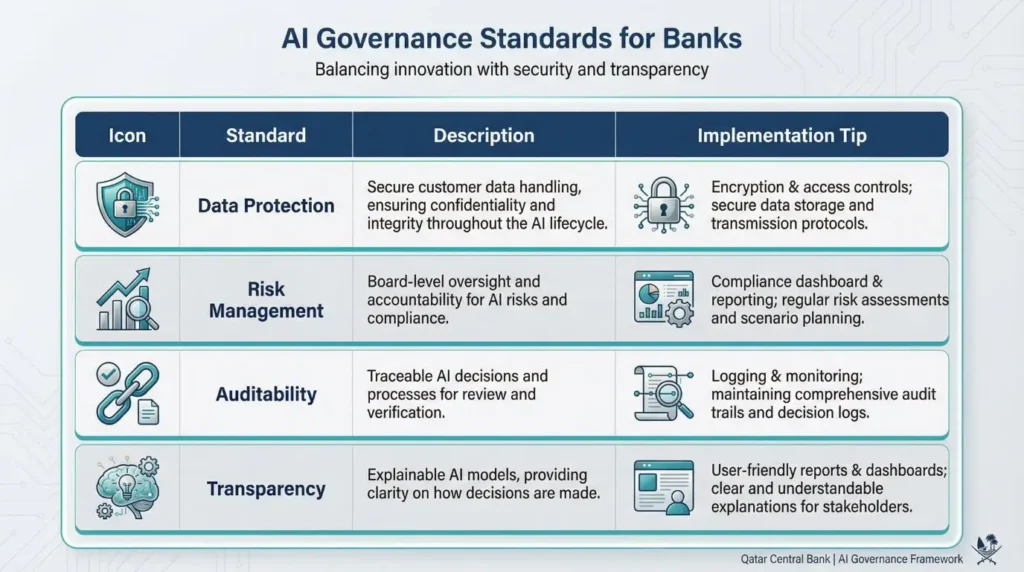
Together with these actions, the AI governance framework in Qatar yields a balanced approach to innovation and security, where the banks will utilize a higher level of technologies in a responsible way without harming the customers or change the market.
3 Regulatory Sandbox Approach.
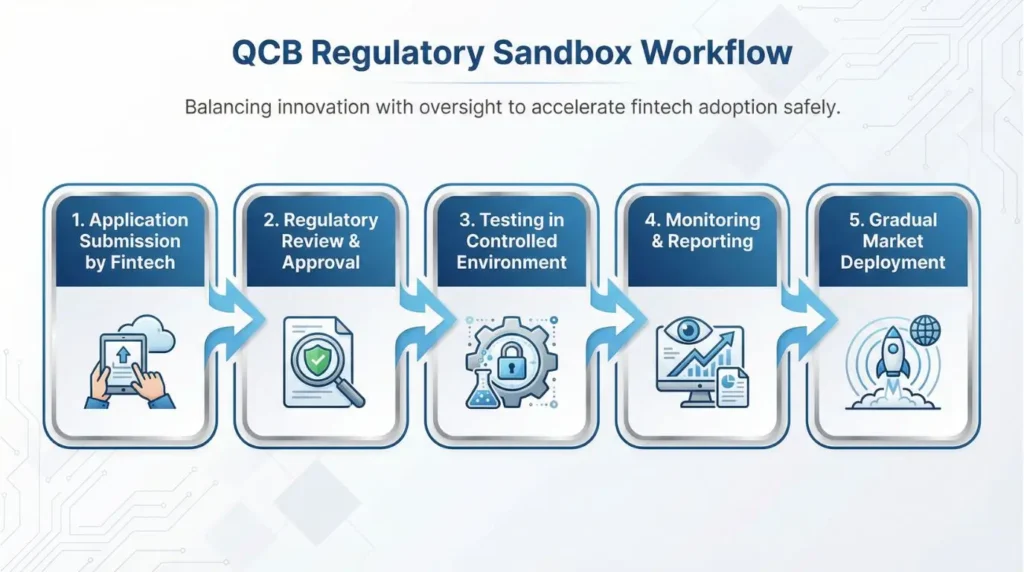
Financial technological innovation tends to outpaced regulation. In order to fill this gap, the Qatar Central Bank (QCB) has implemented a regulatory sandbox concept, which is aimed at allowing fintech-related companies to build and experiment with new offerings in a safe, controlled environment. This framework enables innovators to experiment without jeopardizing the stability of the system, which makes it a responsible entry of new technologies in the market.
One of the most important aspects of the sandbox is that startups and traditional banks collaborate with each other. Through collaboration, fintechs have access to industry-level expertise and operational infrastructure, and the banks receive exposure to innovative approaches to development and agile models. This collaboration minimizes new technology resistance towards regulatory systems.
The sandbox also offers secure testing conditions which simulates the real market conditions to determine the performance of products, security, and compliance. Possible problems can be detected and addressed by developers before massive implementation, and the risk exposed to both clients and economic platform is reduced.
Examples A Qatari fintech focused on digital lending used the sandbox to test its AI-based credit scoring platform. The testing environment that is controlled enabled the firm to test the accuracy and fairness of the algorithms and get advice of the QCB regulators. The product became commercial after the test phase and the product has made lending into loans faster and more accessible to the customers.
4 Mitigation and Education of Frauds.
With the growth of digital banking and the use of fintech, the threat of cybercrime and fraud also grows. With AI-based frauds and phishing, as well as deepfakes, the current financial ecosystem has new challenges, which will need active initiatives. The Qatar Central Bank (QCB) is aware that protecting customers and ensuring trust in the market is equally crucial to the encouragement of innovation.
In order to mitigate such risks, QCB focuses on dynamic regulation, which constantly changes the rules in the market in order to counter new methods of fraud. This guarantees that the banks and fintechs will be able to work within a safe environment without falling behind the technological risks.
In addition to regulation, QCB encourages corporate and non-corporate awareness campaigns. The banks should be motivated to undertake an annual customer education program whereby they educate their clients on the prevalent scams, secure digital practices, and how to report any suspicious activities. At the same time, the awareness among wider audiences is caused by national promotion by the regulator, which strengthens the need to be more cautious in a digital economy.
Case example: A major Qatari bank annually conducts interactive workshops and online tutorials with their customers on how to recognize fraud emails, check the authenticity of the transaction, and keep their financial information safe. Such efforts have minimized cases of fraud that are being reported, and ensured that more customers trust digital banking platforms.
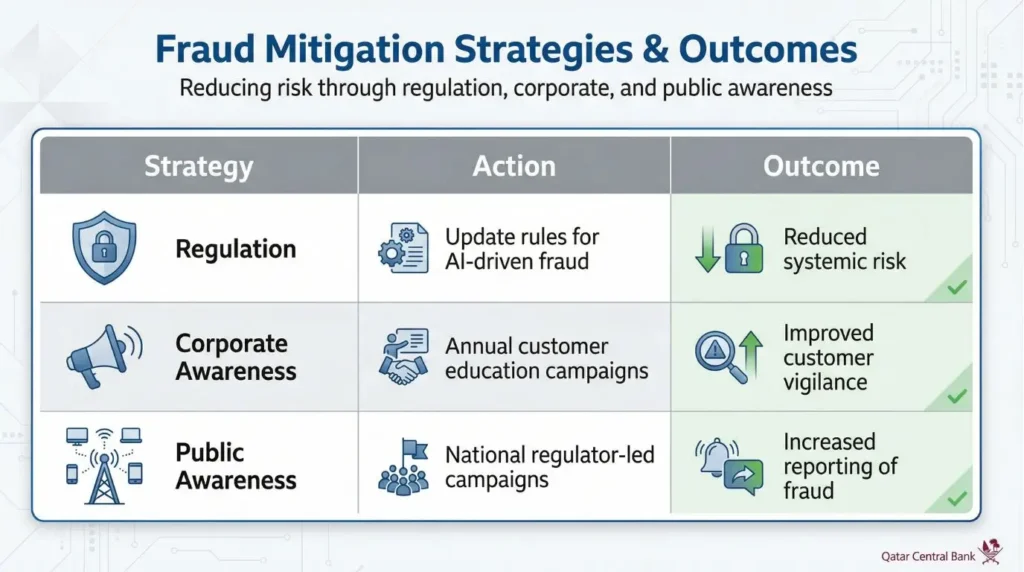
Qatar is reducing risk of fraud through a combination of control, education and active awareness and providing a safe and reliable digital banking environment.
5 Strategic Environment – Qatar National Vision 2030.
Digital banking programs in Qatar are in tandem with the Qatar National Vision 2030 that focuses on the diversification of the economy, innovation and leadership in the field of Islamic banking across the globe. High-tech infrastructure, such as 5G coverage throughout the country and close access to broadband, is the basis of the development of fintech and digital uptake.
Case in point: A number of Qatari banks now provide Shariah-compliant robo-advisory services, which is a combination of AI-initiated investment strategies with the principles of Islamic finance. This will not only expand the distribution of advanced financial services but also make Qatar a regional centre of ethical and technologically advanced financial services, which is aligned to the long-term strategic ambitions of Vision 2030.
6 Implementation Guide/ Step-by-Step.
The lessons of the progressive thinking of the Qatar Central Bank may be applied to the work of financial institutions and fintech innovators to make their processes more efficient, secure, and innovative. Take the following steps:
1. Take advantage of the Instant Payment Systems.
Include systems such as Fawran in the day to day activities to facilitate real time transactions. Result: The acceleration of capital flow, cash management, and customer satisfaction.
2. Implement AI Governance
Implement all-inclusive AI compliance models such as data security, risk handling, and board supervision. Result: AI-based decisions made in a secure and transparent manner, which earns customer trust and regulatory trust.
3. Interact with Regulatory Sandboxes.
Test the new fintech products in a controlled sandbox. Co-operate with the established banks and regulators in order to verify performance and compliance. Result: Low risk with lower risk in the market and fast-tracked products.
4. Create Fraud Prevention and Customer Training Initiatives.
Conduct annual anti-fraud education campaigns to customers and update the anti-fraud policies on a regular basis. Effect: Fewer cases of frauds, increased awareness, and increased confidence of the population in digital services.
5. Align with Strategic Goals
Make sure that all efforts are geared toward larger goals, like the leadership of the Islamic finance and the use of digital infrastructure according to the Qatar National Vision 2030. Deliverable: Financial services that are future-proofed, regional recognition, and long-term sustainability.
Through this roadmap, institutions will be able to strike a balance between innovation and stability, and record tangible gains in effectiveness, safety and customer interaction.
7 Best Practices, Tools and tips.
Financial institutions, as well as regulators, ought to pursue practical approaches and use the appropriate tools to maximize the benefits of digital payments, AI governance, and fintech innovation:
Best Practices:
Be transparent in AI systems and decision-making.
Regular internal audits to comply with the rules and identify weaknesses.
Conduct customer and public awareness campaigns to create user awareness of fraud prevention and responsible internet behaviors.
Encourage cross-banking and fintech startups to make the best innovations in a responsible way.
Recommended Tools:
AI Compliance Platforms: Governance and risk management living systems Monitor, audit, and document AI systems.
Digital Payment Integration Solutions: Provide an immediate and safe transaction through many channels.
Fraud Detection and risk analytics tools: Discover the presence of suspicious transactions and prevent the arising threats.
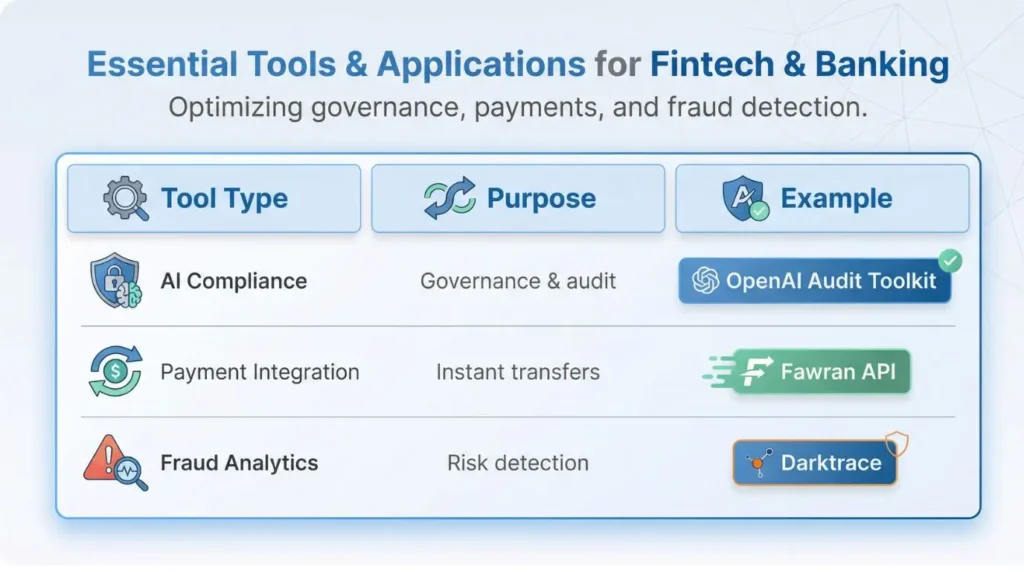
Such practices and tools assist institutions to innovate and at the same time to maintain a balance between innovation and security, thereby ensuring sustainable growth and trust.
8. Conclusion
The strategy of Qatar Central Bank has four main pillars, including Fawran instant payments, AI governance, regulatory sandbox testing, and fraud mitigation through customer education. The combination that they form is an efficient, secure, and friendly innovation financial ecosystem. Banks and fintechs are able to make transactions faster, embrace AI with responsible practices, introduce new products without risks, as well as secure customers against the emergent threats.
Next Steps: Use the following strategies in your organization, consider being a member of the QCB sandbox where fintech innovations can take place safely, or use the QCB resources to make sure your work processes and compliance are more efficient. The action will allow organizations to future-proof their operations as well as provide a stable and forward-looking financial market.
FAQ
Q1: What is the working of Fawran instant payment system?
It also enables real-time transfer in real time, with the help of mobile numbers, emails or nicknames-no IBAN is needed-and thus enhances speed and capital flow.
Question 2: What is the compliance requirement of AI regulation?
The QCB guidelines that banks need to adhere to include data protection, oversight at the board level, risk management, and auditability of AI systems.
Q3: What are the ways that fintechs can be included in the sandbox?
Applications need to be submitted, products are undergo regulatory scrutiny before testing in a controlled setting after which they are scaled once approved.
Q4: What are the recommendations of fraud mitigation measures?
The frequent revision of the anti-fraud policies, the education of the customers, and the campaigns aimed at national awareness are the secure digital operations.
Q5: What is the significance of the approach?
It is a middle ground between innovation and market stability that establishes a secure, effective, and progressive financial ecosystem.

Muhammad Asif is the Founder and Growth Engineer at WebNextSol, with 5 years of experience building AI-powered systems that help businesses save time, generate leads, and grow. He combines expertise in WordPress, automation, cloud architecture, and SEO to deliver practical, results-driven digital solutions.