Table of Contents
1. Context and Problem Definition
Voice AI Customer Service: is changing how organizations respond to major challenges, where most of them are not sure about the response time, scalability, and consistency. The non-technological support processes are very dependent on the human factor, which causes the bottlenecks in times of peak demand and uneven customer experience. Microsoft also says that 59 percent of customers will use automated solutions to make basic inquiries.
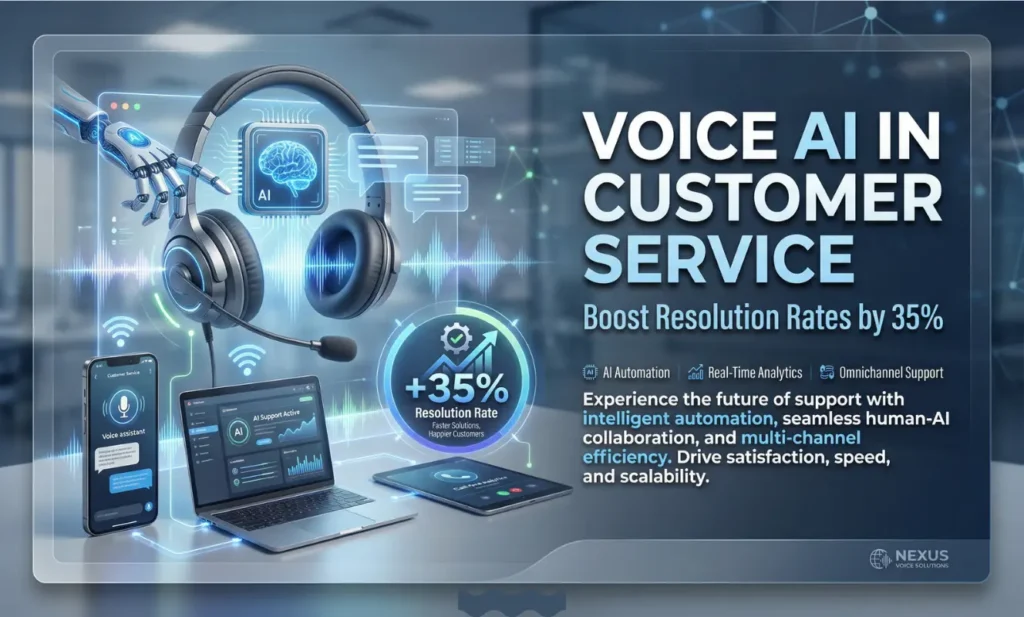
Voice AI is a disruptive solution. Through combining natural language processing (NLP) and conversational AI, companies can automate regular calls and offer 24/7 services and direct more intricate questions. There are reports of up to 35 percent faster resolution time and 20–25 percent lower operating expenses among those who have already adopted it. Efficiency is not the only driver of this shift; consumer expectations also play a significant role, as customers increasingly demand instant, human-like responses, making the use of voice AI a strategic necessity.
2. The Importance of This (Business Impact)
Voice AI has effects on organizations on financial, operational, and customer satisfaction metrics:
Cost Efficiency: A 25–30 percent reduction in the workload of the agents translates to high cost savings.
Quick Resolving: Artificial intelligence and automated routing reduce processing time by a third.
Customer Retention: Customized AI communications will raise NPS scores by 10-15 points.
Scalability: Can accommodate a burst without new personnel, thus increasing operational resilience.
Monitoring AI adoption in terms of call resolution time, customer satisfaction (CSAT), and agent efficiency allows for ROI measurement.
3. High-Level Framework (Core Model)
VOICE Framework Customer Service AI Implementation
V – Voice Data Integration: Gather customer interaction information to train AI.
O – Optimization Algorithms: Use NLP and sentiment analysis to enhance the accuracy of the response. I – Intelligent Routing: Automate human agent escalation on demand.
C – Continuous Learning: Rewrite scripts and interactions with AI analytics.
E-Evaluation and Metrics: Monitor KPIs in terms of resolution time, CSAT, and cost savings.
Benchmark Data: Firms that employ this model achieve 25-30% operational savings and 15-20% customer satisfaction improvements in 12 months.
4. Key Points and Strategies
Automated Call Handling
Voice AI helps companies to replace the common, tier-1 customer queries with automation, allowing human agents to pay more attention to more complicated and valuable processes. One of the most urgent issues in customer service, which will be solved with the help of such automation, is the situation when the demand to call is high at the busiest times. When implemented, the wait times can be cut by a large margin, and the organization’s operation efficiency can be enhanced through the deployment of AI-driven voice solutions.
Sample: One of the largest telecommunication companies introduced Voice AI to handle billing requests, confirm payments, and answer general account-related queries. Consequently, human calls decreased by 40%, and support teams were now available to attend to technical problems and complicated troubleshooting. Not only did such automation enhance the time taken to respond, but it also lowered the burnout and turnover of the agents.
Statistical Support: Juniper Research (2023) found that by 2025, AI will be able to process 30 percent of the total customer service calls in the world, indicating the speed of automated voice systems adoption and functionality. Automation of the daily dealings will allow them to have quicker resolutions and still ensure that the quality of service remains the same.
Sentiment-Driven Responses Further voice AI has now been enhanced to include sentiment analysis to decode tone, emotion, and intent in real time. Knowing how the customers are emotionally feeling, AI can provide dynamically changing responses, de-escalate frustration and create more personalized interactions. This is a strategy that will enhance customer loyalty and minimize the chances of abuse of experiences.
Workflow Sample: In e-commerce, the support bots with sentiment analysis can recognize indicators of customer frustration, e.g. repetitive questions or high tones of voice, and automatically redirect the conversation to a human agent or modify the reaction of AI. This proactive management increased customer satisfaction (CSAT) scores by 12 and also decreased repeat contacts over the same issue.
Using sentiment-based AI helps organizations reduce repeat calls by 15 percent and greatly improve the chances of solving issues on the first call. The inclusion of sentiment analysis enhances AI communication, making it both efficient and empathetic, as it supports customers in a manner that aligns with contemporary expectations.
Customers today can have more than one interaction with businesses: phone, chat, social media, and virtual assistants. The actual potential of voice AI lies in its use in an overall omnichannel support system, where all platforms are able to offer consistent and high-quality experiences.
Multi-Channel Integration
Framework Case Study: Major banks have implemented omnichannel Voice AI to bridge the phone calls, mobile apps, and web chat. The outcome was a 20 percent rise in customer interaction, quicker response to queries, and enhanced customer satisfaction. Connecting all channels with the help of AI, organizations must ensure that the history of customers, their preferences, and previous interactions can be observed in real time, which will provide a consistent and individual experience across the touchpoints.
Utility Commercial Rhyme: Solutions such as Google Cloud Contact Center AI and Amazon Connect offer solid options for integrating voice and channels of choice, device-based insights, artificial intelligence-infused call routing, and flawless platform interoperability. These technologies help to provide the complete scalability of an enterprise with a high level of reliability and performance.
5. Strategic Takeaways
Call handling in an automated way will lessen the burden on operations, enhance efficiency, and make the human agents concentrate on high-value activities.
Emotional reactions contribute to enhancing customer experience, loyalty, and first-call resolution as well as minimizing repeated calls.
Multi-channel incorporation provides coherence in the support of touch points thereby increasing interaction, customization, and customer loyalty.
These actions make customer service more efficient, focused on data and customers, and able to grow, while also showing clear returns on investment by reducing costs, speeding up processes, and improving customer satisfaction.
6. Stepwise Implementation / Use Cases
Step 1 – Audit Customer Interactions.
In order to implement the Voice AI, the initial step is to perform an audit of all interactions with customers. This will entail picking up past call recordings, chat logs, and CRM transcripts to know the nature of queries that are most commonly being asked by the customers. These recordings are transcribed on the basis of speech-to-text software and can be analyzed on a scale.
Situation: A retail firm examined one year of calls to its customer services and found that 50 frequently asked questions contributed to 70 percent of all agent calls. By determining these high-volume inquiries, the business can be able to focus on automation opportunities in the most effective manner.
KPI: Track the proportion of automated calls, as this measurement will serve as the basis for potential efficiency enhancements. Organizations typically identify during this initial assessment that they can completely automate 20-40 percent of the interactions, resulting in immediate resource optimization.
Step 2 – Implement Voice AI
The implementation of AI-based applications, such as interactive voice response (IVR) and chatbots, should follow the audit process. These applications use natural language processing (NLP) to comprehend and act on common customer queries in real time.
Tools: The most popular ones are Google Dialogflow, Amazon Lex, and Microsoft Azure Bot Services that can be easily integrated with current CRM tools and can be deployed quickly.
Scenario: AI can be applied in the e-commerce world, where answering queries such as order status, delivery or password resets may be done without the need to engage a human. The automation of repetitive tasks relieves the agents from the burden of handling complex or sensitive issues.
Step 3 – Monitor & Optimize
KPI: Within the three responses, the workloads of the agents can be decreased by 20-35 percent in the first three months of AI implementation, which is directly translated into the decrease in operational costs and service stability.
The voice AI implementation is not a one-time project. During monitoring and optimization, there should be continuous monitoring and optimization to make it accurate and relevant. Analytics dashboards and sentiment analysis engines can assist businesses in monitoring AI performance and identify gaps and refining response workflows.
A telecommunication service provider had realized that the call routing processes used to change accounts were committing the same errors. The system was also changed to recognize more complex queries and escalate them by reviewing AI logs. Another consequence of the sentiment analysis was also the identification of frustrated callers, which triggered human intervention on the front line.
KPI: Key performance indices will be the decrease in the average handling time (AHT), better first-call resolution, and an increase in CSAT scores. Continuous and data-driven optimization tends to improve satisfaction in companies by 10-15%.
Step 4 – Scale Across Channels
The last action is the growth of the voice AI capabilities to facilitate the omnichannel experience. Customers are now demanding a harmonious flow of phone, chat, mobile applications, and virtual assistants. Embarking on AI in these touchpoints will be a way of delivering uniformity and cohesion.
Tools: API integrations and CRM platforms will have to be used to bridge AI systems across channels. Introduced solutions, such as Amazon Connect or Google Cloud Contact Center AI, can be used to manage interactions in one place and trace them in real time.
Situation: Clients can start a support request through a chat, make a voice call, and have stable support without needing to repeat any information. This will be an end-to-end automation, which will make it efficient and frictionless.
KPI: Track rates of engagement, decrease of repetitive interactions, and general efficiency of operations of the omnichannel. Companies that have adopted the use of multi-channel AI usually state that it has increased their engagement by 20-25 percent and their response time is quicker.
7. Strategic Takeaways
Adhering to this four-step implementation model—audit, implement, monitor, and scale—organizations will be able to properly decrease the amount of manual work, enhance customer satisfaction, and get a measurable ROI. Voice AI turns into not only an additional aiding tool but also a key driver of efficiency, scalability, and more positive experiences with customers.
Technical Workflows, Prompting Frameworks, Cloud Comparison, and Ethics in Voice AI Deep Dive.
Technical Workflows
The voice AI is a combination of various sophisticated technologies that provide human-like interactions with customers in terms of customer service. At the core are
Automatic Speech Recognition (ASR): Translates speech into text with great precision. It is suitable in enterprise call centers, as modern ASR engines are capable of working with various accents and other background noise and terminology specific to a particular domain. The accuracy of the major ASR systems is more than 95, which means that there will be minimal errors in interpreting the queries of customers.
Natural Language Processing (NLP): Conveys the meaning, intent, and feeling of what the customer is saying. NLP allows the AI to process the context, identify complicated queries and produce the corresponding answers. The AI can solve a variety of questions without the need of human intervention using techniques such as entity recognition and intent classification.
Text-to-Speech (TTS): Turns AI-generated text replies into natural-sounding speech.
Contemporary TTS engines are capable of imitating human intonation and rhythm and producing conversational experiences that are intimate and understanding.
After coordinating ASR-NLP-TTS in real-time, Voice AI delivers natural and continuous interactions, which are very reminiscent of human agents, to reduce friction in customer communication and enhance engagement metrics.
Prompting Frameworks
Intelligent prompting models make Voice AI react smartly to different customer situations. Prompts are dynamic; they change according to:
Customer Sentiment: The sentiment analysis recognizes customer frustration, confusion, or satisfaction. As an illustration, when a caller appears to be frustrated, the AI can proceed to a human agent or change its voice to de-escalate the circumstance.
Complexity of the Query: Simple queries execute a set of automated operations, whereas multi-step queries or ambiguous queries seek further clarification or routing.
Interaction History: AI uses CRM information to make a response personal, whereby it refers to previous purchases, previous requests, or loyalty level.
This real-time prompting guarantees increased first-call resolution regimes, fewer repeat interactions, and a more personalized customer experience. Sentiment-aware dynamic prompts within organizations have shown a 15% decrease in repeat calls and a quantifiable change in customer satisfaction.
8. Cloud Comparison: AWS vs. Azure vs. GCP
Enterprise voice AI is based on scalable cloud computing to handle millions of interactions per day. Large providers have differentiated capabilities:
AWS (Amazon Web Services): Controls 33% of the market in AI-based customer relationship solutions. Proposes Amazon Connect, which is a fully managed cloud call center and incorporates ASR, NLP and TTS to 99.9 percent uptime and worldwide coverage.
Microsoft Azure: Azure Bot Service and Cognitive Service are offered, which are used to integrate NLP and voice. Powerful in enterprise ecosystems, especially when the companies are already using Microsoft 365 and Dynamics 365.
Google Cloud Platform (GCP): Provides Dialogflow CX and Contact Center AI and provides advanced models of NLP and simple integration with Google Workspace. Being renowned as having the best AI model performance in complicated conversation flows.
The uptime reliability, ease of integration, AI model performance, and geographic compliance are the factors that must be taken into account by the decision-makers when choosing a cloud platform.
9. Ethical Considerations
Since voice AI receives and analyzes sensitive voice data, compliance (ethical and regulatory) is paramount:
Data Privacy: More than 52 percent of consumers mentioned privacy issues in interactions with AI. It is necessary to enforce the use of end-to-end encryption and secure storage.
Regulatory Compliance: Make sure that it complies with GDPR, CCPA, and industry-specific requirements (e.g., HIPAA in healthcare).
Openness and Permission: The customer should know that they are communicating with AI, for which they must have clear opportunities to get human service.
Bias Reduction: AI should be trained with a wide range of data to prevent discriminatory behaviors or accent and dialect misunderstandings.
These principles will not only help to reduce the risk but also enhance customer trust, and thus, ethical AI will become a competitive advantage.
10. Real-World Use Cases
Healthcare: Hospitals and clinics receive a high volume of calls when patients book appointments, receive test results, and have general inquiries. In one case, a large healthcare provider was able to shorten wait times by 40 percent in patient scheduling using Voice AI, and all interactions were done following the requirements of the HIPAA regulation. The AI system made regular calls, checked patient data, and sent automated messages, leaving the employees to concentrate on urgent care matters. This not only made the operations run more efficiently but also increased patient satisfaction whereby the wait time and dropped calls were minimized.
E-Commerce: Retailers can experience the problem of excessive call traffic on the issues of order tracking and returns and payment inquiries. Adopting Voice AI also enabled an online retailer to automate the reply to frequent questions, and the list of first-call resolution rates increased by 25%. The implementation of AI with their CRM and order management system provided customers with real-time updates and proactive notifications, which minimized repetition of calls and improved the shopping process overall.
Telecom: Thousands of billing- and account-related inquiries are executed by telecom providers every single day. One of the largest telecommunication firms has used Voice AI to run automatic billing and account queries that reduced the number of agents by 35%. Then human agents could work on the challenging technical support problems, which enhanced the quality of resolution and the response time. It was also done in a way that minimized operations expenditure and provided customers with higher satisfaction because of improved and quick service provision.
11. Platforms, Stack, and Tools Recommendations
To implement Voice AI successfully, it is essential to choose powerful platforms and additional tools that will guarantee scalability, reliability, and a high level of integration. Google Cloud Contact Center AI provides high-quality NLP-powered interactions and occupies 33 percent of the voice AI market, which is why it is the leading solution to be offered to companies that want to automate calls using intelligent factors. Amazon Connect offers fully managed and omnichannel support with 99.9% uptime and helps organizations to scale efficiently to phone, chat and virtual assistant channels. Microsoft Azure Bot Service is easily integrated with Teams, CRM applications, and external applications; thus, it can be deployed and managed centrally.
The extra tools include Zendesk, Freshdesk, and Twilio Voice API, which complement workflow automation, analytics, and customer reach in various touchpoints. To guide the implementation and integration plans, see [How AI is Transforming Businesses and Content in 2025] and other such cluster posts in AI in Workflow Automation and Marketing Automation Tools, and have a unified and future-proof Voice AI ecosystem.
12. Tips and Best Practices
Document AI Workflows: A clear mapping and documentation of AI-driven processes leads to a smooth adoption process and a clear understanding of how it works. The workflow is systematically documented, and this results in 25% shorter time when a new worker is onboarded and fewer errors when implementing AI.
Constant Model Revision: AI models need to be updated regularly in order to keep them accurate and relevant. Updating models with new call recordings, transcripts and interactions with customers every 3-6 months will maintain the accuracy of the response and its focus on changing customer queries.
Track Customer Feedback: NPS, CSAT, and post-interaction surveys allow feedback loops, which allow the AI performance to be consistently verified. Companies that extensively apply such insights claim 15-20 percent increased satisfaction levels and some areas to work on or even intensify.
13. Mistakes to Avoid
Over-Automation: Automating over 50% of contacts may irritate the customer who needs to get empathy or problem-solving.
Lack of Sentiment: AI that does not identify tone or feeling lowers satisfaction by 12-15, which is detrimental to the first call resolution.
Data Management: Unstructured or incomplete voice data will cause inaccurate AI responses and more errors.
Absence of Metrics: ROI can not be measured correctly without monitoring KPIs, i.e., resolution time, CSAT, or efficiency of agents, which leads to a poor decision-making process.
These best practices, along with the pitfalls to be avoided, help make the difference and provide actual efficiency, better customer experience, and long-term operational value to Voice AI.
14. Conclusion:
The voice AI has emerged as a competitive requirement, which has led to efficiency, cost reduction, and better customer experiences. Organizations that have established systematic models such as VOICE have scalability of the interactions between humans and still meet the ethical and operational standards. Companies have the potential to achieve ratings of 20-35 percent in terms of resolution time, agent productivity, and customer satisfaction due to auditing of customer contacts, automation of routine tasks, and proliferation of AI in various channels. Constant work on performance and continuous monitoring guarantee the achievement of continuous development.
Read the complete AI Content | How It Transforms Business and Digital Media in 2025 to learn more about the detailed frameworks, real-life examples, and practical solutions to apply maximal artificial intelligence.
FAQs
What is Voice AI?
Voice AI is a sophisticated technology based on natural language processing (NLP), speech recognition (ASR), and text-to-speech (TTS) to comprehend, analyze, and respond to verbal customer requests. It helps companies to mechanize the repetitive interactions and learn real-time human-like conversations to enhance speed and service uniformity.
What is the cost of the operation that Voice AI cuts?
Voice AI can greatly decrease the workload of human agents by automating tier-1 calls like order tracking, billing questions, and password resets. A typical outcome of organizations adopting voice AI is a 25–30% decrease in the effort of their agents, which results in reduced staffing expenses, less overtime, and efficient resource utilization.
Does the Voice AI have the potential to enhance customer satisfaction?
Yes. Firms that use Voice AI are experiencing a 20 percent increase in CSAT scores largely because of the reduced response times, 24/7 service, and regular processing of simple questions. Furthermore, emotion-sensitive AI technology recognizes frustration or dissatisfaction, transferring complex matters to human agents for more personalized assistance.
What industries are the best areas of use of voice AI?
High-volume and repetitive customer interactions give industries with high volumes the highest ROI. These are e-commerce, healthcare, telecommunication, and banking, where automation uses less time to reduce the wait period and the first call response rate and increases the ability to concentrate on complex or sensitive issues among staff.

Muhammad Asif is the Founder and Growth Engineer at WebNextSol, with 5 years of experience building AI-powered systems that help businesses save time, generate leads, and grow. He combines expertise in WordPress, automation, cloud architecture, and SEO to deliver practical, results-driven digital solutions.