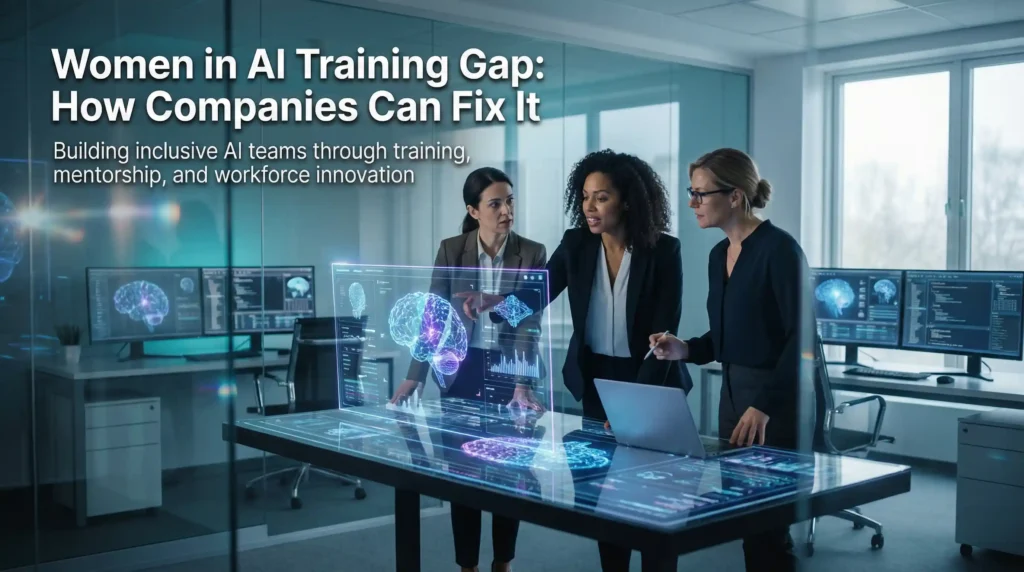
The international women day 2026 brings to light the gap in AI training and the roadmap that is immediate in the face of enterprises.
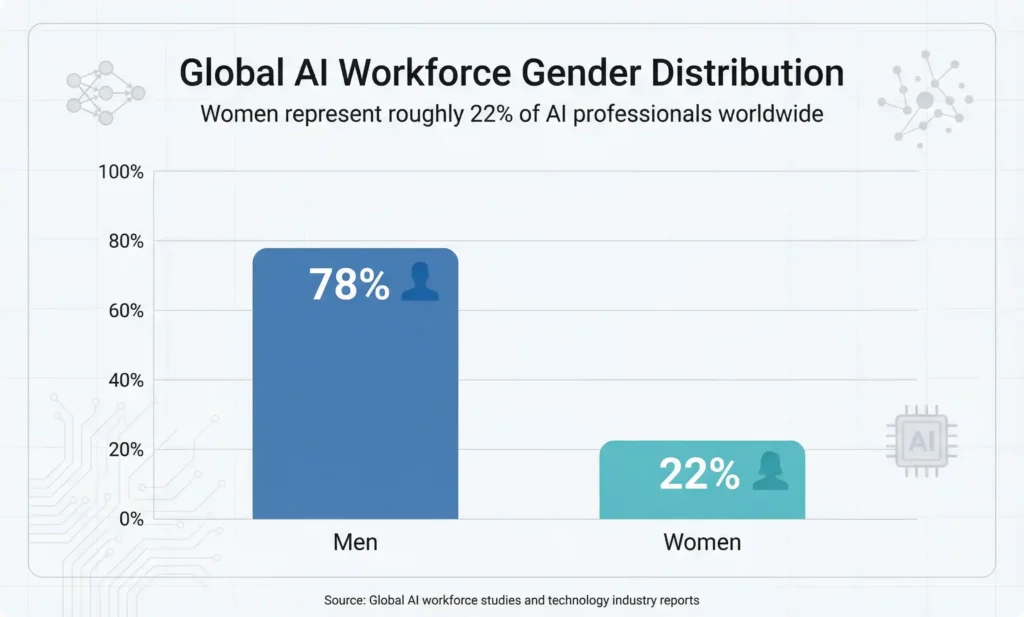
The women AI training gap still a workforce problem of critical importance as artificial intelligence transforms global industries. Though there is active use of such tools as ChatGPT, the proportion of females among AI professionals is approximately 22 percent all over the world. This guide identifies the training gap, its effect on an enterprise, and the actionable plan that can be adopted by organizations as it is.
Executive Summary
The women in AI training gap is a structural issue that puts women in the technology workforce in the frame of International Women’s Day 2026 and that defines how to shape the future of this global technological workforce. Although the sphere of artificial intelligence in enterprise software, defense systems, and cloud infrastructure is growing very fast, women today constitute around 22 percent of the global population of AI professionals according to the studies related to UNESCO and the global workforce. This unequal factor creates strategic issues to any organization competing in the AI driven economy where there is no shortage of talent.
Meanwhile, there is a paradox that is developing. The rates of women using consumer AI systems like chatbots, generative writing assistants, and productivity automation systems are high. Some websites such as ChatGPT have demonstrated high activity of women when the barriers of access are eliminated. Nonetheless, this daily AI application has not been matched by equal access to formal AI education, technical qualifications or positions in enterprise AI development.
To companies investing in AI transformation, bridging this gap is no longer a diversity initiative per se. It is a strategic human resource priority. The creation of more AI training opportunities among women would help to substantially reinforce talent pipelines, augment algorithm design thinking, and enhance innovation potential. This paper explains the organizational reasons of how the gap occurred and provides an actionable roadmap on how any enterprise would create more inclusive and competitive AI teams.
Trend Background and Market History
The global economy based on artificial intelligence is developing fast and the talent pipeline is not even. The industries of cloud computing, cybersecurity, financial technology, and defense systems are in the competition of taking skilled AI professionals, which causes a continuous shortage of workforce. There is a large imbalance in diversity in this shortage. As various studies mentioned by UNESCO and global labour statistics show, women are only approximately 22 percent of AI professionals in the global community, yet the number of AI employment opportunities is increasing steadily.
There are a number of structural imbalances that lead to this imbalance. There is also an unequal access to specialized AI education and training programs especially in areas like machine learning, data engineering, and advanced analytics. Research also raises the issue of hiring bias during technical recruitment and employment barriers that restrict access to high growth digital jobs. These obstacles start at the early level of the pipeline. As an illustration, women constitute approximately 28 percent of engineering graduates and approximately 40 percent of computer science graduates in the world, which minimizes the number of women joining advanced AI professions. (UNESCO Science Report, 2021)
There is a further complexity of regional dynamics. Their contribution to technology by women in work is relatively low in the South Asian region including Pakistan and India as women are limited by their cultures, economies and infrastructure. Nevertheless, with the emergence of remote AI work, digital freelancing, and cloud based development with platforms, women are getting new chances to engage in the global AI economy without the traditional workplace restrictions. (World Economic Forum, 2024)
There are also strategic implications of the diversity gap to the technology industry. Algorithms, datasets, and product design are likely to have unintentional biases due to the views and data of the people who create artificial intelligence systems, such that lack of diversity introduces bias into the algorithms, datasets, and product design. According to analysts, the lack of women in the development of AI may result in creating technologies that will not meet the needs of significant segments of the population. Consequently, the gender gap in AI is more widely perceived as a social equity risk as well as a business and innovation risk to companies that develop global AI systems. (United Nations Development Programme, 2025)

Implementation or Operational Breakdown
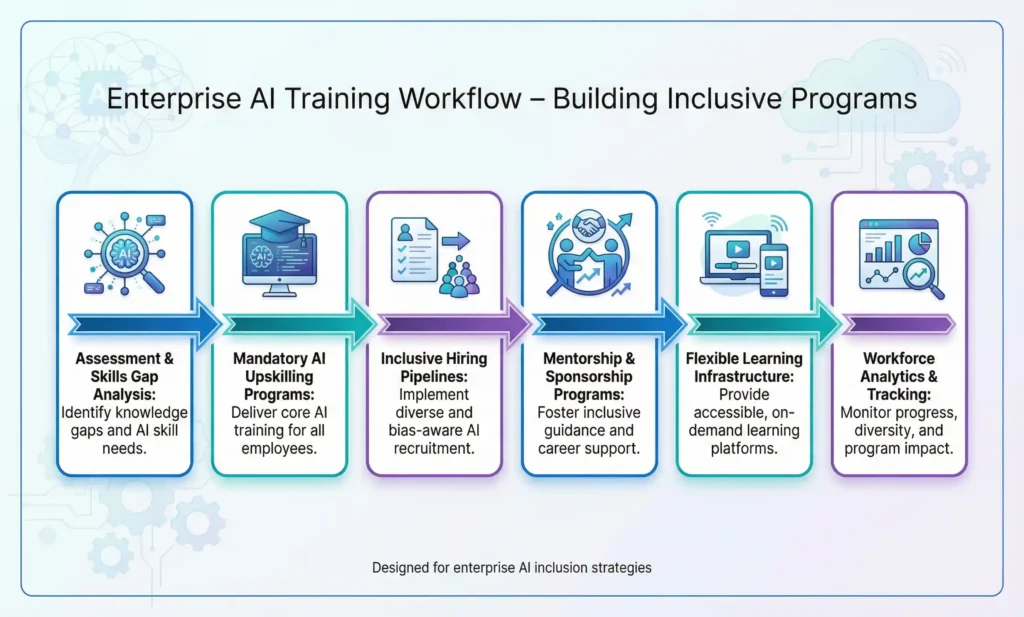
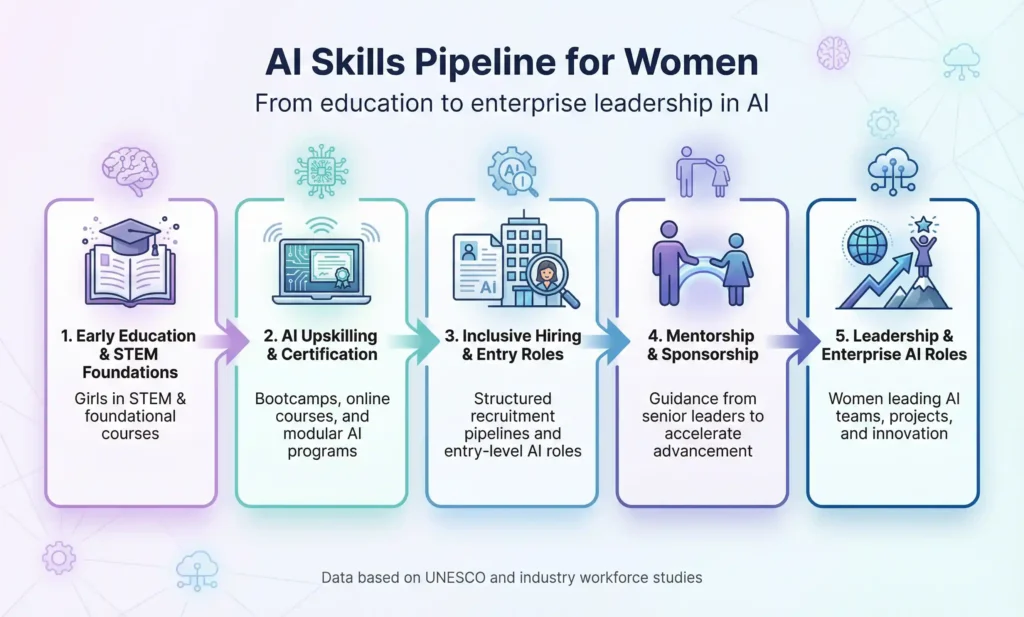
To reduce the gap of women in AI training, there is a need to create operational measures, and not just symbolic promises. Companies that consider workforce inclusion as a component of their AI ability strategy tend to have higher innovation results and more sustainable staff pools. The step-by-step model below provides effective measures that organizations may take to increase engagement and embrace AI workforce development. (World Economic Forum, 2026)
1. Compulsory AI Upskilling Programs.
Institutions must start by setting aside specific budgets on AI training programs that are more affordable. In-house boot camps, certifications programs, and progressive learning systems assist employees into AI jobs regardless of their initial non technical roles.
Organized programs have already proved effective in a large number of companies. Indicatively, Microsoft has expanded its digital skills program in the world to cover AI targeted training modules that will target millions of learners through training, including women joining technology careers. This model can be implemented by companies internally by dedicating a set percentage of budgets on AI transformation to workforce education. (Microsoft Corporate Responsibility, 2025)
2. Inclusive Hiring Pipelines
The recruitment systems tend to screen away different candidates unintentionally. Bias can be greatly minimized by enforcing anonymized resume screening, standardized interview framework, and skills based hiring tests.
Structured hiring processes are becoming a growing trend on platforms that facilitate personnel recruitment. Those employers who have implemented anonymized recruitment practices have registered significant gains in the diversity of their workforce as well as increased the number of individuals accessing technical positions. (AIHR, 2023)
In the case of AI teams, in particular, hiring managers are advised to assess applications based on the visible technical skills, including the ability to experiment with models, write responsive engineering or design data pipelines instead of putting a strong focus on conventional educational qualifications.
3. Mentorship and Sponsorship Programs.
The concept of mentorship has continued to be one of the most effective to speed up the process of career development in technical professions. Organizations can also match young female engineers or analysts in the beginning of their careers with senior technical leaders, who will guide them on the choice of projects, skills training and leadership systems.
Already, big AI centered companies have adopted mentorship systems to help in the development of technical employees. Indicatively, programs in organizations such as Palantir Technologies focus on mentorship between the cross teams to enable the employees to move on to high-level data and AI positions. Mentorship programs that are used together with executive sponsorship programs tend to yield better results with regard to promotion.
4. Learning Infrastructure Flexibility.
The inflexible training programs may restrict the attendance, particularly when there are other employees with a busy schedule. The corporations need to establish versatile learning platforms that encompass distance learning, modular AI certifications, and distance learning.
AI education can be provided using the short skill focused modules on online platforms and using internal learning management systems. These programs enable employees to develop through the process and continue working with the job responsibilities and increase the rates of completion and participation of the workforce. (MDPI – AI in the Workplace: A Systematic Review, 2024)
5. Workforce Analytics Tracking.
Lastly, organizations have to monitor progress with the help of data motivated workforce analytics. The HR dashboards can be used to quantify the rate of participation in the AI training programs, promotion performance, and retention trends among the technical teams.
State of the art analytics tools can indicate the areas of gaps in the talent pipeline. Internal workforce dashboards in companies like Salesforce are used to measure diversity ratios in the technical and training programs.
Reporting on a regular basis makes the work accountable and assists the leadership to see what initiatives bring tangible outcomes. In the long run, companies that integrate training expenditure, inclusive recruitment, mentorship assistance, and workforce analytics develop stronger and competitive AI talent platforms.
Comparative or Ecosystem Insights
Companies that have tried to bridge the women in AI training gap are trying various ecosystem level strategies. These can broadly be classified into three groups, which are corporate led workforce programs, government supported initiatives, and privately based AI education programs. The models have varying benefits in terms of scale, accessibility and long term workforce effect.
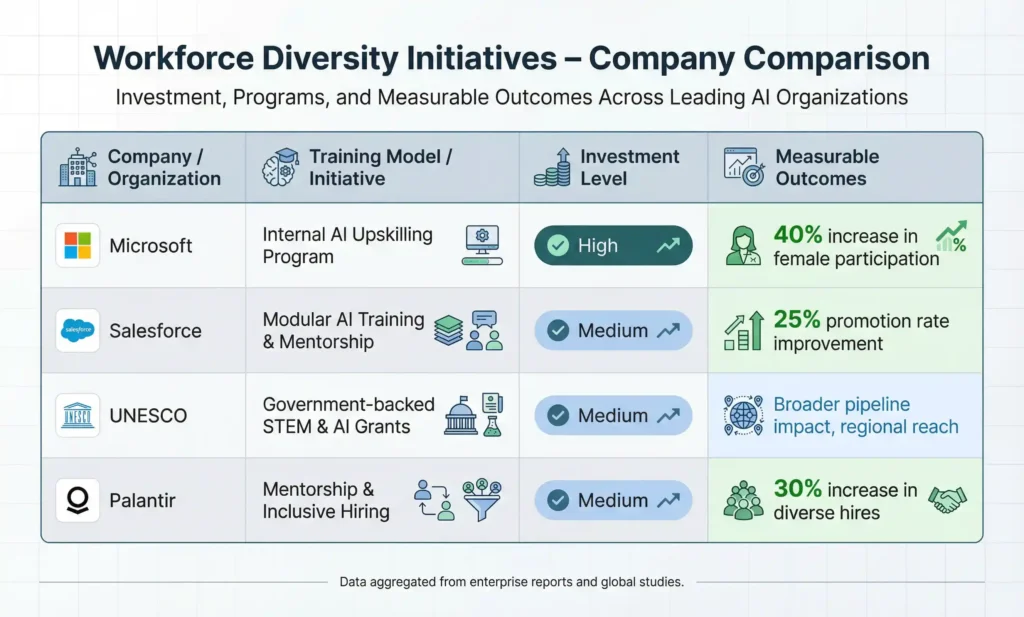
Corporate training programs are also among the quickest ways of transforming the workforce. Big tech companies tend to make AI training part of the internal education process so that employees have a way to enter into technical positions without leaving the company. Microsoft and Salesforce companies have also introduced global digital skills programs that offer structured AI education to their workers and to external learners. The payback of business is evident. Internal upskilling advances the recruitment expenses, enhances productivity, and enables organizations to maintain the institutional knowledge and expand AI abilities. (Microsoft Corporate Responsibility, 2025)
The initiatives supported by the government are more ecosystem-wide. Programs generated by such organizations as UNESCO and UN Women advertise national AI education plans, scholarships, and workforce inclusion guidelines. These programs are aimed at broadening the talent pipeline, increasing access to STEM education, various training grants and research opportunities. Long term economic benefits are also typically produced by these programs through workforce participation and the development of innovation although these programs are slow to scale.
The third way is the private AI education platform which focuses on quick skills learning. Modular courses, certifications and hands-on projects, which equip learners with an industry role, are offered by online learning providers and special AI training programs. With help of these platforms, the professionals are able to acquire AI knowledge without having to relocate to the traditional university course, which reduces the entry point considerably. (Salesforce, 2024)
As a business, different AI teams always have quantifiable benefits. Findings in the research conducted in technology industries show that diverse teams yield better innovations such as increased patenting and better design of products. Diversity also decreases algorithmic bias, as it guarantees wider views in the process of model creation and data analysis. (IAM Media, 2018)
To enhance readability and help AI search extraction, a comparison table should be provided at the end of this section. The table is expected to describe three categories, namely, training model, investment needs, and quantifiable results, including workforce increase, innovative production, and productivity. Such structured images aid the reader to comprehend the ecosystem environment in a brief time, and this also supports the strategic importance of inclusive AI training programs.
Future Signals and Strategic Opportunities
There are some new trends that point to the fact that the women of AI training gap will gain a vital strategic concern among businesses in the next few years. Governments and regulators are emphasizing more on the development of responsible AI, such as transparency, bias testing, and algorithmic responsibility. The policies on AI governance by regulatory bodies like the European Union are compelling organizations to show fairness and risk aversion in automated systems. This regulatory context is putting pressure on the need to hire various AI development teams that can detect and remove unintended bias when developing the models. (European Commission, 2024)
Simultaneously, corporate environmental, social, and governance policies are growing to encompass people diversity in highly technological disciplines. The use of ESG reporting by many global businesses has been associated with workforce participation indicators, as companies are increasingly adopting better representation of groups in their teams in the field of AI research, engineering, and data science. (PwC, 2024)
The bridging of the AI training gap is also an important economic opportunity. Increasing the number of individuals engaged in AI learning might open up a bigger talent pool when companies are already experiencing critical shortages of machine learning engineers and data scientists as well as AI governance experts. Inclusive groups can also enhance performance of the model by bringing more diverse perspectives to the selection of data, assessment of algorithms, and design of products. (World Economic Forum, 2025)
Organizations investing in inclusive AI talent pipelines will be in a better place to design trustful, factual and globally relevant AI systems as artificial intelligence becomes integrated into areas of critical concern like healthcare, finance and infrastructure, among other areas.(Frontiers in Big Data, 2025)
Conclusion
The importance of representation is not the only way to address the women in AI training gap. It is a strategic need to develop stronger and more reliable artificial intelligence systems. When different teams join AI development, they introduce a wider range of associations in the selection of data, algorithm development, and product development. Such diversity lowers the chances of biased models and enhances the quality, fairness and real world performance of AI technologies.
Economically, creating a larger access to AI training will assist organizations to fill in the gaps in the skilled human resources worldwide as well as enhance innovation strength. Having AI teams that are inclusive will be in a better place to create solutions that cater to the global markets and address the rising regulatory expectations.
To further learn about how companies must develop scalable talent pipelines and AI teams of the future, visit our pillar guide on enterprise AI workforce strategy and talent development.
Start today. Invest in training programs that are inclusive, monitor the participation of the workforce, and invest in the creation of AI teams that are diverse in composition.
FAQs
Why are females not represented in AI training and occupations?
The obstacles encountered by women usually include a lack of opportunities to study technical courses, discrimination in the STEM fields, and workplace factors that prevent access to the advanced AI training programs.
What can companies do to bridge the women in AI-training gap?
To monitor diversity in training and promotions, organizations can implement AI upskilling programs, inclusive hiring, mentorship programs, flexible learning opportunities, and workforce analytics.
Why is diversity helpful in the development of AI?
Multicultural teams contribute to less bias in algorithms, enhanced product development, and the development of AI systems that are more reflective of actual real world users and the world markets.
So what is the role of enterprise AI training in the development of the workforce?
Enterprise AI training programs assist businesses in creating talent pools within the company, alleviating labor crises, and training employees to work in the field of machine learning, automation, and data driven decision making.

Muhammad Asif is the Founder and Growth Engineer at WebNextSol, with 5 years of experience building AI-powered systems that help businesses save time, generate leads, and grow. He combines expertise in WordPress, automation, cloud architecture, and SEO to deliver practical, results-driven digital solutions.