
Table of Contents
Summay
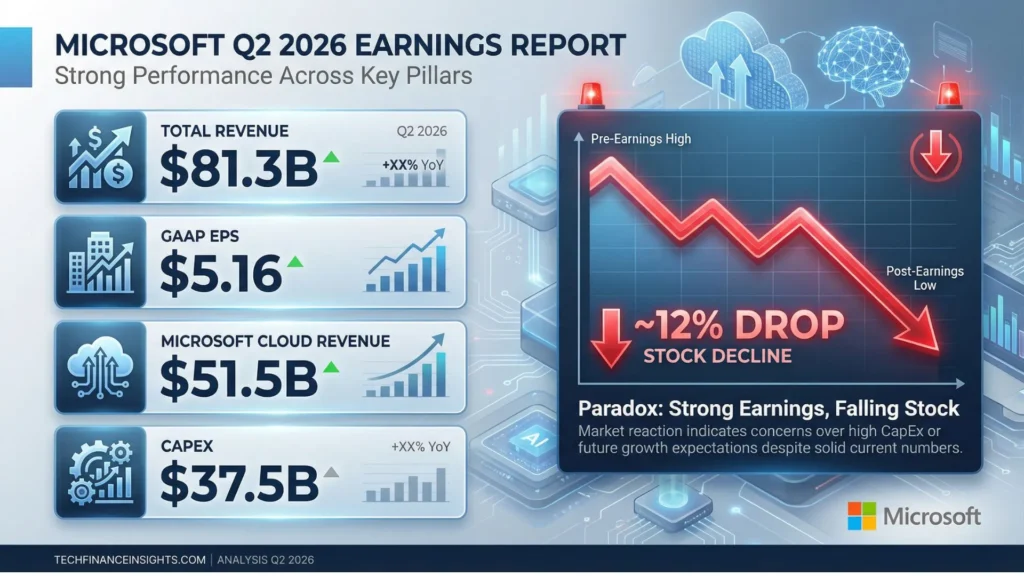
Even though Microsoft earnings on both revenues and EPS exceeded expectations in the Q2 2026 incomes, Microsoft stock dropped nearly 12 percent following the inspirations. The selloff was not caused by poor demand, but rather by a steep rise in the capital expenditure on AI, physical capacity constraints within Azure, and an increase in dependency on OpenAI. Microsoft showed USD 81.3B in revenue, but investors concentrated on USD 37.5B in CapEx and about 45% of Remaining Performance Obligation is now an OpenAI based one. Consequently, the MSFT share price fell because markets were doubting short-term gains made on AI infrastructure. To the point, the reason why Microsoft stock is down is about the valuation risk: investors are re-pricing MSFT stock as an AI infrastructure platform that requires a lot of capital and not a highly-marginated software business.
1. What Made Microsoft Stock Volatile on the 2nd day of that week?
The fiscal Q2 2026 performance of Microsoft looked good according to conventional metrics:
- Revenue: USD 81.3 billion, up 17% YoY
- GAAP EPS: USD 5.16 which is significantly higher than consensus.
- Microsoft Cloud revenue: USD 51.5 billion, increasing 26 percent YoY.
However the MSFT stock price fell by more than 5 percent in a single day down to USD 423 – the biggest one-day decline since 2020. This gap between profit and stock response signifies a new beginning in the perception of Big Tech by investors.
1.1 Revenue Beat vs. Market Expectations.
Microsoft results exceeded the analyst expectations yet the forecasts were high. The market is not merely demanding to know the capability of Microsoft to grow; it is enquiring whether it can grow effectively. Though the earnings of MSFT are showing good demand, the cost of that expansion is becoming questionable in the eyes of investors.
1.2 The CapEx Shock
Q2 2026 reported USD 37.5 billion of capital expenditure, which is 66% more than the previous year, most of it dedicated to AI infrastructure:
- AI workloads Procurement of GPUs.
- AI-optimized data centers
- Power and cooling upgrades
- Development of custom silicon (Maia 200)
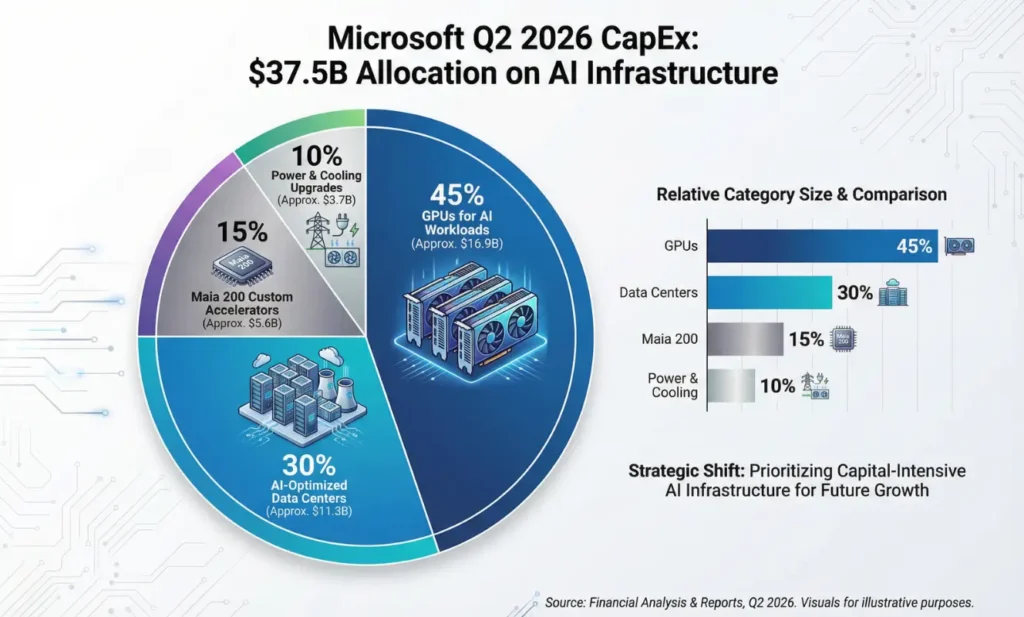
This huge investment reinvents Microsoft as a software-oriented company into a capital-intensive infrastructure operator. This CapEx burst size and timing is the key factor that has made MSFT stock price decrease despite good revenues and earnings.
2. Why Microsoft Earnings were high yet MSFT Stock declined
Weak revenue was not the cause of the recent selloff in MSFT stock, instead, it was margin anxiety.
2.1 Margin Compression Signals
The consolidated gross margin at Microsoft fell to 67% compared to more than 72% in the preceding quarters which is the fifth consecutive quarter of pressure on the margin. Key contributors include:
- AI-oriented data center depreciation.
- Expensive GPUs and network cards.
- Scaling costs of energy and infrastructure.
Software margins are strong and AI infrastructure is acting like industrial capital, not a traditional SaaS. Investors are re-pricing the MSFT stock prices to accommodate this new cost structure.
2.2 Market Re-Rating in Progress
In the past, Microsoft was a premium-trading company owing to:
- Strong recurrent business revenues.
- Low marginal cost of growth
- Good conversion of free cash flow.
This model is broken by the emergence of AI. Any single unit of AI capacity will demand huge initial investment, leading to compression of the margin in the short run. As such, the market is defelibrating Microsoft stock till the ROI of AI infrastructure is apparent.
This is the dynamics that justified why the good Microsoft earnings failed to boost the stock price at once. Investors are not doubting demand; they are doubting the efficiency of Microsoft in turning AI investment into sustainable profit.
3. Azure Growth and the Capacity Ceiling Investors Lost
Azure remains among the most fast-developing business units of Microsoft, which is often misinterpreted by investors.
3.1 Azure No Demand Constrained.
Azure increased by 39% compared to the previous year in constant currency compared to 40% in the previous quarter. Although this has been perceived to reduce the momentum, the actual picture is capacity issues and not demand.
Microsoft has verified that there are limitations on the number of compute units that Azure can sell at any one time due to availability of gpus, power delivery, and physical data centers. It is infrastructure which effectively stifles growth rather than market appetite.
3.2 Tactical Distribution of Limited Compute.
Microsoft strategically allocates its meager GPU and AI to:
- AI capabilities of Copilot and Microsoft 365.
- Enterprise workflow AI agents.
- Enterprise contracts, many years in duration.
Less cloud capacity or capacity deferral is being provided to lower-margin third-party Azure workloads. This would shield the long-term profitability but stifle short-term growth metrics hence adds to the downward pressure on the MSFT stock price.
3.3 The importance of this to investors.
The lesson learnt: reported growth can be weaker than the strength of underlying demand. Capacity constraints show that Microsoft can experience a high degree of pricing power and long-lasting demand and then monetization will occur when the infrastructure is caught up.
With the current capacity of the GPU and data centre of Azure, it appears that the MSFT stock will be vulnerable to any indication of a slackening reported growth- even when the latent demand is strong.
4. OpenAI Concentration Risk and its Interference with Microsoft Stock
The focus on the concentration of the future AI revenue of open AI is one of the least appreciated disclosures in the Microsoft Q2 2026 earnings.
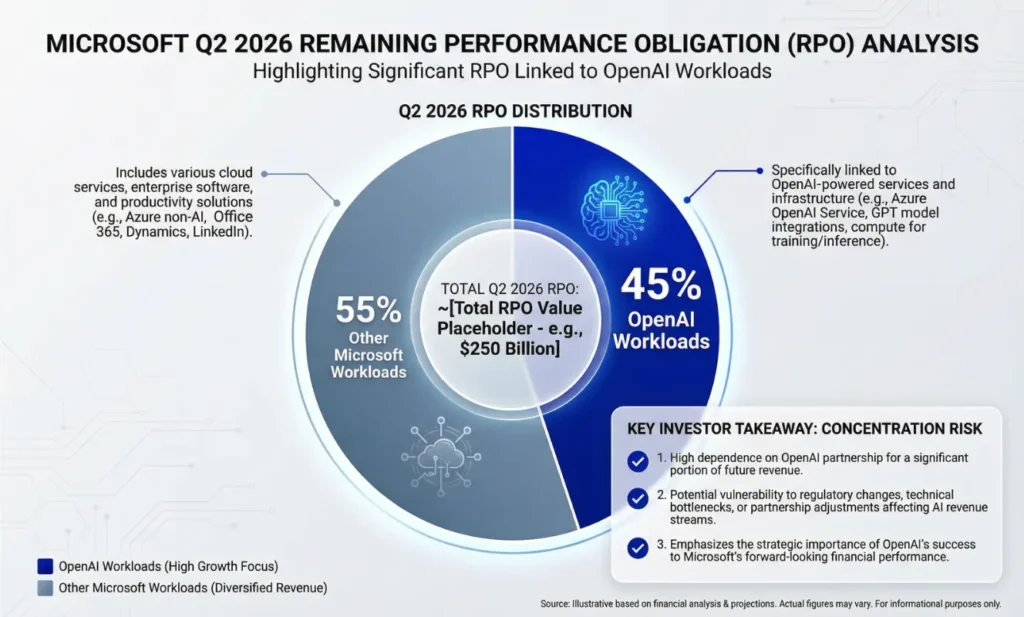
4.1 45% of RPO Linked to OpenAI
Microsoft also announced that about 45 percent of its USD 625 billion Remaining Performance Obligation (RPO) is associated with the workloads related to OpenAI. This has brought about a new platform risk to the company.
If OpenAI were to:
- Change its compute strategy
- Experience regulatory/compliance restrictions.
- Risk weather of enterprise demand.
In this way, one of the key streams of AI-driven revenues at Microsoft could be directly influenced.
4.2 Why Investors Are Concerned
Such dependency is not typical of a company of the size of Microsoft. Although OpenAI is a strategically important move, investors are doubting the suitability of the company to continue trading at a premium when such a significant percentage of future income relies on a single partner.
The reaction in the market is an indicator of forward-looking risk evaluation and not weaknesses of operations. Even when there is high revenue growth, the effect of concentrated exposure creates a headwind to valuation.
5. Strategic Diversification and Mitigation.
Microsoft is working towards dealing with the risk by:
- Azure AI Foundry is growing, with more than 11,000 models.
- Getting sovereign cloud areas to seize controlled enterprise workloads.
- The realization of multi-model enterprise AI products.
This is to decrease dependency on one partner, and diversification will be a time-consuming process. Until it makes a noticeable change in revenue composition, OpenAI concentration is also a major factor affecting MSFT stock price.
6. Maia 200 and the AI Infrastructure Strategy of Microsoft
One of the pillars of Microsoft long-term AI infrastructure strategy and its cost management is the Microsoft custom silicon program, which focuses on the Maia 200 accelerator.
6.1 Maia 200: Abilities and Strategic Value.
The Maia 200 delivers:
- FP4 accuracy compute 10+ petaflops.
- High-performance AI inference on business needs.
- Less than one third of the Total Cost of Ownership (TCO) of Nvidia H200-class hardware.
It is not just a game against Nvidia, this is scaled cost-control and efficiency. A combination with Maia 200 in the AI stack will allow Microsoft to more effectively manage the cost of AI compute in huge enterprise deployments.
6.2 Strategic Rationale
By creating its own accelerators, Microsoft will be able to:
- Less exposure to third-party suppliers of GPUs.Increase the long-term margins despite intense investment in AI.
- Create enterprise AI model hardware, such as Copilot and internal AI agents.
This strategy reminds us of the Graviton CPUs used by Amazon, but the size and the capital density of AI used by Microsoft is much larger. Managing the whole stack, or silicon to software, allows Microsoft to obtain a vertical advantage over AWS and Google Cloud.
6.3 The CapEx Trap Risk
There is a notable downside. The world of AI equipment is developing fast, whereas accounting depreciation spreads over several years. Provided that AI models or architectures become more advanced than expected, Microsoft can face the risk of underutilized or outdated infrastructure, which puts pressure on the MSFT stock price over and above good performance.
The investors are becoming more conscious that Microsoft is becoming a capital-intensive AI infrastructure operator, not a high-margin software company. It is important to understand the role of Maia 200 so as to assess both short term margin pressure and long term strategic leverage.
7. Shifting Software to AI Utility at Microsoft
Microsoft is currently undergoing a structural change, shifting away to software experimentation towards AI industrialization in its entirety.
7.1 Experimentation with Enterprise AI.
The following are some of the key indicators that demonstrate the depth of this transition:
- 15+ million paid Copilot seats, which increased by 160 percent on a year-over-year basis.
- Almost 900 million monthly active Microsoft 365, Dynamics 365, GitHub, and LinkedIn AI-driven interactions.
- The AI is no longer a side feature, but it is an integrated part of the core operating model of Microsoft.
Such integration is an indication of a strategic shift: Microsoft is becoming a capital-intensive AI utility, with compute, software and services being closely connected to present enterprise-scale AI solutions.
7.2 Financial Repercussions of MSFT Stock.
Microsoft 365 margins are at an excellent level of more than 80 percent to keep software profitable.
Investments in AI infrastructure, such as data centers, GPUs, and custom accelerators are putting pressure on company-wide margins.
There is a momentary decrease in free cash flow due to the fact that AI capacity capital expenditure is increasing.
The market is recalibrating. Microsoft share returns would no longer map seamlessly into short-term price returns since investors are currently modeling long-term AI capital intensity as opposed to conventional SaaS scale.
Main Implication: The shift of Microsoft to an AI-based operating model is an important concept that would be critical to the investors who are analyzing MSFT stock. The present stock pullback cannot be attributed to the decline of demand and technological implementation, but rather short-term financial pressure.
8. Competitive Situation: Microsoft vs AWS and Google Cloud
The strategy of AI and cloud resource usage of Microsoft is rather different than those of its main competitors, which are generating both strategic benefits and perception on the MSFT stock.
8.1 AWS: More Flexible and Less Integrated.
- AWS provides scalable capacity and fast provisioning, and enables customers to scale fast.
- The vertical integration of AI is however limited with less control over special hardware to do AI tasks.
- Trade-offs to flexibility and cost efficiency of AI-specific projects may be experienced by enterprises.
- Google Cloud: ML-Centric, Enterprise-Light.
8.2 Google cloud leads in machine learning tools and data analytics.
- The penetration of enterprises is still lower than that of Microsoft and restricts the implementation of large-scale, integrated AI solutions.
- More platform oriented than end to end AI infrastructure.
8.3 Microsoft: End-to-End Control
- The company integrates custom silicon (Maia 200), AI WAN, Azure capacity, and enterprise software into one vertically integrated stack at Microsoft.
- This will maximize TCO, guarantee high performance of AI workloads and make Microsoft a long term AI infrastructure leader.
- The trade-off: the high cost of capital upfront as it is currently felt in the short-run volatility of the MSFT stock price.
8.4 Investor Implications
The approach taken by Microsoft is one which places value on long term dominance on infrastructure rather than a short term comfort on margins. Markets are already factoring in the risk which is tied to capital intensive roll-out of AI, which is why the MSFT stock price has responded even after good earnings were announced.
9. FAQs
Q1: What is the reason Microsoft shares are declining post Q2 2026 profits?
A: The Microsoft stock dropped by about 12 percent even though the revenue is booming since the investors are considering the increasing capital expenditure on AI usage, compression margins, limitation of Azure capacity, and overreliance on open AI. The market is reevaluating MSFT as an AI infrastructure investment business, but not as a software compounder.
Q2: Is Microsoft missing earnings?
A: No. Microsoft revenues (USD 81.3B, up 17 percent YoY) and GAAP EPS stood above analyst estimates of USD 5.16 and revenue in the cloud business increased 26 percent YoY. This decrease in the stock is an indicator of future-oriented reactions towards ROI, AI expenditure and concentration risk, rather than actual performance.
Q3: Do we have Microsoft as a long-term purchase?
A: Microsoft dominance of AI infrastructure, enterprise ecosystem, and Azure is still attractive to long-term investors. The capital intensity is a short-term volatility and not a declining demand. MSFT shares can have the opportunity of temporary retreats when AI investments grow.
Q4: What was the amount spent by Microsoft on AI in Q2 2026?
A: Microsoft has already announced USD 37.5 billion of capital spending, which is concentrated on AI-optimized data centres, graphic card buying, bespoke accelerators (Maia 200), and network infrastructure. This type of investment indicates the transition to the AI-industrial platform.
Q5: What is the largest threat to MSFT stock?
A: The most important risks are margin pressure on expensive AI infrastructure, possible hardware overbuild, and focus on revenue, which is related to OpenAI (45% of Remaining Performance Obligation). The diversification and effective deployment will be of great importance to stabilize the MSFT stock price.
10. What the Microsoft Stock Drop Really Signals
The decrease in the value of the MSFT stock, following the Q2 2026 earnings, is not an indicator of the diminishing demand, innovation, or leadership. Rather, it is a resetting of valuation.
Microsoft is shifting to a low-margin software compounder to a capital-intensive AI infrastructure platform. This move offers some short term uncertainty as investors wrap their heads around increasing AI CapEx, Azure capacity constraints, and OpenAI revenue concentration, but it puts the company in a strategic position to leverage in the long run.
The pullback of Microsoft stock price is not a noise in the market to investors, enterprise leaders, and stakeholders. It is an indicator that Microsoft will have an infrastructure-focused, AI efficiencies, and enterprise-scale integration-driven next decade, as opposed to software growth per se. Those companies that expect to see this development can be more aligned to the strategy of AI that Microsoft has to offer, and long-term investors can see the current volatility as the opportunity to enter the market.
11. Conclusion
Microsoft stock surged down after Q2 2026 earnings and it is not a sign of poor demand or execution rather it is a sign of structural change. Microsoft is taking the high margin software business to a capital intensive AI infrastructure platform. An increase in the AI CapEx, Arizona capacity constraints, and high dependence on OpenAI have put short-term pressure on valuation, despite high revenues and earnings.
To investors, the pullback underscores the point of taking MSFT stock in its long-term AI strategy as opposed to a short-term software growth. Stakeholders and enterprises aligned with the Microsoft AI infrastructure roadmap can take advantage of this move in a strategic way and long-term investors could find the current volatility as an opportunity to join a company that would lead for the long term through AI in an enterprise-scale way.

Muhammad Asif is the Founder and Growth Engineer at WebNextSol, with 5 years of experience building AI-powered systems that help businesses save time, generate leads, and grow. He combines expertise in WordPress, automation, cloud architecture, and SEO to deliver practical, results-driven digital solutions.