
Table of Contents
1. Breaking Trends: AI as the Iron Man Suit of Game Development
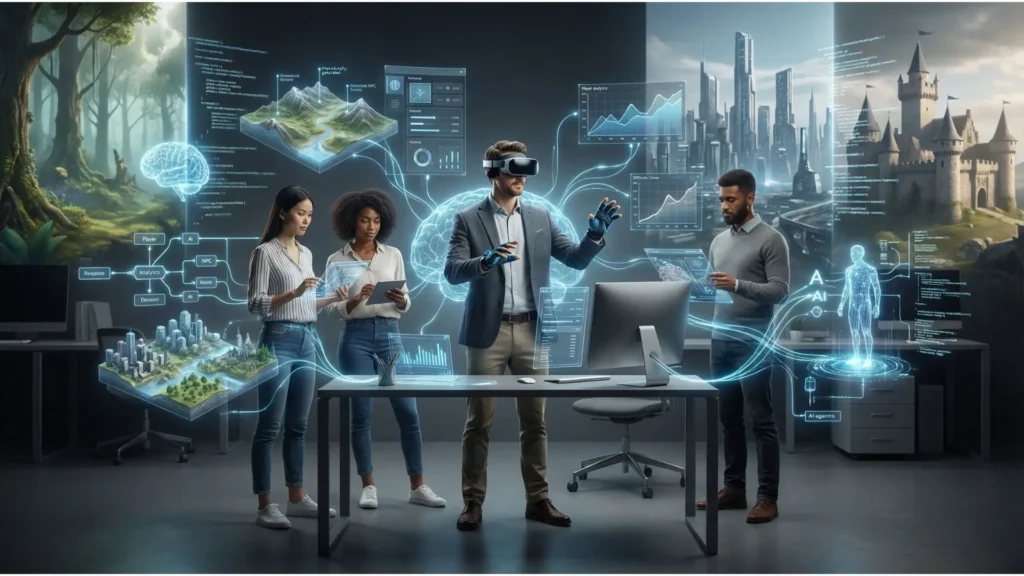
The artificial intelligence phase is over in the global gaming industry. By 2026, AI in game development is creating an earthquake. With an increase in production costs and player demands, the developers need to change to keep an industry that has a USD 189 billion annual income. Jack Buser, the Global Director of Games at Google Cloud, says that artificial intelligence is more like an Iron Man suit; an extremely high-tech exoskeleton that enhances creative potential and does not eliminate human ingenuity.
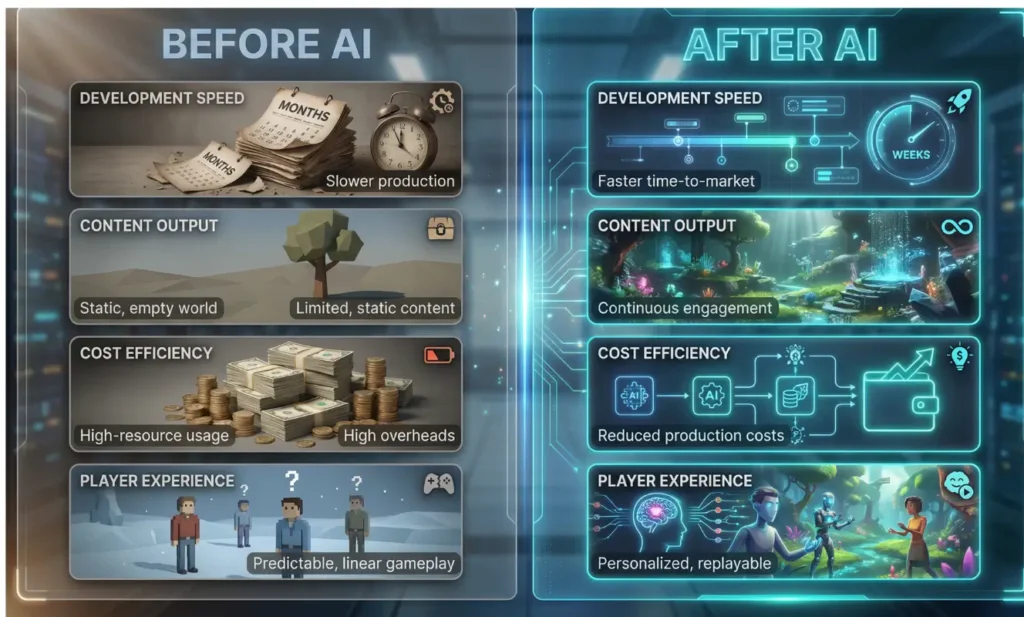
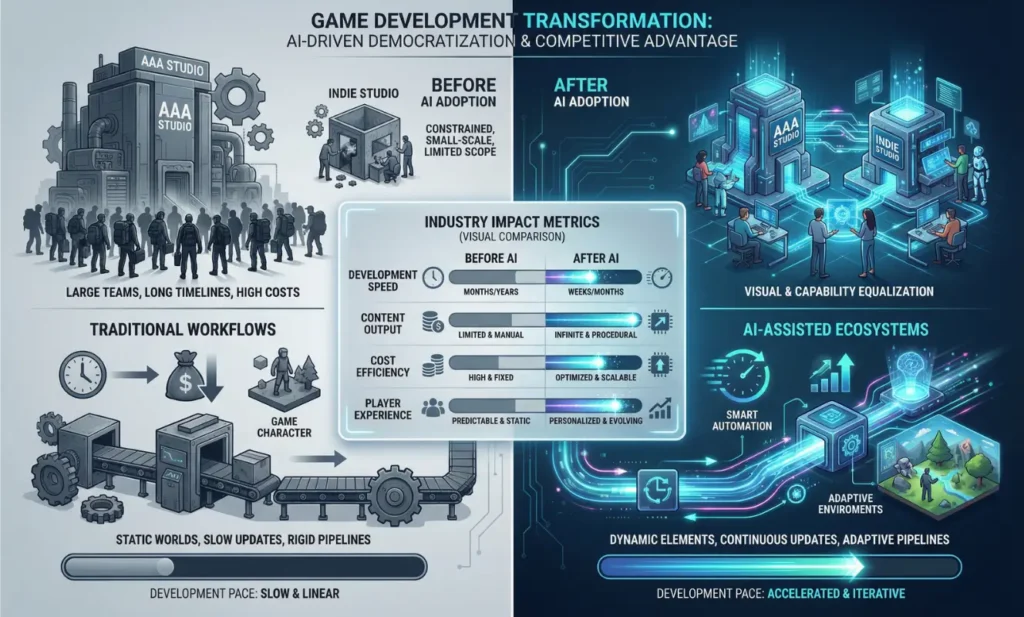
One game design would be that of infinity in quests, open-ended characters and custom difficulty which is created on the fly. The workflows that were once done within a month or even a year are now now achievable within a few weeks with the help of AI assisted workflows. It is not merely a trend to the developers and studios but rather a strategic necessity in order to survive and thrive in a market that is becoming increasingly competitive.
Quick Stat: 97 per cent of the world wide developers think that generative AI is transforming the procedure of game creation and 90 per cent of them already incorporate it in their process.
The AI is here to stay in the gaming industry and is not just automation but a kick-starter to the imagination process a non-need to work hard, but a breathing game that will grow with the gamer.
2. Artificial Intelligence: The Ultimate Creative Skeleton to Developers
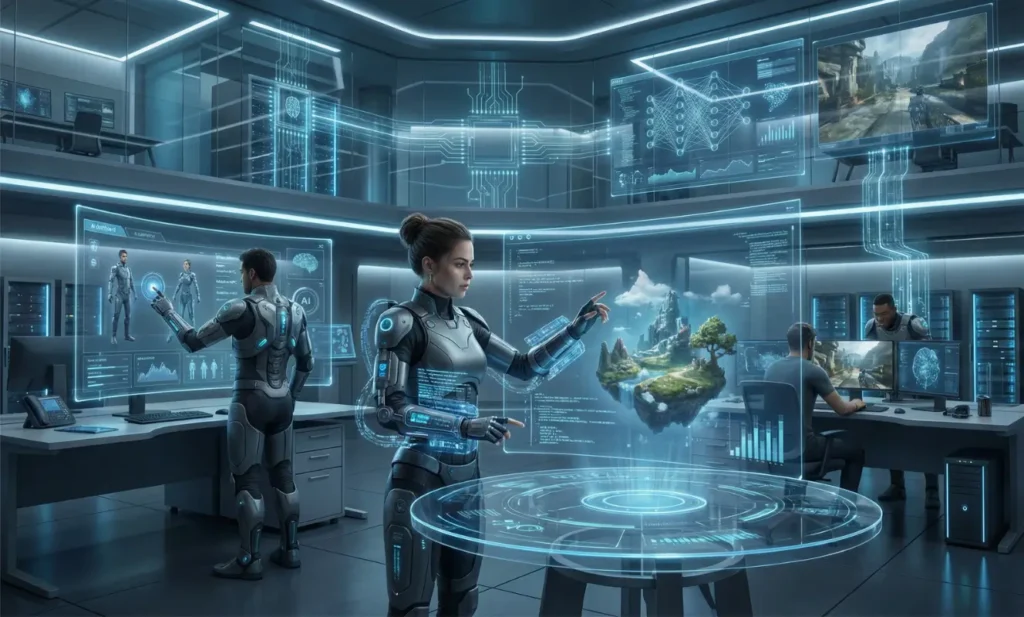
AI is no longer a tool in the background and it now became an indispensable element of the process of creating a game, becoming a creative skeleton to designers. Task reuse allows developers to put less attention on the repetitive work, and to focus on what is more important the storytelling that is most innovative, and dynamic worlds, and immersive gameplay.
The key ways that AI can be utilized to facilitate innovation are:
Massive Time Saving: Series Entertainment reports that AI-based processes reduced development time by 90 percent. Artists and designers will be in a position to generate an environment, characters and assets in days and not months.
Ideation at Scale: Studio Capcom leverages the Vertex AI and Gemini systems of Google to create hundreds of thousands of ideas – items, environments, and quests – that developers can edit and turn into a working product and accelerate the creative experiment process.
The Agentic Development: AI agents no longer are scripts but can balance the gameplay, debug the game in real time, and assists with QA, these are the tasks that previously were carried out by large manual teams. According to Google cloud research, currently, 87 percent of developers use AI agents in pipelines.
Liberate the developers to explore AI, pursue more ideas, and eventually offer richer and more innovative experiences and survive in a highly expensive and saturated economy.
3. From Static Worlds to Living Games
Gaming does not transform to be a fixed, live, service designs, but instead transforms into the Living Games, which are worlds that evolve and respond dynamically to the actions of every participant. AI is the force behind this change, as it allows developers to create immersive and personal experiences, which they could not do before.
3.1 Key advancements include
Infinite Content Loops: AI generates the never-ending quests, world modification, and plots specific to each player according to his actions, and continually generates the engagement without requiring an operator to revise the content.
Adaptive NPCs: More recent NPCs perceive the environment of a game semantically, choosing and acting like humans. Gone are the days of predictable, scripted characters, nowadays there is never anything the same in any interaction.
Individually customized Challenge: AI-powered analytics monitor the player skill and interest and adjust the challenge and rewards. This will reduce the number of players churned as well as make games tough yet fun.
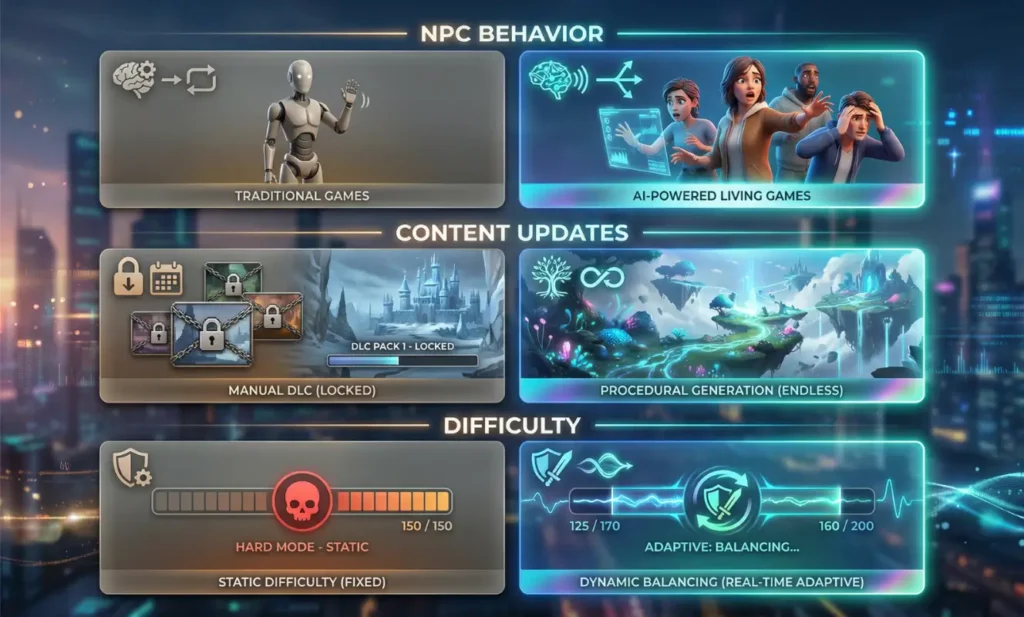
Quick Stat: 87% of developers use AI agents to build adaptive systems and 2026 is the year when personalized gameplay becomes a new standard.
The AI-based games are no longer any kind of frozen world but alive ecosystems, able to respond to any player intuitively, which makes them extremely immersive and preconditions the future of the interactive entertainment industry.
4. Cases: Capcom, Series Entertainment, Tencent and Indie Success
AI is not merely a piece of paper because it is delivering tangible results to both larger and smaller studios, including those of AAA and indies. The list below represents some of the ways in which AI is being applied by certain leaders to transform how games are developed:
Capcom
Using Google Vertex AI and Gemini, generates hundreds of thousands of ideas of settings, objects, and quests.
Outcome: Faster decision-making on ideas: Designers are able to select the most promising ideas within minutes, which was months of brainstorming by hand.
Effects: The higher volume and the decreased costs of production of large franchises like Street Fighter and Resident Evil.
Series Entertainment
Bases on the argument of a reduction of development time by 90 percent under the circumstance of AI-integrated workflow.
At the expense of human developers, AI occupies the regular work like asset creation and quality assurance and enables the latter to work on the gameplay creation.
Tencent’s GiiNEX Engine
Enhances 3D city-building, animations and dialogues in the lifecycle of whole games.
The need to have large masses reduced is mitigated by intelligent AI software without compromising the quality of output AAA games have.
Indie Studio Success: Lost Lore.
The Designed Bearverse, which produced 17 concepts of characters within a week due to the assistance of AI programs, including Midjourney.
It would have taken 34 days to make by hand, which demonstrates that AI democratizes the development of small teams.
5. Industry Implication: Democratization and Competitive Advantage
The competitiveness is shifting with the introduction of AI into the creation of games. AI-following studios are better placed in terms of being strategic and those that fail to keep up with it are likely to be left behind. Key implications include:
5.1 Indie Studio Democratization: Should Be One on One.
AI is levelling the competitors playing field to the point that small organisations will be able to create visual fidelity and depth of games that was previously a prerogative of those who were developers of the AAA.
The smaller budgets have allowed the indie studios to now produce high quality content with reduced barriers to entry and stimulation to innovate.
5.2 The Risk of Inaction
The studios that fail to adopt AI have existential dilemma. The outdated systems of production cannot sustain the brief update cycles, procedural nature of content and dynamism of the players interaction.
Jack Buser emphasizes that being able to use AI will cease to be a choice in 2026, it will be survival required.
5.3 Transforming the Revenue Models and Ecosystem Strategies.
The war has now moved on to the ecosystem orchestration and content-as-a-service models as the projections are now topped at revenues of 350-550 billion in the year 2030.
This change is being based on AI-built pipes that enable endless generation of content and custom experiences of players.
Ethical and Regulatory Implications.
The rapid use of AI is raising questions about the eradication of workplaces, the purity of creativity and privacy of information.
The progressive studios should create a balance between efficiency and ethical behaviour in order to achieve the consumer trust.
By adopting AI, AAA and indie studios have a more edge, as they will create at a faster pace and have more rich worlds and customized gameplay and build more sustainable and innovative development ecosystems.
6. The begins with Opportunities: AI Supercharging Game Development
The artificial intelligence does not just enable it to be a quicker method of creating a game, but it also allows the possibilities of innovation, creativity and efficiency in ways that it was not achievable before. That is the extent to which AI can be utilized by studios and developers:
Advantages of AI implementation into practice.
Superhuman Productivity: Although introducing robots to complete the tedious tasks can free the developers to be more creative in design, it may compromise the worth of creativity of design.
Unlimited Content Generation Procedural worlds and adaptive quests allow studios to entertain players indefinitely with no human help.
Player-Centric Design: AI analytics will track player actions and change difficulty, rewards and plot to create a special experience that will retain the player.
Cost Performance: Reduce the manpower and the iteration cost and yet save the AAA-quality even with the indie studios.
Checklist of Studios (Johns 458).
Introduce AI Tools: Integrate AI solutions into the development process: Vertex AI, Gemini or Midjourney.
Training AI Agents: AI based QA, balancing, NPC behaviour and procedural content generation.
Follow Player Information: Customize difficulty, content and rewards using AI analytics.
Brutality: Procedural ideation: Ideate on a large number of gameplay situations in parallel using AI assistance.
Protect the Ethics: Protect the creative integrity, player data and diversity of AI generated content.
Money Saving Pro Tip: Even the small studios can produce the AAA-grade visuals and the gameplay density, assuming that they make use of the AI processes and agent-based systems.
These actions guarantee a peak creativity among the developers, reduced development period and presented games that can continuously adapt to the preferences of players- in reality the possibility of AI to be the Iron Man suit.
7. Your Future in the Age of AI-Powered Gaming
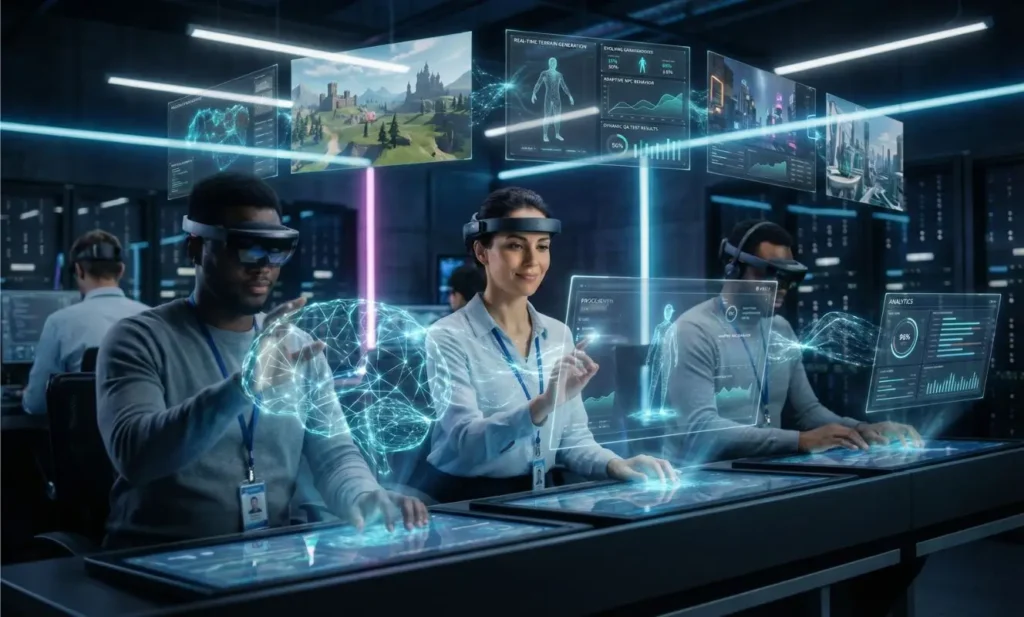
The AIs are not arriving to the gaming world tomorrow but they are there today. The strategic advantage that will be experienced by developers deploying AI will be more in-depth and flexible experiences, as well as time and money savings.
Key Takeaways:
The application of AI as an Iron Man suit, as it boosts creativity, does not meet the human aspect.
Living Games and adaptive NPCs are changing player or retention.
The oncuts in the development time and the quality game creation democratization has proven to be dramatic as per experience.
By 2030, its usage will render it impossible not to be lagging behind in a USD 350- USD 550 billion market.
The way forward of Developers and Studios:
Audit on your current workflow to identify work that can be improved through AI.
Implement AI vendors, such as Vertex AI, Gemini, Midjourney or AI based game engine.
Progressively deploy AI – develop resources, process automation, quality automation.
Optimize AI utility by measuring the performance measures and interactions of players.
Transit experience amongst teams such that it becomes open to complete creativity.
Even small studios can also reach the level of AAA-quality, and compete with it on an international scale, but with the assistance of effective AI workflows.
Now, your move will cut your future-proof studio, make the games that will really impress players. The gaming revolution powered by AI has arrived and there is no need to wait any more.
FAQ
1. What is generative AI in the game industry?
The generative AIs are obviously a technology that builds up content, characters, environments, quests and dialogues automatically. It promotes life games of 2026 where real-time behavior of players is refereed.
2. What is the effectiveness of AI in terms of the promotion of the development of the game?
The AI usage is done to automate the routine processes such as developing assets, detecting bugs, quality control, and games balance in order that the developer can use his or her artistic ability to accelerate the development speed by up to 90 of the original speed.
3. Is it possible to confront AAA studios with indie studios with the help of AI?
Yes. Games AI is also making game creation more democratic, as such, small-teams are now able to afford to make quality graphics and complex mechanics and adaptive gameplay without or with smaller massive budgets.
4. What are the dangers of using AI in the game world?
These concerns are privacy of information, ethical concerns, loss of creativity and eventual job loss. The studios should be responsible regarding the use of the AI, as well as be in control of creativity and fairness in the play.