
Table of Contents
1. The Emergence of AI-Native Discovery: Why Prism is a harbinger of a 2026 scientific revolution
In early 2026, OpenAI Prism achieved a milestone that scholars were looking forward to. Not only is it not another AI writing tool, but it is the first AI-native research workspace designed expressly to handle scientists.
This is important since science has reached a dead end. As the future of software development in 2025 took the direction of AI, research processes were still disjointed, manual, and slow. The writing took place in LaTeX editors, reading in PDFs, citing in managers, and reasoning in disconnected chat tools. Prism collapses those silos into one environment in which AI is directly incorporated into the scientific document.
Prism does not only react to text prompts, but also equations, references, and logical structure, and is powered by the high-reasoning GPT-5.2 model. It is able to make a derivation analysis, propose the literature, and assist to refine argumentation without losing context.
The timing is deliberate. By the year 2026, AI will be moving away as an assistant to a collaborator and the next target is science. Prism indicates a shift in structure: discovery is not only becoming human-led with AI assistance anymore, but it is being AI-accelerated.
It is not a progressive upgrade. It is a reset.
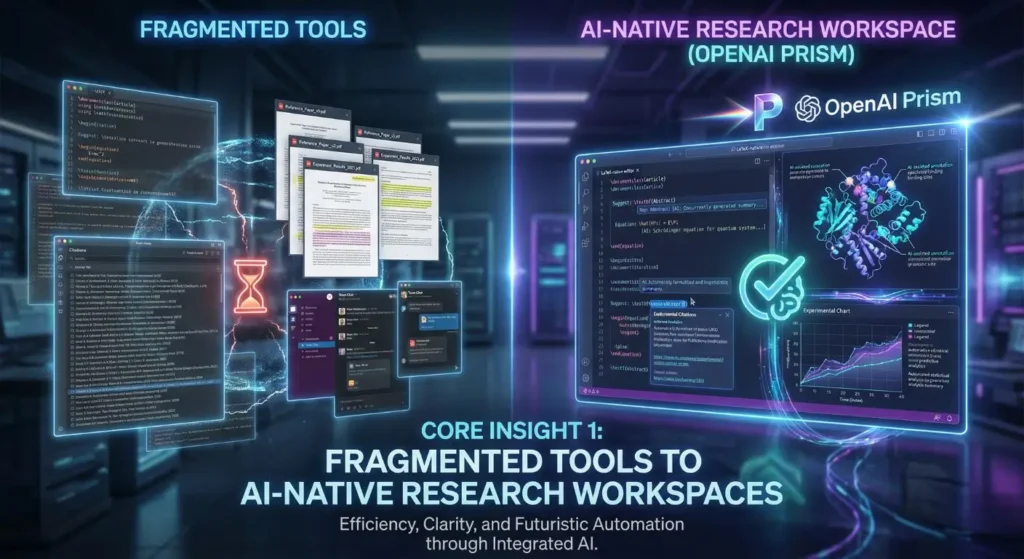
2. Core Insight1: Fragmented tools to AI-Native research workspaces:
Contemporary processes of scientific activity are infamously discontinuous. Researchers have a multitude of platforms: LaTeX writing, PDF reading, reference managers citing, and chat applications brainstorming. It is time-consuming to alternate between these tools, it needs more cognitive load, and it allows one to make a mistake.
Enter OpenAI Prism. Consolidating all of these heterogeneous components into one AI native LaTeX workspace Prism will remove friction and allow researchers to think at the highest level as opposed to administrating it. Prism is based on Crixet, which is mature and AI is directly embedded into the document, thus the system comprehends equations, derivations, references and logical flow.
2.1 Mini Case Example:
A small molecular biology lab with Prism documented that the time spent in preparing manuscripts was reduced by 30 percent due to the fact that AI did citation formatting and whiteboard to LaTeX conversion on its own.
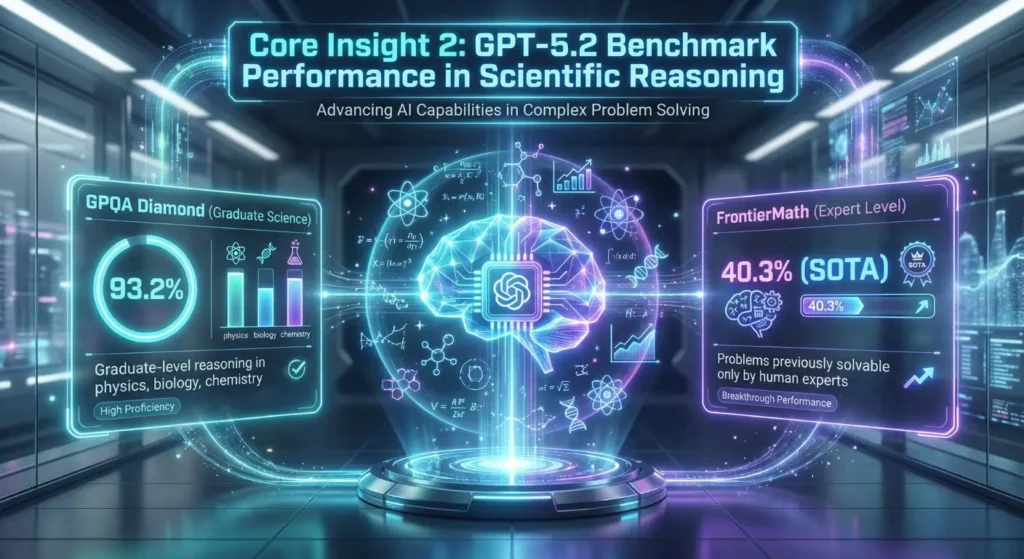
3. Core Insight 2: Why the Economics of Scientific Reasoning is Altered by GPT-5.2
The core of Prism is GPT-5.2 Thinking, which is already trained to think mathematically and scientifically. In contrast to previous models that mainly offered text suggestions, GPT-5.2 is able to make reasoning based on a multi-step derivation, and test hypotheses, as well as discerning intricate dependencies between figures, equations and citations.
3.1 Mini Case Example:
In their study, a computational chemistry group trained GPT-5.2 to verify the derivations of reactions in a variety of papers, cutting down on the cross-validation time of three days to a few hours and maintaining 99% accuracy.
Impact: OpenAI reduces the time and financial cost of high-level reasoning by implementing GPT-5.2 in Prism, allowing researchers to spend their time on being creative and experimenting.
4. Core Insight 3: Inside Prism, Features Designed for Real Scientists
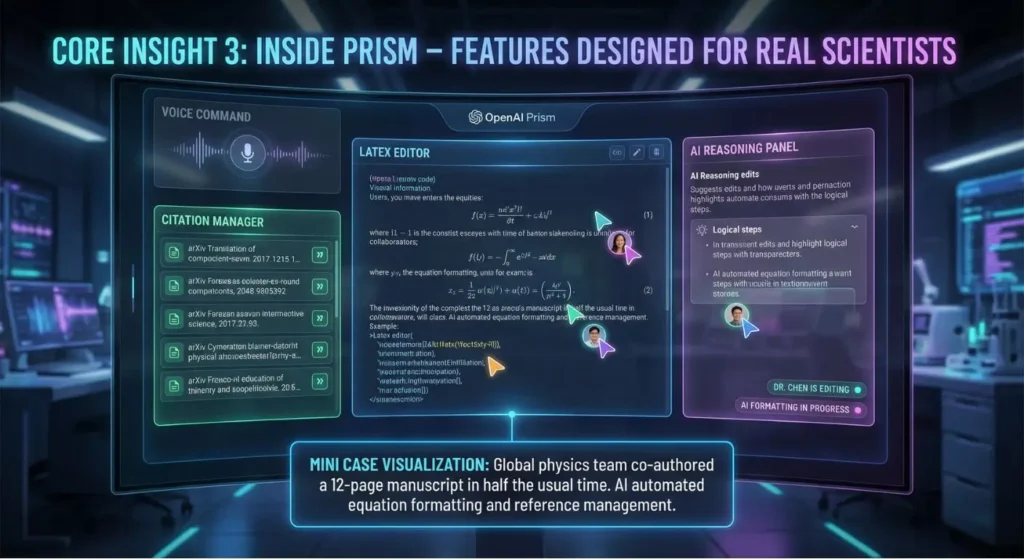
Prism is not only an AI project but scientific workflow-based. Key features include:
Multimodal LaTeX Conversion: Automatically convert whiteboard drawings or hand-written equations from clean LaTeX.
Deep Literature Intelligence: combining access to arXiv with real-time citation recommendations and literature analysis.
Online Cooperation: Infinite co-authors, real-time editing, and onboard AI help-all-global research groups.
Voice-Based Editing: Hands-free document review and editing is accessible and more efficient with the use of advanced audio models.
4.1 Mini Case Example:
A PhD physics group in three nations took advantage of Prism through real-time AI support to co-create a 12-page article in a quarter of the ordinary time, which AI generated all formulae and the reference list properly.
Impact: These characteristics make AI more than a side tool and make it a part of the research team, doing the mechanical overhead, allowing people to focus on discovery.
5. Core Insight 4: The Competitive Landscape Why OpenAI Moved First
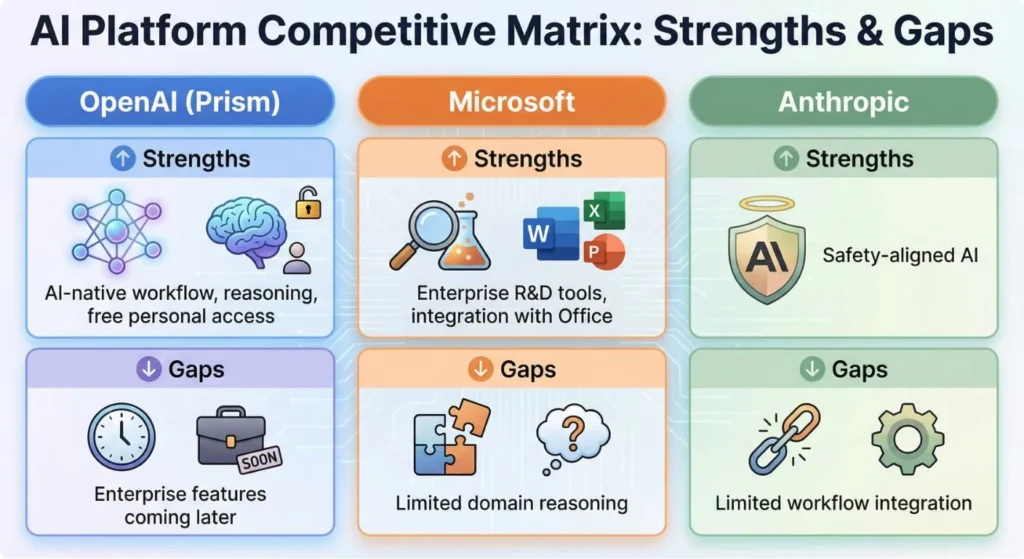
Science AI has become a saturated market. Other competitors such as Microsoft prioritize enterprise level integration in R&D, whereas Anthropic prioritizes safety-based reasoning models. The advantage of OpenAI is that it has the reasoning capabilities of GPT-5.2 and a LaTeX-native workstation.
5.1 Mini Case Example:
Being an early adopter of Prism in a biotech lab enabled a three person team to work effectively in an international capacity as efficiently as a 10 person lab, proving the value of being a first mover in an AI-native platform.
Impact: As the first to have a full, AI-native workflow, OpenAI becomes the default platform of scientists, making it expensive and slow to move to competitors and establishing the standard of AI-assisted research in the next ten years.
The Significant Lessons in the Interest Department.
Prism also removes the friction in the workflow so that the researchers can concentrate on high level strategy.
GPT-5.2 is a state of the art in reasoning with less time and cost in comparison to expert tasks.
AI-native capabilities such as multimodal LaTeX conversion and real-time collaboration are quicker speeding up production without compromising quality.
The first-mover benefit of OpenAI of fully integrated AI-native workflows is transforming the competitive environment and making Prism an industry standard in 2026 research.
What Prism Unlocks to Researchers, Universities, and R&D Teams.
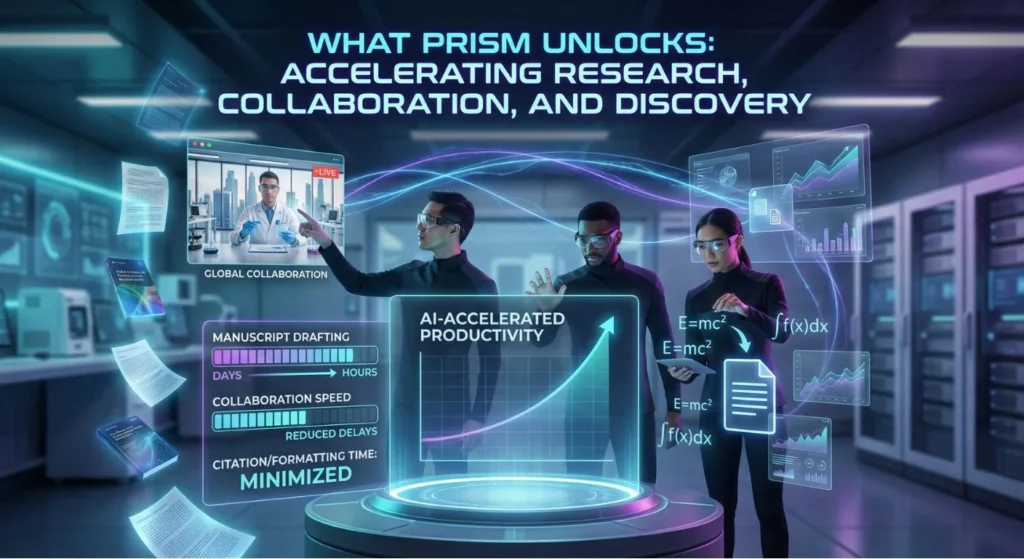
Prism changes potential to performance by eliminating friction and speeding up the discovery. To personal researchers, GPT-5.2 in Prism saves time citing, formatting and reviewing literature- allowing scientists to generate hypotheses and model experimental procedures.
Universities and research institutions receive standardized AI-native workflow within departments, enhancing collaboration, consistency, as well as lowering costs related to the use of several siloed platforms. Teams in small labs and R&D can now operate on the scale of large organizations, cooperate around the globe with no technical overhead.
Use Cases in Action:
MNTs who are writing papers together in real time.
Biotech startups with more rapid hypothesis tests prior to lab testing.
Graduates transforming whiteboard derivations to LaTeX in minutes.
Roadmap:
Prism will grow to add Enterprise and Education plans, more lab integrations, and more comprehensive AI reasoning, so it is not only a writing tool but a central research location powered by AI.
In Prism, management of tools is less important than bringing breakthroughs- making the process of idea into discovery faster.
How to Get Started with Prism
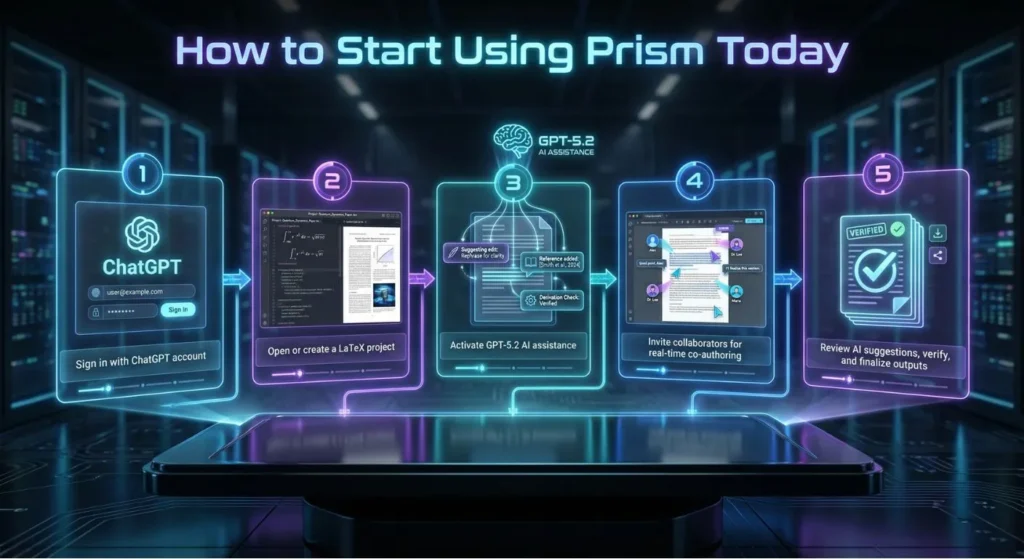
Prism is easy and instant to get started with. It is free to sign in with a personal ChatGPT account and have a fully AI-native LaTeX workspace.
Next Steps:
LaTeX Open Prism and open a new or an existing LaTeX project.
Auto-write equations, references, and figures, draft, and refine them.
Share papers with collaborators in real-time, without versioning.
Check AI recommendations, check results, and complete your study.
Prism transforms AI into a co-researcher and can speed up productivity and make breakthroughs. With its adoption today, you or your team will be at the forefront of discovery with AI in 2026.
Conclusion
Prism is not the name of another research tool, it is the beginning of a new age of scientific discovery. Directly integrated into workflows, AI also allows a researcher to work on a breakthrough, rather than manual labor. Use Prism now and be the leader in AI-native science in 2026.
FAQ
Q1. What is OpenAI Prism?
Prism is a free AI-native LaTeX workspace that directly adds GPT-5.2 reasoning to scientific documents, enabling writing and collaboration and solving complex problems.
Q2. Is Prism free?
Yes. The Prism is free to the personal ChatGPT account holders. Enterprise and Education plans will be implemented in 2026.
Q3. What is the difference between Prism, Overleaf, or ChatGPT?
Prism inserts AI in a contextual manner in the manuscript, comprehending equations, citations, and figures, unlike Overleaf (only editor) or ChatGPT (only text).
Q4. Can AI outputs be trusted?
Prism is human-in-the-loop; scholars are to check evidence, references, and findings to prove academic integrity.
Q5. Who should use Prism?
Graduate learners, independent scientists, research and development departments, and universities looking to speed up AI-assisted discovery.

Muhammad Asif is the Founder and Growth Engineer at WebNextSol, with 5 years of experience building AI-powered systems that help businesses save time, generate leads, and grow. He combines expertise in WordPress, automation, cloud architecture, and SEO to deliver practical, results-driven digital solutions.