Determine AI-created or AI-modified text with great precision and humanization suggestions.
Introduction
Polygraf AI is an advanced content-detection service that examines the text to find out whether it was created or edited by AI algorithms like ChatGPT, Google Gemini, or is improved with assistance of Grammarly. It is targeted at educators, publishers, and businesses and makes content authentic and assists in ensuring quality in the ever-growing automated content environment.
Polygraf AI has a detection accuracy of more than 98%, and it is able not only to focus on AI-created text but also on the source, the possible plagiarism, and suggestions to make the text appear more human. It is placed under the AI Detection category and enables the teams to protect academic integrity, authenticate reviews, and uphold editorial quality. With the integration of accuracy analysis and actionable insights, Polygraf AI enables the company to make wise choices regarding content credibility and authorship.
What Is Polygraf AI?
Polygraf AI is an advanced level AI content detection tool that determines the writing or editing by AI systems. It combines the most sophisticated linguistic analysis, pattern recognition made by AI and identification of the source to assess the content authenticity precisely.
The tool is placed as a check and content integrity tool to organizations that want to ensure that trust is maintained in written work. It addresses a severe issue in digital content management separating human-written text, AI-generated or AI-enhanced text. Polygraf AI assists teams in making sure that the published content is up to editorial and compliance standards by offering actionable insights and humanization advice to protect reputation and intellectual integrity.
Key Features
- AI Generation Detection
Determines the fact of text being created by AI models such as ChatGPT, Google Gemini, or other systems.
- Source Identification
ID: Identifies the AI system or content enhancement tool used to the text to give it an accurate attribution.
- Plagiarism Detection
Checks content with the available materials to identify copying or unauthorized reuse.
- Humanization Recommendations
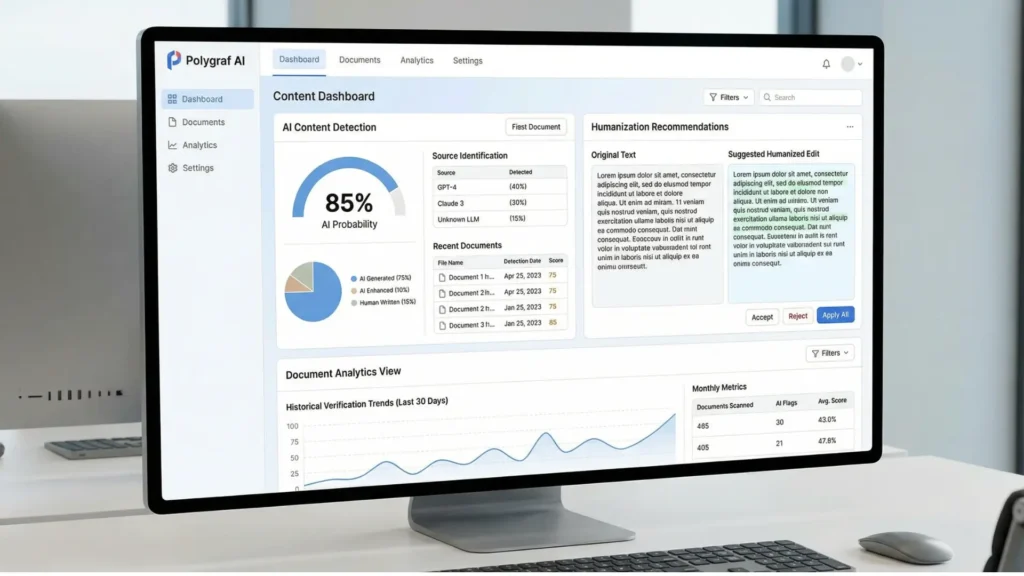
Proposes improvements to enable AI-generated content to become more natural and human.
- High Accuracy Analysis
Has more than 98% detection, which reduces false positive and creates more trust with the outcomes.
- Real-Time Reporting
Enables real-time feedback and hints to carry on content verification processes.
- Comprehensive Dashboard
Shows analytics, history of detection, and trends of various documents in a centralized view.
- Multi-Industry Adaptation
Applicable to both academic, publishing, corporate and marketing content settings.
All these aspects are integrated to deliver actionable insights that are used to assure content authenticity as well as simplify the verification processes.
Use Cases / Applications
1. Academic Integrity
Check the submissions of students to avoid AI-assisted plagiarism or academic malpractices.
2. Publishing & Media
Make sure that the editorial material is original and not produced by AI-bias or manipulation.
3. Corporate Review Checking.
Check customer reviews or internal records to retain credibility and authenticity.
4. Content Marketing Teams
Vet posts to blogs, social media posts and copywrite to create authenticity before posting.
5. Regulated Industries
Compliance Support: Ensuring that the critical documentation is in compliance with human authorship requirement.
Polygraf AI is specifically important in an environment where credibility of the content and regulation compliance are of importance.
Pros & Cons
Pros:
Very sensitive detection of AIs-generated or improved content.
Makes practical recommendations on humanization in order to enhance the quality of the text.
Serves a variety of industries with loose verification processes.
Cons:
Premium based solution with costing features aimed at enterprise or business users.
Complex content verification dashboards need training or familiarization to May.
Pricing & Access Model
Polygraf AI is based on the paid subscription model with the option of a free trial to be evaluated. The free trial will enable the user to familiarize with the detection features, source identification, and humanization suggestions offered by the product before deciding to subscribe to the product.
Paid plans are tailored towards academic institutions, publishers, and enterprise content teams with the need to scale yields of verification of multiple users and large volumes of content streams. Polygraf AI is an AI-based solution that is more reliable in content authenticity validation than manual content auditing or typical plagiarism checkers, which is faster.
Who Should Use This Tool?
Polygraf AI can be optimal in the work of educators, content publishers, corporate content teams, and compliance officers, who require ensuring that the content is authentic and it is not misrepresented with the help of artificial intelligence. Detailed analytics and reporting are also available to advanced users, whereas humanization recommendations and simple detection workflows can be exploited by the less technical users.
Basic verification can be convenient to individual casual users, but Polygraf AI is an enterprise-level tool that is designed to handle high volumes of text, either being generated or analyzed by an organization.
Conclusion
Polygraf AI is a one-stop shop to detecting AI-generated or AI-enhanced information with high precision. It enables organizations to uphold credibility and editorial standards of their content through the combination of detection, source identification, plagiarism checking, and humanization recommendations.
The Polygraf AI is suitable in the education sector, publishing, and corporate teams as it simplifies the content validation processes and certifies authenticity in various applications. Although it is enterprise and professional-focused, its practical insights qualify it as a dependable tool during the era of rampant AI-assisted content creation.
FAQs
1. What is the type of the AI generated content Polygraf AI can detect?
The Polygraf AI is capable of detecting the text generated by giant language models, such as ChatGPT, Google Gemini, and text enhanced with Grammarly. It can also detect the slightest AI-enhancement and stylistic advancements.
2. How accurate is Polygraf AI?
The site can identify with over 98 percent and false positives are minimized and verification is good with enterprise, academic and publishing applications.
3. Does Polygraf AI acknowledge what AI tool has made the text?
Yes, Polygraf AI possesses the functionality of a source identification, and you can get to know whether a particular content was produced or edited with the assistance of a particular AI system or tool.
4. Is it also able to detect plagiarism?
Polygraf AI has the capability of cross-matching the text with the available sources in identifying duplicated or re-used information that can be applied in the verification of originality along with AI detection.
5. What are the recommendations of humanization?
Polygraf AI will provide useful suggestions on how to process AI-generated or AI-enhanced text to sound more natural and more human, as well as increase its level of readability and maintain its authenticity.
6. Who should use Polygraf AI?
Educators, publishers, corporate content teams, and compliance officers can use the tool to make sure that the content itself is authentic, that the inaccuracy is not tolerated via AI assistance, and that the quality of the editorial process is preserved.
7. Does Polygraf AI perform in the environment where it can be casually used?
Individual users can have the basic verification features available but the platform is primarily meant to be used with enterprise and professional environments that are involved with high volumes of content.
8. Is Polygraf AI real-time verified?
Yes, the platform provides live feedback, analytics, and reporting to carry on with content verification processes, which is suitable in live editing and publishing.
9. What industries can Polygraf AI be used the most?
Academic institutions, publishing houses, corporate content teams and marketing agencies and regulated industries all serve as the primary winners. Any organization whose content credibility is the most important parameter can use its features.
10. Before I make a subscription, I have an opportunity to give Polygraf AI a try?
Yes, Polygraf AI has a free trial, and one can visualize what it can identify, locate a source and plagiarism, and humanization advice without being tied to a subscription.

Muhammad Asif is the Founder and Growth Engineer at WebNextSol, with 5 years of experience building AI-powered systems that help businesses save time, generate leads, and grow. He combines expertise in WordPress, automation, cloud architecture, and SEO to deliver practical, results-driven digital solutions.